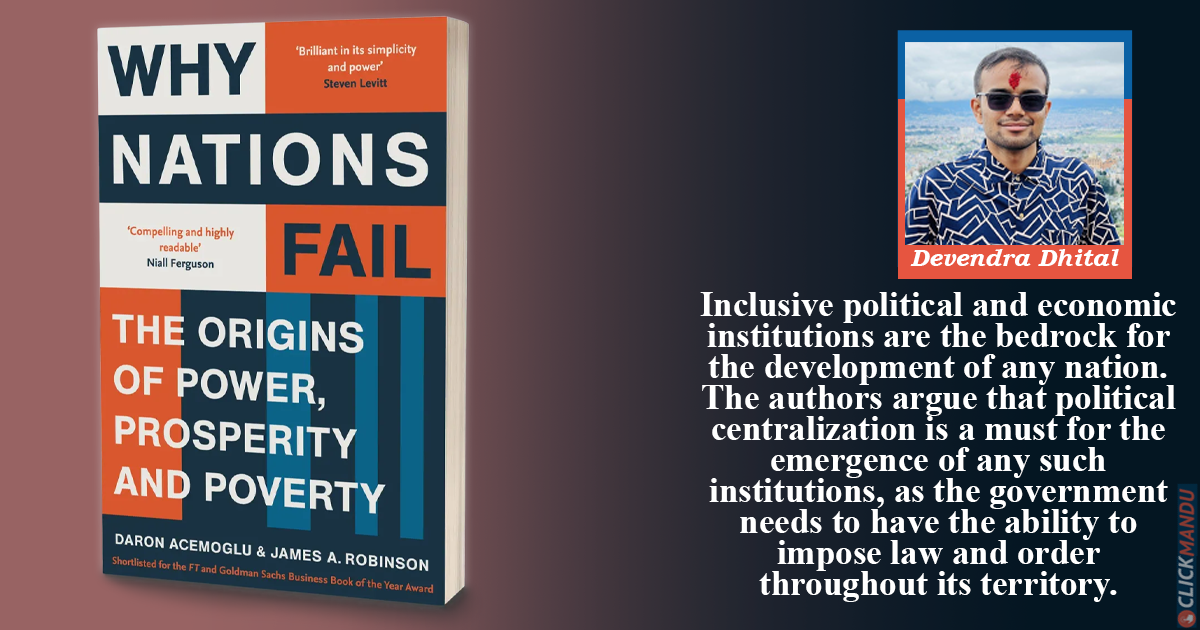

Daron Acemoglu and James Robinson were two of the three economists awarded the Nobel Prize in 2024 for their wide-ranging research on the origins of wealth and prosperity around the world over centuries. Why Nations Fail captures and elaborates the main thesis of their multidecade research.
The list of the richest countries in the world comprises mostly North American and Western European countries. In contrast, African, South Asian, and Latin American countries feature disproportionately among the poorest nations in the world. Natural curiosity over such divergence has given birth to many theories as explanations.
A famous concept by sociologist Jared Diamond, known as the geography hypothesis, points to geographic and climatic differences in various parts of the world as the ultimate cause of such divergence. These differences determined where domesticable plants like cereals, maize, wheat, and domesticable animals like the ancestors of goats and sheep were to be found. This led to these geographically lucky areas being settled and populated early, ultimately leading to specialization and prosperity there. This is a very short account of the captivating tale of world history of more than 10,000 years that Diamond has illustrated in his book Guns, Germs, and Steel.
However, Why Nations Fail argues that this theory is flawed and does not explain the divergence of nations. Equally inaccurate is the culture hypothesis crediting Western culture and its ethos of individual responsibility for the prosperity. Similarly, the ignorance hypothesis, which assigns the reason for the poverty of many countries to the lack of their policymakers’ competence in policymaking and management, explains nothing.
The book introduces the peculiar nature of global inequality by describing the city of Nogales, which is divided by a border fence into two halves. The northern half falls in the US domain and thus shines with peace and plenty, whereas the Southern half, governed by Mexico, languishes in poverty and plight. They are alike geographically and share the culture, but differ in the most important aspect that the writers explain as the source of inequality, not just in Nogales now but everywhere and at every time throughout history, i.e., the institutions that govern the social and economic interaction people have.
A political institution is the framework that determines the nature of economic institutions that develop in society. Both those institutions can be either extractive or inclusive. Inclusive political institutions include the rule of law, wide participation in decision making, checks against the excess of power, etc, which helps engender inclusive economic institutions like secure property rights, a well-functioning market, and open competition in most sectors of the economy.
A political institution is the framework that determines the nature of economic institutions that develop in society. Both those institutions can be either extractive or inclusive.
Predictably, extractive institutions are the opposite of these and feature autocratic rule of a small group, disregard for the rights and freedom of citizens, expropriation of property at the whim of the ruler, monopolistic organization of the market, and so forth. Such institutions are shaped in order to extract the output of the minority for the benefit of elites in power. The book contains many examples of both such institutions and, unsurprisingly, countries with inclusive institutions are the ones that are prosperous today with sustainable growth.
However, there can be growth under extractive institutions like the growth Soviet Union experienced during the mid-20th century under an autocratic communist regime. It was primarily due to the reallocation of resources from the unproductive agriculture sector to the industries. Nevertheless, such growth under extractive institutions does run out of steam as it did in the Soviet Union. It is because sustainable economic growth needs innovation, and such innovation brings forth something that all autocratic rulers in charge of extractive institutions fear: Creative Destruction.
An example of such destruction is the loss of wealth and power by the land-owning aristocrats in the aftermath of the Industrial Revolution in 18th-century Britain. The reallocation of resources to industries caused a reduction in land price and rent and an increase in labor wages, reducing both profit and the power of aristocrats. They did try to block the innovation, but did not succeed as the institutions were sufficiently inclusive by then. However, in most countries, including Russia of the 20th century, elites have every incentive to block innovation and sufficient power to succeed in doing so. Thus, the vicious circle of extractive institutions continues.
Inclusive institution, on the other hand, by giving free rein to the forces of creation and innovation via the incentive of profit and the certainty that innovators can keep their profit, sets the base for sustainable growth. That is the path that the developed countries of today have marched along, beginning at different times over the last few centuries.
The first country in the world to industrialize and generate a historically unforeseeable amount of wealth and power is Great Britain, and unsurprisingly, it was the first country to take the path toward inclusive institutions after the Glorious Revolution of 1688. It happened by distributing the centralized power of the monarchy across a broader spectrum of society over different stages. Following that, other countries in western Europe, the USA, Australia, South Korea, Japan, and so on have moved towards lasting prosperity only after having switched from extractive to inclusive institutions. Interesting stories of their journey have been wonderfully recounted in detail in the book.
It is not preordained that some countries will be rich while others will be in poverty. Which institutions a country organizes is influenced by the dynamic interaction between existing institutions, critical moments in history, and pure chance. As an example, before the Industrial Revolution, there was only a minor difference in the institutions of England and France, and that too was probably because England was less densely populated. However, the critical event of the industrial revolution acting on this existing minor difference made English institutions more inclusive, whereas the French ones more extractive. Some minor differences in initial conditions could have reversed the situation and destiny of these nations.
Interestingly, throughout the book, wherever Nepal’s name has been mentioned, it is as an example of a state where there is a lack of enough centralization and government authority for the emergence of such an institution.
Inclusive political and economic institutions are thus the bedrock for the development of any nation. The authors argue that political centralization is a must for the emergence of any such institutions, as the government needs to have the ability to impose law and order throughout its territory. The unalluring alternative of such centralization would be chaos with various factions vying for power, which is no condition to motivate innovation and entrepreneurship.
Interestingly, throughout the book, wherever Nepal’s name has been mentioned, it is as an example of a state where there is a lack of enough centralization and government authority for the emergence of such an institution. It is mentioned alongside Afghanistan, Somalia, and Sierra Leone. It is quite arguable whether that is the only or main reason for the underdevelopment of our country.
However, it seems quite obvious that our institution is far from inclusive. There is democracy and regular elections, but the book, through the examples of Zimbabwe and Colombia, makes clear that it is not a sufficient condition for inclusiveness and thus prosperity. However, there is hope since there are examples of countries that have come out of the trap of extractive institutions and grown rapidly in a short time, like Brazil and Botswana.
Besides the delight of reading the course of world economic history so intelligently written, Why Nations Fail is also highly recommended to anyone interested and willing to meditate on why nations succeed and how to protect them from failing.
The writer is a Chartered Accountant and working as a Chief Finance Officer at Liberty Micro Life Insurance.

Comment Here