
Nepal today finds itself at a critical juncture. With an interim government mandated to hold elections within six months, the atmosphere is thick with political uncertainty. In such times, stability is not just desirable—it is essential. Economic stability, fiscal discipline, and clarity of purpose must guide every decision.
What the nation cannot afford is policy chaos, sudden shocks, or reckless spending that deepens unrest. That is why a pragmatic roadmap, focused on stabilization in the short run and laying a foundation for post-election recovery, is not just a suggestion—it is an imperative.
Immediate priorities: Weeks, not months
The very first weeks of this interim period will determine whether confidence holds or collapses. The government must send strong signals: no arbitrary taxes before elections, direct social cash transfers to the most vulnerable, a clearly identified set of “no-cut” capital projects that will move forward, and a broader recovery plan that reassures both citizens and markets.
Such a stability package would calm fears, show fiscal restraint, and channel aid to the most at-risk. A simple one-page declaration could accomplish this, committing to (a) no sudden taxes, (b) targeted assistance, (c) the continuity of key projects, and (d) a recovery outline.
In addition, Nepal must guard its foreign exchange credibility. The country may have solid reserves, but overdependence on remittances leaves it vulnerable. No rash capital controls must be attempted. Instead, the poorest municipalities should receive strengthened food and energy safety nets. That is how to prevent distress before it erupts.
Third, the government must freeze politically sensitive, large new spending promises. At the same time, it should frontload “shovel-ready” job-creating projects and publish a clear list of five to seven such initiatives with funding and timelines. People need jobs now, not vague promises.
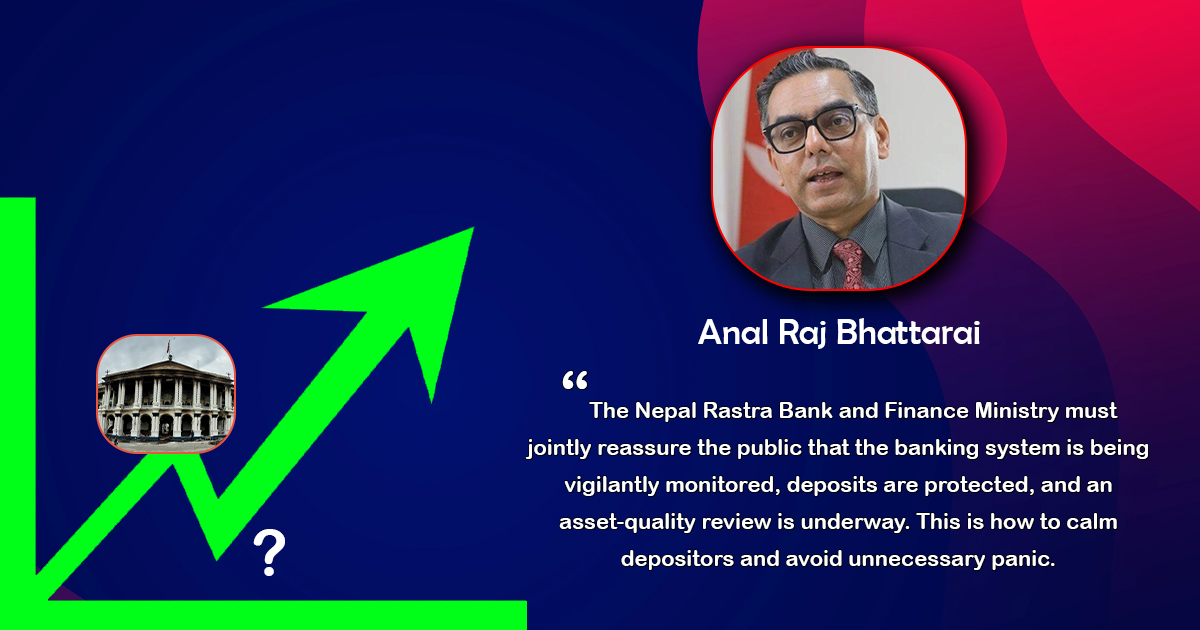
Finally, stability in the financial system cannot be left to speculation. The Nepal Rastra Bank (NRB) and Finance Ministry must jointly reassure the public that the banking system is being vigilantly monitored, deposits are protected, and an asset-quality review is underway. This is how to calm depositors and avoid unnecessary panic.
Election period: Six months of calm, not chaos
The months leading up to elections must be an era of restraint. The interim government should push all ministers to endorse a three-point economic continuity pledge: no abrupt fiscal shifts, no arbitrary expropriations, and full respect for existing Public-Private Partnership (PPP) and Alternative Investment Fund (AIF) contracts. This alone would reduce anxiety for investors and citizens alike.
Rule of law, too, cannot be compromised. Nepal must show visible progress in Anti-Money Laundering and Combating the Financing of Terrorism (AML/CFT) compliance, as well as clarity in hydropower off-taker policies. Our international credibility depends on it.
If financial stress spikes, support must be targeted, not broad-based. SMEs and agriculture may need temporary credit backstops. What must be avoided is blanket loosening of credit that signals panic.
Medium-term preparation: Building the next government’s foundation
While the interim government must act cautiously, it must also prepare a credible inheritance for the elected government that follows. That means publishing a six-month reform calendar—covering tax administration improvements, plans for an independent fiscal council, and asset-quality review timelines. This will strengthen Nepal’s sovereign rating narrative and boost confidence.
Another critical step is fast-tracking the Alternative Investment Fund (AIF) to attract long-term diaspora capital. But this cannot be done recklessly. Governance safeguards—conflict-of-interest rules, a professional board structure, and ESG standards—are mandatory.
Tax reform, too, cannot wait. The economy’s excessive dependence on import-based duties is a weakness. The government must outline a phased roadmap toward a broader VAT base and stronger digital tax collection—without imposing hikes before elections.
Export diversification and self-reliance must be more than rhetoric. Within 90 days, a joint public-private task force should identify three key export chains—agro-processing, ICT services, and hydropower-linked exports—and deliver a concrete action plan.
Meanwhile, financial sector reforms must not be delayed. A timeline for the Loan Portfolio Review (LPR), milestones for amendments to the NRB Act, and early steps toward stronger asset recovery frameworks will reassure both international partners and domestic stakeholders.
The role of communication and governance
Even the best plans will fail if citizens and markets are left in the dark. That is why plain, weekly updates on key indicators like reserves and treasury balances are essential. Transparency will rebuild confidence.
Additionally, an “Election-Period Economic Monitoring Cell”—comprising a senior civil servant, an independent economist, and a private sector representative—should pre-clear all major fiscal moves. This will curb ad-hoc decision-making.
A simple checklist for ministers
Do not weaponize economic restrictions for politics.
Do not reverse policies suddenly.
Keep AML/CFT momentum visible.
These are not complex rules, but they can make the difference between stability and chaos.
Conclusion
Nepal’s interim government has an unenviable task: to lead without overreaching, to stabilize without suffocating growth, and to prepare without overpromising. Yet, by following this roadmap, it can ensure that the next elected government inherits a nation not on the edge of collapse, but ready for recovery.
The test of leadership in uncertain times is not in bold experiments but in steady hands. If this interim government embraces fiscal discipline, transparency, and targeted relief, it can leave behind a legacy of resilience—something future generations will thank it for.
The writer is a financial expert.

Comment Here