
Kathmandu: The Gen-Z movement and its aftermath have dramatically reshaped Nepal’s political landscape. After physical attacks on the properties and persons of top leaders, the events took a new turn when KP Sharma Oli resigned as prime minister. In the resulting situation, former Chief Justice Sushila Karki, backed by the youth movement, became Nepal’s new prime minister.
Following an agreement among the president, the speaker, the army chief, Karki, and representatives of Hami Nepal—the group said to have led the Gen-Z protests—Nepal witnessed history with the appointment of its first female prime minister. On Friday night, in a procedure that slightly deviated from Article 76 of the Constitution, President Ram Chandra Paudel appointed Karki as prime minister and administered the oath of office.
At that time, however, Karki did not appoint any other ministers. Instead, she immediately dissolved the House of Representatives through her single-member cabinet and recommended elections, which the president scheduled for March 4.
On Sunday, Karki set up the new Office of the Prime Minister and Council of Ministers in a newly constructed building inside Singha Durbar, since the old office had been destroyed in arson attacks during the protests. Yet, three days into her tenure, the cabinet has not been expanded.
Initially, it was expected that her interim cabinet would include members from various groups: some linked to the Gen-Z movement, some from the president’s circle, some from the army, supporters of Kathmandu’s mayor Balen Shah, lawyers like Om Prakash Aryal who mediated talks, and even non-political figures like Kulman Ghising and Sanduk Ruit.
But the urgency lies elsewhere. Corruption and distortions in the state machinery have stifled investment and job creation. With limited opportunities at home, hundreds of thousands of young Nepalis have left the country. Past governments—Congress, UML, Maoists—failed to appoint experts as finance ministers. Instead, they handed the keys of the treasury to political loyalists who misused resources for personal gain, playing with tax rates and policies to enrich themselves and their associates. This bitter truth has brought the nation to its current crisis.
On social media, names like former DIG Ramesh Kharel and Kathmandu police chief Raju Pandey are being floated for ministerial posts. But while there is talk about filling posts in home, energy, and education, the real question—who should be the finance minister—remains largely unaddressed.
The COVID-19 pandemic and subsequent economic slowdown had already strained the economy. The destruction during the Gen-Z protests has deepened the crisis. Poverty and unemployment are rising, resources are shrinking, and billions in assets have been lost to fire and vandalism. Public morale is at its lowest, and expectations from the new government are sky-high.
Ironically, banks now have excess liquidity, interest rates are at historic lows, foreign reserves are at record highs, and public debt remains around 45 percent of GDP. But corruption has kept investment stagnant. Without jobs at home, young people continue to leave. Unless the finance ministry is entrusted to someone competent and credible, this cycle will not end.
Corruption has kept investment stagnant. Without jobs at home, young people continue to leave. Unless the finance ministry is entrusted to someone competent and credible, this cycle will not end.
Prime Minister Karki must resist pressure from lobbyists and choose a capable, honest, and visionary finance minister who can restore trust. The crisis Nepal faces is, at its core, a crisis of confidence. Business leaders and foreign investors alike have lost faith. Only by appointing someone respected by both the public and the global community can confidence be rebuilt.
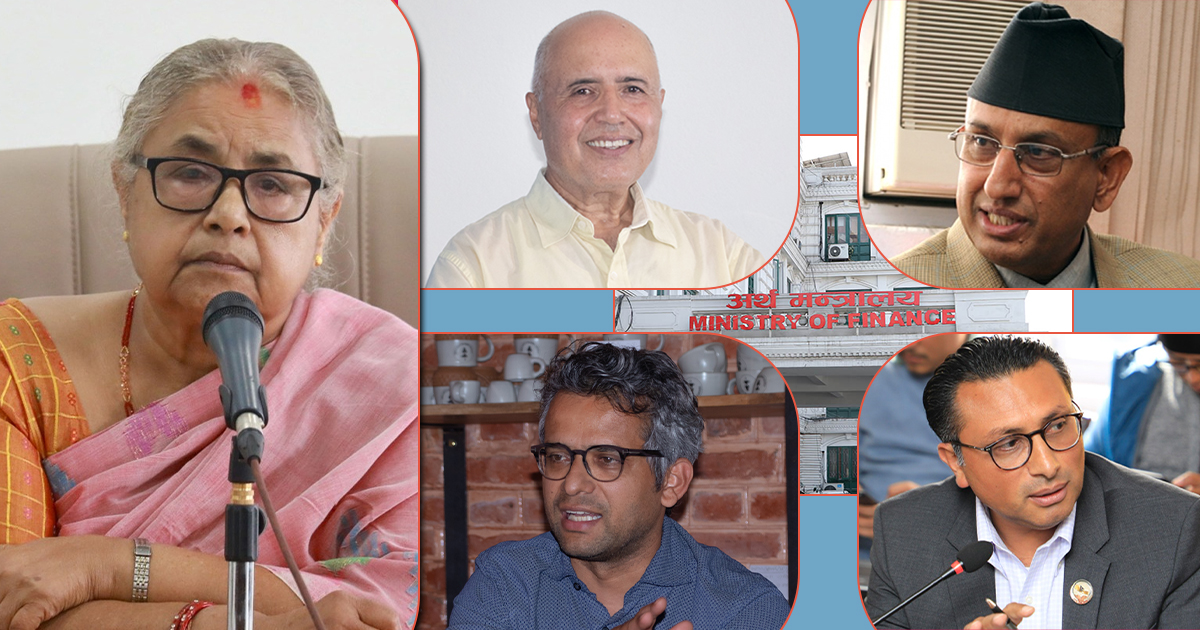
Names are already being discussed.
Mahesh Acharya, Former Finance Minister: Known as one of the best finance ministers in Nepal’s history, Acharya spearheaded economic liberalization and introduced a landmark budget in 1991 that promoted private sector growth. His clean record and reformist credentials make him a strong candidate once again.
Rameshore Khanal, Former Finance Secretary: A widely respected technocrat, Khanal has been praised for his integrity, expertise in taxation and monetary policy, and refusal to bow to political pressure. His reforms in VAT, revenue collection, and fiscal transparency left a lasting impact. At 67, he is seen as one of the most qualified candidates.
Sameer Khatiwada, Economist: A younger generation voice, Dr Khatiwada currently serves as Principal Public Management Economist at the Asian Development Bank. With a PhD from Geneva and a Master’s from Harvard, along with 18 years of professional experience, he represents a new technocratic approach that could align with the spirit of the Gen-Z movement.
Swarnim Wagle, Former Vice-Chair of the National Planning Commission: With over 25 years of international development experience, including with the World Bank and UNDP, Wagle is both a respected economist and an active politician. Currently vice-chair of the Rastriya Swatantra Party, he could bring global credibility and domestic political strength if appointed.
Other senior economists such as Keshav Acharya and Bishwambhar Pyakurel, as well as younger scholars like Bigyanbabu Regmi, Nishant Khanal, and Siddharaj Bhatta, also represent a pool of talent that the government could draw from. Breaking the tradition of always choosing “experienced” but politically compromised figures and instead appointing new, capable economists aligns directly with the Gen-Z movement’s demands.
For Prime Minister Karki, the choice is clear: the key to the nation’s treasury must be entrusted not to loyalists, but to those with competence, honesty, and vision. Failure to do so will deepen public despair. Success, however, could restore confidence, revitalize investment, and put Nepal’s struggling economy back on track.
The people’s expectations are enormous. And this time, the government cannot afford to fail.

Comment Here