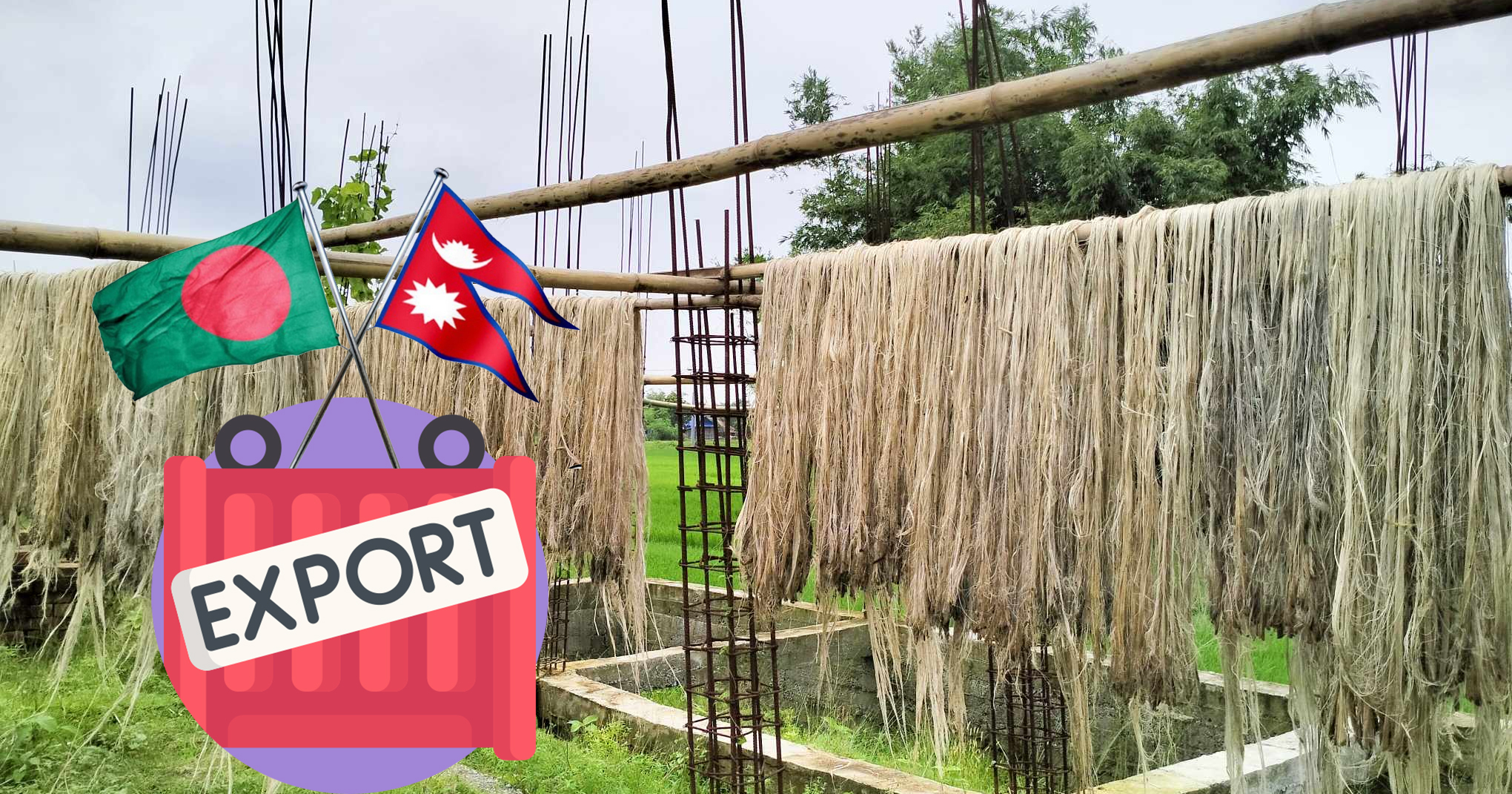

Biratnagar: The Bangladeshi government has imposed an undeclared ban on raw jute exports for the past two weeks, citing reduced production and concerns that domestic industries would face shortages.
This year, raw jute production in Bangladesh has decreased by 100,000 tons. While 1.7 million tons were produced last year, this year’s output has dropped to just 1.6 million tons. Bangladesh has more than 125 jute industries, and the government has restricted exports fearing they would face a shortage of raw material.
This policy from Bangladesh has directly affected Nepal’s export-oriented jute industries, which have already been struggling for over a decade due to India’s anti-dumping duties. Nepali jute factories import raw jute from both India and Bangladesh, process it into finished goods, and export mainly to India.
Recently, Nepali industries had been increasingly drawn toward Bangladeshi jute because it was not only of higher quality but also cheaper compared to Indian jute.
Currently, 95 percent of Nepal’s jute products are exported to India. According to the Department of Customs, jute goods worth over 8 billion rupees were exported to India from Nepal last year.
Statistics show that in the month of Shrawan this fiscal year, Nepal imported 432,400 kilograms of jute worth 56.5 million rupees from India, while from Bangladesh it imported 2.4 million kilograms worth 285.7 million rupees during the same period.
Last year, Nepal imported 26.35 million kilograms of raw jute from Bangladesh and 23.78 million kilograms from India.
Since Bangladeshi jute was slightly cheaper this year, Nepali producers had been importing raw jute from Bangladesh to manufacture finished goods and then exporting them to India. Now, with Bangladesh halting exports, Nepal will have to rely on Indian imports, which will make it harder to compete with India’s own industries, according to Nepal Jute Industry Association’s General Secretary Som Adhikari.
Diplomatic efforts are underway to reopen Bangladeshi exports. Industry stakeholders have also initiated talks, and according to Adhikari, the Nepali Embassy in Bangladesh is taking necessary steps. If exports are not reopened, Nepali industries could face severe setbacks, with production possibly being cut by more than half.
Currently, six jute industries are in operation within the Sunsari–Morang Industrial Corridor, requiring more than 70,000 tons of raw jute annually. A decade ago, there were around a dozen jute industries in the corridor employing over 20,000 people.
Out of the required raw jute, about 20,000 tons are supplied domestically, while the rest is imported from Bangladesh and India. Nepali industries generally source from whichever country offers lower prices. At present, Bangladeshi jute is cheaper by 10 to 15 rupees per kilogram compared to Indian jute.
India and Bangladesh are considered “hubs” for jute cultivation. According to the Bangladesh Jute Association, Bangladesh produced 1.611 million tons of raw jute this year, compared to over 1.7 million tons last year.
Similarly, India produced 1.517 million tons of jute this year, down from 1.765 million tons last year. With production falling in both countries and prices rising, Bangladesh imposed the export halt to protect its domestic industries from shortages.
Until recently, Bangladeshi traders had been freely exporting raw jute. But the government recently restricted exports, citing the need to increase domestic supply and control rising prices. This undeclared ban has left Nepali industries scrambling.
On September 8, the export division of Bangladesh’s Ministry of Commerce issued a circular to the Bangladesh Jute Association, moving raw jute into the “conditional export” category.
According to industry sources, although Bangladeshi exporters have submitted the necessary paperwork to the Ministry of Commerce, export permits are not being issued. They added that two weeks ago, the government released about 50 trucks of raw jute for which payment or letters of credit had already been processed, but since then, no further exports have been approved.

Comment Here