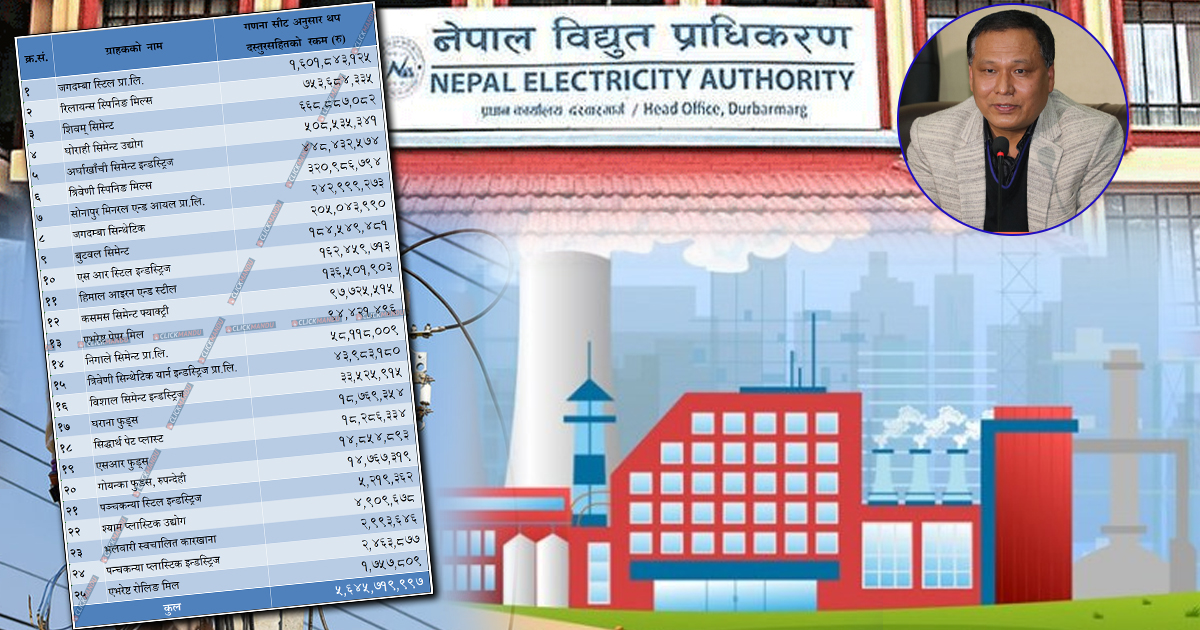

Kathmandu: Nepal Electricity Authority (NEA) has stated that industrialists owe Rs 5.64 billion in outstanding payments related to the dedicated trunk line dispute.
According to NEA sources, updated records show that the remaining amount due for premium charges on dedicated trunk line electricity consumption, including fines, totals Rs 5.6452 billion.
Industries operating on dedicated trunk lines were paying regular tariffs at the time. Later, in April 2019, the NEA issued new bills solely for the missed premiums (in the form of a single-page letter). However, industrialists refused to pay until provided with evidence, stating they would settle only upon verification.
Meanwhile, the NEA classified these as arrears and added monthly fines and interest, escalating the amounts. As the dispute intensified, some industries paid out of fear, but 25 have yet to settle. “Why pay what isn’t owed?” they argued, allowing the arrears to balloon to nearly Rs 6 billion.
According to the NEA, the largest outstanding amount is from one industrialist owing Rs 1.61 billion. Similarly, Reliance Spinning Mills owes Rs 70.53 million, Shivam Cement Rs 668 million, Ghorahi Cement Rs 508 million, and Arghakhanchi Cement Rs 448 million, per NEA data.
The NEA reports that Triveni Spinning Mills owes Rs 321 million. Five other industries owe more than Rs 100 million each, three more than Rs 50 million, six more than Rs 10 million, and the rest less than Rs 10 million.
Some of the industries listed with outstanding dues are currently non-operational, according to the NEA.
What is the dedicated trunk line dispute?
To understand the dedicated trunk line dispute, it is essential to consider three distinct periods.
First: The period before tariffs for dedicated feeders and trunk lines were determined—from July 2015 to January 2016.
Second: The period after tariffs were set but before load-shedding ended—from February 2016 to April 2019.
Third: The period after load-shedding ended until the premium tariff was abolished—from May 2019 to June 2021.
The current dispute pertains only to the second period. There are no issues in the first or third. In the first, tariffs had not yet been established. In the third, load-shedding had already ceased. The contention in the second revolves around premiums. Industries had already paid their regular tariffs.
The general public often misinterprets this dispute as industrialists failing to pay electricity bills to the NEA. In reality, they have paid their regular bills; the issue is solely the unpaid premiums.
The NEA issued regular bills to industries, which were settled by industrialists within the stipulated time, often availing a 2 percent discount for prompt payment.
It was only in April 2019 that the NEA sent letters demanding payment of the missed premium tariffs, sparking the controversy.
The letter from Kulman Ghising, then NEA Managing Director, in 2019, stated: “Billing should have been done according to dedicated feeders, but it was processed under regular feeders, leading to the shortfall—please pay the due amount.”
This letter stunned industrialists who believed they had cleared all dues.
The issue drew widespread scrutiny, polarizing opinions.
Industrialists maintained they should not pay unowed premiums and held firm. Meanwhile, the NEA and Ghising treated the shortfall as revenue, paid taxes to the government on it, and recorded it as profit in their accounts.
Industrialists demanded proof of six hours of load-shedding and their own usage of 20 hours of electricity daily. “If there were six hours of load-shedding and we used electricity for 20 hours, we will pay the premium,” they insisted.
Ghising, however, stood firm: “Whether there was six hours of load-shedding or not, and whether you used electricity for 20 hours or not, the additional tariff must be paid.”
This stance tarnished the industrialists’ reputation. Ghising publicly labelled them “profit-mongers lighting up while the public endured load-shedding,” a narrative that permeated public discourse.
During times when the public faced up to 18 hours of load-shedding daily, the NEA introduced a scheme: Industries could access electricity as needed but would pay up to 60 percent premium.
To avail this, industries had to apply to the NEA for dedicated feeders and trunk lines.
Two key meetings of the then Electricity Tariff Fixation Commission are crucial regarding premiums for dedicated feeder and trunk line users: Meetings No. 103 and 108.
But first, what are dedicated feeders and trunk lines?
A “dedicated feeder” involves laying a separate line from the substation to supply uninterrupted electricity to a specific customer, even during load-shedding. If one line faces shedding, power can be routed through another. A “trunk line” draws from a 24-hour transmission line, installs a transformer within the industry premises, and provides continuous supply.
On January 13, 2016, the Tariff Commission approved collecting premium tariffs from customers receiving uninterrupted supply via dedicated systems—meaning the NEA could charge extras for 24-hour availability.
Similarly, in the Commission’s 108th meeting on 30 June 2016, it permitted the NEA to collect premiums from industries running electricity continuously for 20 or more hours via trunk lines during periods of six or more hours of load-shedding nationwide, treating them as dedicated customers.
On 26 June 2016, the NEA decided to charge extra fees from customers using dedicated feeders for continuous supply starting 16 July 2016. Based on this, the NEA could bill businesses using Time-of-Day (TOD) metres, which record usage by time slot.
The dispute covers the period from that date until April 2019, when load-shedding ended in industrial areas.
In April 2019—11 months after load-shedding ceased—the NEA abruptly issued a terse letter demanding premium payments. However, it provided no TOD metre evidence of daily usage hours. Later, the NEA submitted TOD metre logs to a parliamentary committee, but these did not conclusively prove industrialists owed the premiums.
Industrialists’ current stance remains: “Provide proof per the Commission’s decision of more than six hours of daily load-shedding and our usage exceeding 20 hours—we will pay the premium.”

Comment Here