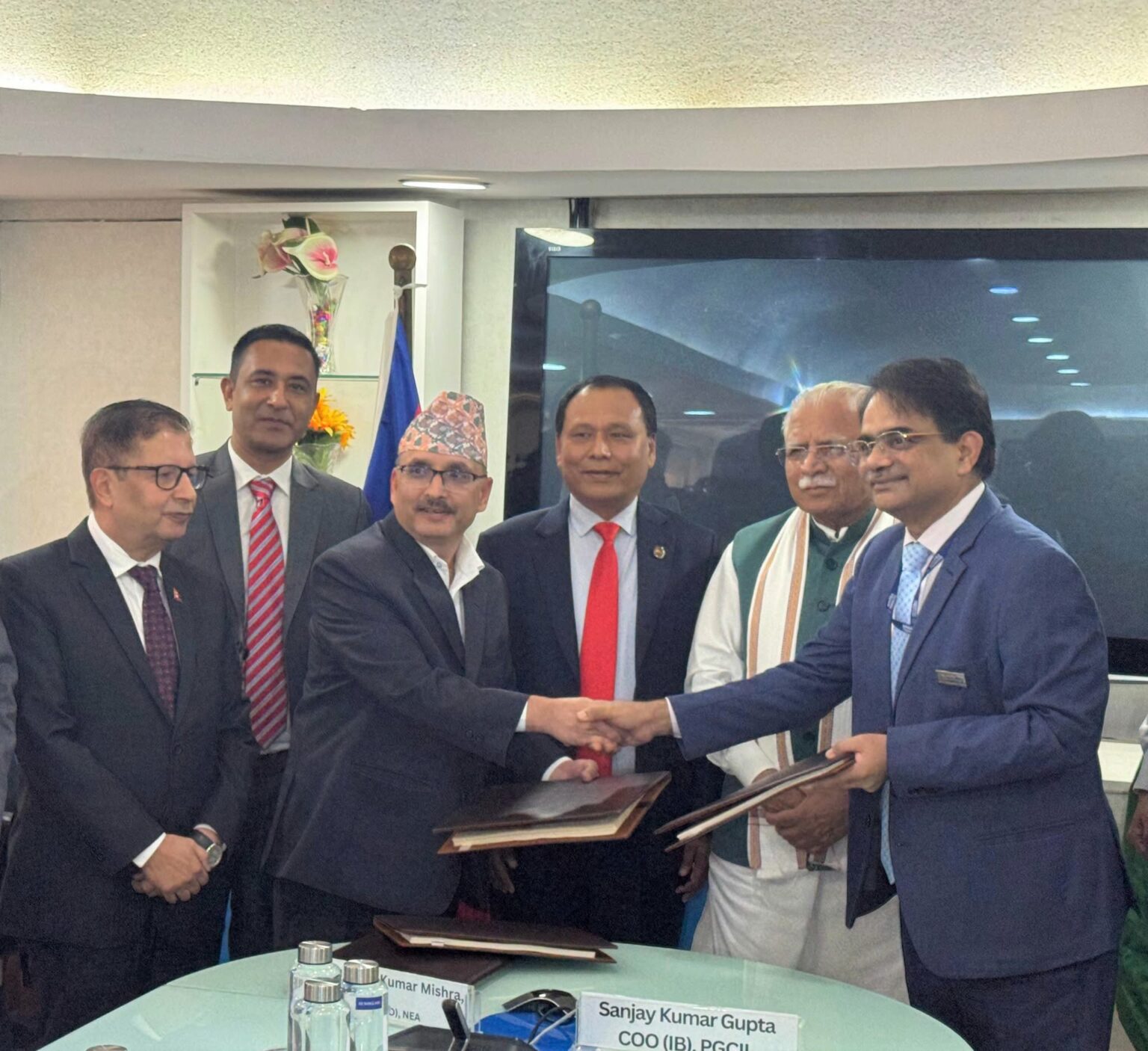

New Delhi: Nepal and India have signed a joint venture (JV) and shareholders’ agreement to construct the Inaruwa-Purnia and Lamki (Dododhara)-Bareilly 400 kV international transmission lines, marking a significant step toward enhanced bilateral and regional electricity trade.
The signing took place on Wednesday in New Delhi in the presence of Nepal’s Minister for Energy, Water Resources and Irrigation, Kulman Ghising, and India’s Minister of Power, Manohar Lal Khattar. The ceremony was attended by Nepal’s Ambassador to India, Shankar Prasad Sharma; India’s Power Secretary Pankaj Agarwal; Additional Secretary from India’s Ministry of External Affairs; and Joint Secretary Sagarraj Gautam from Nepal’s Ministry of Energy, Water Resources and Irrigation, among others.
On behalf of the Nepal Electricity Authority (NEA), Executive Director Subhash Kumar Mishra signed the agreement, while Sanjay Kumar Gupta, Chief Operating Officer for International Business at Power Grid Corporation of India Limited (PGCIL), signed for the Indian side. With this investment agreement in place, the path is now clear for establishing companies with investments from NEA and PGCIL to build both transmission lines.
Addressing the event, Minister Ghising described the advancement of these two additional cross-border lines as another crucial milestone for bilateral and regional electricity trade. He emphasized that the construction of these international transmission lines will lay the foundation for exporting Nepal-produced electricity to India and the broader region, providing access to international energy markets and facilitating domestic as well as direct foreign investment in Nepal’s hydropower sector.
Indian Power Minister Khattar stated that upon completion, these two cross-border lines will fundamentally strengthen electricity exchange between Nepal and India, improve regional energy security, and create a more robust grid, ultimately contributing to the economic growth of both nations.
Nepal’s Cabinet, in its meeting on 16 October 2025, had approved the establishment of two joint companies in Nepal and India—with investments from NEA and PGCIL—for constructing the transmission lines, and authorized NEA to make equity investments in these entities.
Minister Ghising reiterated that the two new international transmission lines will prepare the groundwork for exporting Nepali electricity bilaterally and regionally, enhancing access to global energy markets and easing investments in Nepal’s hydropower projects.
For the segments falling in Indian territory, the joint company to be established in India will have 49 percent shares held by NEA and 51 percent by PGCIL. Conversely, for the Nepali segments, the joint company in Nepal will hold 51 percent shares for NEA and 49 percent for PGCIL.
The financial structure for both lines will consist of 80 percent debt and 20 percent equity capital. The Inaruwa-Purnia line spans approximately 26 km in Nepal and 109 km in India, while the Lamki-Bareilly line covers about 33 km in Nepal and 185 km in India.
According to a 2019 study report by the Nepal-India Joint Technical Team, the preliminary cost for the Inaruwa-Purnia line is estimated at Rs 2.65 billion for the Nepali section and INR 4.13 billion for the Indian section. For the Lamki-Bareilly line, costs are projected at Rs 2.57 billion in Nepal and Rs 6.14 billion in India. NEA will invest Rs 1 billion in the Nepali JV and Rs 2 billion equivalent in the Indian JV from its own resources.
In line with the provisions of the Nepal-India agreement on electricity trade, cross-border transmission line interconnection, and operation coordination, the 12th meeting of the Secretary-level Joint Steering Committee, held in New Delhi on 11 February 2025, reached consensus on the construction, operation, and investment modality for the lines.
Following multi-stage discussions between NEA and PGCIL, a Memorandum of Understanding (MoU) was signed on 22 April 2025, to establish the joint companies for the transmission lines. Both lines are targeted for completion by 2030.
Currently, the 400 kV Dhalkebar-Muzaffarpur line serves as the first cross-border transmission line operational for Nepal-India trade. The Butwal-Gorakhpur line is under construction as the second international line. Agreements have also been reached for a 220 kV line from Nepal’s Chameliya to India’s Jali Jivi in Uttarakhand.
Additionally, 132 kV, 33 kV, and 11 kV transmission lines connect to India’s Bihar, Uttar Pradesh, and Uttarakhand states. Through its 400 kV and 132 kV infrastructure, NEA currently exports up to 1,000 MW of electricity daily to India and Bangladesh.

Comment Here