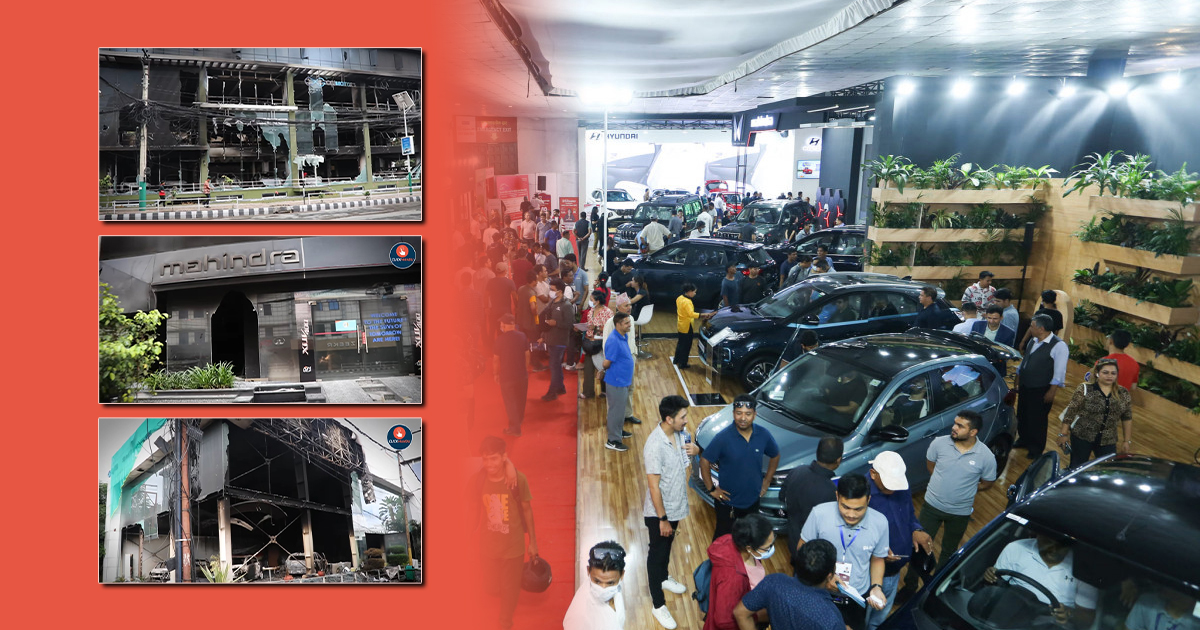

Kathmandu: Nepal’s automobile dealers, already battered by disruptions during the prime vehicle-buying season, are growing increasingly anxious over rumours of another protest movement.
The Gen-Z demonstrations on September 8 and 9 dealt a severe blow to trade, and the announcement of a new nationwide agitation starting November 23 has deepened the uncertainty.
The critical Dashain-Tihar festival period—traditionally the high point for vehicle sales—failed to bring cheer to auto businesses this year because of the Gen-Z protests. Dealers who normally attract customers with festive offers and deliver vehicles booked at exhibitions were unable to replicate that experience.
Instead, just as the market showed signs of recovery after the Gen-Z unrest, the prospect of another agitation has created fresh confusion. Milan Babu Malla, treasurer of the NADA Automobile Association of Nepal and executive director of MAW Group, said successive protests and signals of instability are further eroding market confidence.
“The atmosphere in the auto sector was positive until the Gen-Z protests. Strong public turnout and bookings at the auto show gave us hope for robust sales,” Malla said. “But everything fell apart afterward. Vehicle sales during Dashain-Tihar were disheartening.”
He added that potential buyers are reluctant to commit in such an uncertain climate, leaving dealers far from a comfortable position. The Gen-Z protests shrank festival trade, and now the mere talk of another movement has left businessmen unsure of their next steps, Malla noted.
It is only natural for dealers to worry when a new agitation is rumoured before the wounds of the Gen-Z protests have healed. Durga Prasai, who advocates for the monarchy and leads the National, Nationality, Religion, Culture and Citizens Rescue Campaign, has announced a countrywide movement for systemic change starting November 23.
Earlier, on March 30, Prasai led a pro-monarchy protest that turned highly violent. Widespread vandalism, arson and looting occurred in Kathmandu’s Tinkune area; media houses, commercial centres, and private and government buildings were targeted.
This history explains the fear surrounding Prasai’s agitations. The Gen-Z protests caused massive damage to key government infrastructure and private commercial properties, leaving the private sector in a state of alarm.
Deepak Thapaliya, general manager of Laxmi Intercontinental, the authorized distributor of Hyundai vehicles in Nepal, said additional protest announcements will have a negative ripple effect across the entire market.
“Auto business requires long-term planning. But back-to-back protests make it extremely difficult to move forward with business strategies,” Thapaliya said. “Dealers who lost the main season are now facing even greater uncertainty because of the new agitation talk.” He added that such activities discourage prospective vehicle buyers.
It is only natural for dealers to worry when a new agitation is rumoured before the wounds of the Gen-Z protests have healed.
The NAIMA Nepal Mobility Expo (August 6–11) and the NADA Auto Show (August 19–24) had generated considerable excitement among dealers. They aimed to maximize bookings at both events and complete deliveries by Dashain.
Heavy discounts and promotional schemes fueled initial bookings, but the Dashain season ended on a sour note. The Gen-Z protests on September 8 and 9 sent shockwaves through the market, triggering a wave of cancellations for vehicles booked at the auto show even before Dashain.
Organized by the Nepal Automobile Importers and Manufacturers Association (NAIMA) and Nepal Automobile Dealers’ Association (NADA), the two auto shows recorded roughly 8,000 vehicle bookings, dealers said. Importers had already begun bringing in stock for delivery.
Yet large-scale cancellations followed the exhibitions, and the Dashain-Tihar trade remained severely constricted, according to treasurer Malla. “We were hopeful of good business from before the vehicle exhibitions, but the Gen-Z protests virtually halted the major trade expected during Dashain-Tihar,” Malla said. “Just when we thought the situation might normalize, talk of another agitation has surfaced.”
The bulk of auto dealers’ revenue and earnings typically occurs during Dashain-Tihar. But protests caused an alarming rate of booking cancellations during this peak period. Even after announcing festival offers, dealers saw little improvement in sales.
While market stagnation is widely discussed, vehicle imports show no signs of contraction. According to Customs Department data, in the first three months of fiscal year 2025/26, electric vehicles worth Rs 6.25 billion—2,620 units—were imported.
In the same period last year, imports stood at Rs 6.10 billion for 2,516 units. Up to mid-October this fiscal year, 751 units of up to 50 kW capacity worth Rs 1.26 billion were imported, compared with 772 units worth Rs 1.39 billion in the previous year.
Imports of vehicles up to 100 kW capacity reached 1,545 units worth Rs 4.02 billion, against 1,582 units worth Rs 4.1634 billion last year.
For vehicles up to 200 kW, 323 units worth Rs 957 million were imported, compared with 159 units worth Rs 533.8 million in the prior year.
In the 300 kW category, only one unit worth Rs 4.849 million was imported this year, versus three units worth Rs 18.482 million last year.
Given the extensive vehicle damage during the Gen-Z protests, dealers expect some replacement demand. A few days ago, the Finance Ministry approved the purchase of 251 vehicles for the police in the first phase: 175 for Nepal Police, 70 for Armed Police Force, and six for the National Investigation Department.
Private-sector vehicles were also torched and vandalized during the Genji protests, leaving room for additional replacement purchases.
According to the Nepal Insurance Authority’s data up to October 26, insurance claims totaling Rs 3.4425 billion were filed for 2,270 damaged vehicles. Of this, insurance companies have paid out Rs 477.7 million, including advance payments.

Comment Here