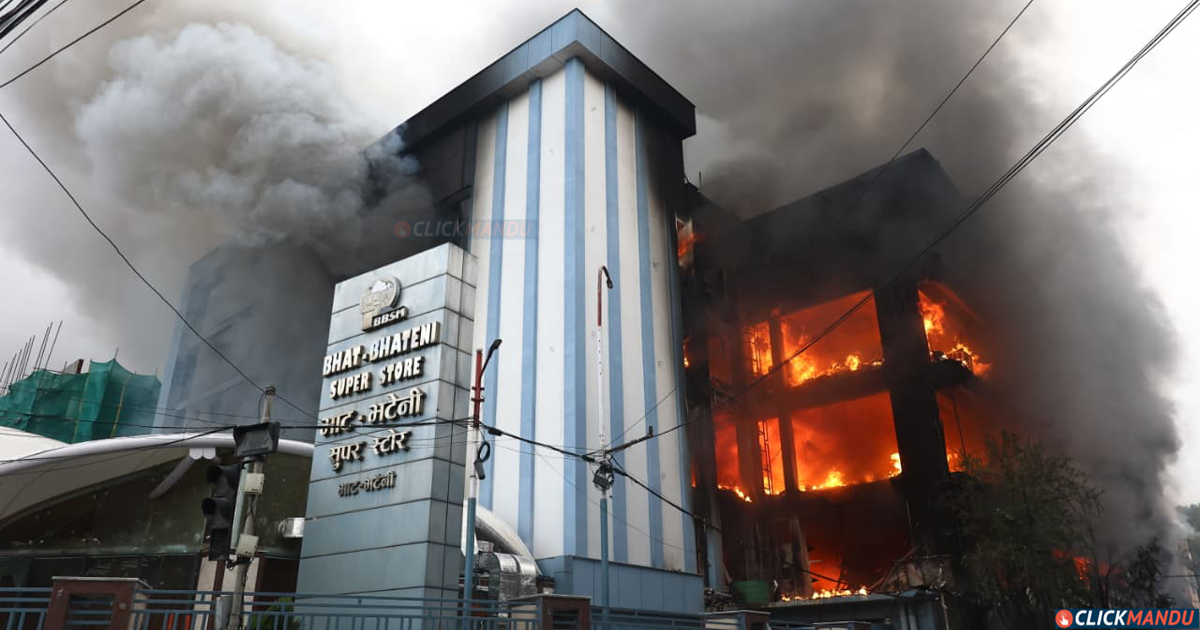

Kathmandu: One and a half months have passed since the Gen-Z protests turned violent, leaving the Bhatbhateni supermarket in Naxal—located just steps from the Prime Minister’s residence in Baluwatar—devastated by vandalism, looting, and arson. Today, green curtains shroud the site, while the compound walls stand in crumbling disrepair.
The walls of the Naxal Bhatbhateni, which suffered total damage during the protests on September 8 and 9, began collapsing on their own shortly afterward. On October 18, authorities temporarily diverted traffic along the Chhatreganesh-Naxal-Bhatbhateni route and used a bulldozer to demolish the hazardous sections. The bulldozer remains parked at the site.
Nearby clothing and other shops continue to operate, and hundreds of vehicles pass along the same road daily. Travellers’ eyes inevitably linger, even briefly, on the ruined supermarket. More than 45 days after the arson, a foul odour of burnt materials still emanates from the building, drawing curious onlookers for a closer glimpse.
Of the 28 Bhatbhateni stores nationwide, seven escaped damage during the Gen-Z protests, while 21 branches were affected. Twelve stores were looted and then set ablaze, and nine others suffered vandalism and looting. For Bhatbhateni operator Min Bahadur Gurung, however, the Naxal store holds special significance compared to the others.
The Naxal Bhatbhateni is Nepal’s very first grand store. Gurung launched his vision of international-standard supermarkets in Nepal from this very location. Even more notably, this site in Naxal marked the starting point of Gurung’s inaugural business journey.
Nearly four decades ago, in 1984, Gurung began with a modest rented shutter near the Bhatbhateni Temple in Naxal, running a small grocery shop. Within a decade, he expanded to operate the 3,000-square-foot Bhatbhateni Supermarket in the same area, introducing Nepal’s first international-level supermarket.
On September 9, the protests at Naxal Bhatbhateni began with stone-pelting. Crowds then stormed inside, looting goods and carrying them away. People were seen walking off with everything from chairs to clothing and other items.
Young protesters, joined by local men and women from the surrounding area, actively participated in hauling away clothes and merchandise. After the looting, the store was set on fire—an inferno that took nearly three days to fully extinguish.
According to Bhatbhateni Supermarket’s Chief Operating Officer (COO) Panu Poudel, the Naxal branch sustained the heaviest damage. Prolonged burning caused walls to collapse on their own. With the roadside wall posing a risk of further collapse and injury, a bulldozer was deployed to clear it.
“We demolished the crumbling wall with a bulldozer because it was becoming dangerous as it began falling on its own. Reconstruction work has not yet started,” Poudel said. “Rebuilding has also not begun at other heavily damaged stores, but it will start soon.” He added that reconstruction at other affected locations would commence shortly.
The presence of a café, hotel, large stocks of groceries, clothing, and household items prolonged the blaze. Gas cylinders in the café and other flammable materials inside fueled massive flames.
The lingering smell results from the burning of vast quantities of food, clothing, and household goods. The odour persists daily for those passing by the store. The sheer volume of materials also delayed fire control efforts.
An insurance claim exceeding Rs 660 million has been filed with Shikhar Insurance for the damage at Naxal Bhatbhateni alone. Approximately Rs 600 million is claimed for goods, with over Rs 60 million for the building. However, as assessments are ongoing, official figures are not yet available.
Significant losses were reported at other locations as well. The fire at the Bhatbhateni in Chuchchepati, Kathmandu, took nearly four days to bring under control. In most stores, sudden vandalism and stone-throwing forced staff to flee, allowing protesters to enter, loot, and set fires.
Total losses across all Bhatbhateni stores during the protests exceeded Rs 10.85 billion. Structural damage amounted to Rs 4.4006 billion, while goods worth Rs 5.9603 billion were completely incinerated. Additionally, Rs 495.7 million worth of items were vandalized or looted.
The lingering smell results from the burning of vast quantities of food, clothing, and household goods. The odour persists daily for those passing by the store. The sheer volume of materials also delayed fire control efforts.
Despite the massive destruction, Bhatbhateni Supermarket issued a message post-arson: “Painful moments have passed, but hope is not lost. Though our store lies in ruins today, your support makes us feel stronger. Thousands of helping hands are cleaning up, wiping away tears, and giving us the strength to rise again.”
The message further pledged: “Bhatbhateni will stand tall once more. With your support, we will make the future even brighter.” Meanwhile, 16 of the damaged branches have already resumed operations.
According to Bhatbhateni, nine stores in the Kathmandu Valley and seven outside—totaling 16—have reopened. The protests caused extensive damage to key government structures, private-sector commercial buildings, and assets nationwide, leaving the business community in a state of fear.

Comment Here