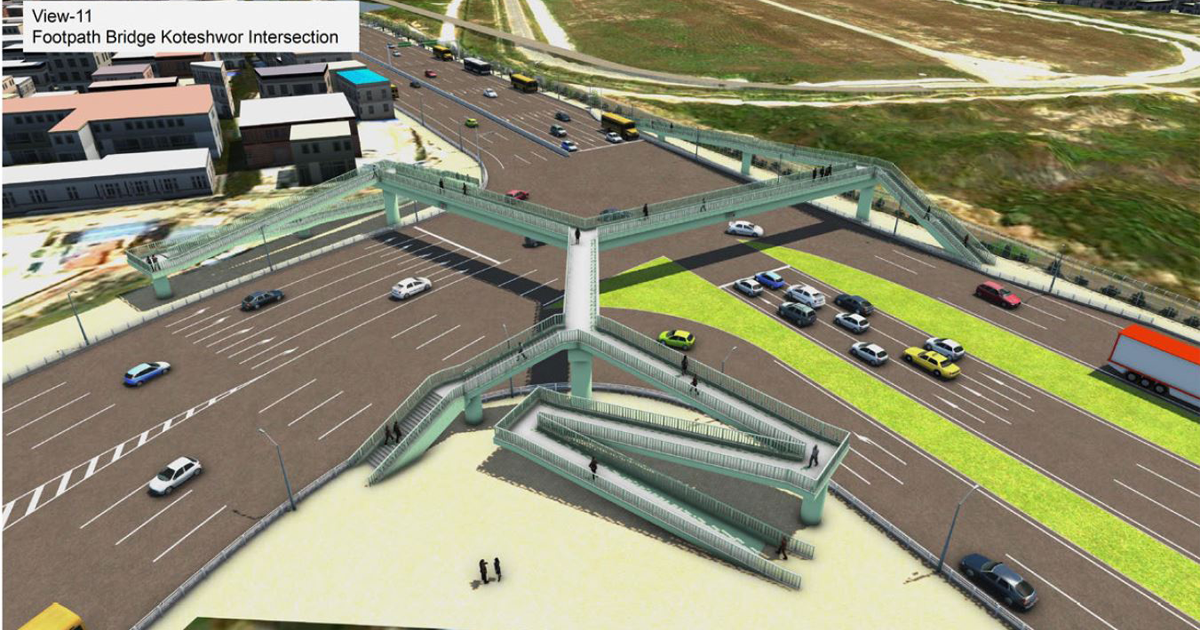

Kathmandu: The government is preparing to advance the process of constructing a flyover with a tunnel at a cost exceeding nearly Rs 28 billion, aimed at reducing the excessive traffic jams at Koteshwor Chowk.
Due to vehicles coming from Dhulikhel, Bhaktapur, Pepsicola, and Gwarko directions, there has been severe traffic congestion from Jadibuti to Koteshwor and from Koteshwor to Tinkune Chowk. Similarly, there has been excessive traffic jams from Tinkune to Gwarko and from Tinkune to Jadibuti.
In recent times, due to the operation of the overpass at Gwarko Chowk, the traffic congestion in the Koteshwor and Tinkune areas has nearly doubled compared to before.
As the problem of traffic jams has become increasingly severe, there is growing demand and pressure on the government from all sides to start the construction of a flyover with a tunnel at Koteshwor Chowk as soon as possible.
However, in the name of alleviating the jam at Koteshwor Chowk, the government is preparing to advance the process of constructing a flyover with a tunnel through loan assistance, which will incur excessively high costs.
Regarding the construction of a flyover with a tunnel, JICA conducted a pre-feasibility study in 2019 and, in January 2024, conducted a further study to prepare the final preliminary report in an advanced version.
According to the re-study report following the pre-feasibility study, it is stated that the construction of the flyover with a tunnel will cost at least Rs 44.64 billion, including VAT, import duties, and other taxes. This amount is based on the preliminary investment framework prepared by JICA in September 2023.
An official from the Ministry of Physical Infrastructure and Transport informed that, based on the pre-feasibility, when preparing the Detailed Project Report (DPR) and Environmental Impact Assessment (EIA), the investment amount could increase according to the current US dollar exchange rate.
Of this, JICA will provide loan assistance of 34.49 billion Japanese yen (equivalent to Rs 31.6755 billion at the current exchange rate), and the remaining shortfall will be borne by the Nepal government, which has reached a final decision.
The government had announced advancing this project through the policy and programme of the fiscal year 2017/18.
According to the pre-feasibility study, experts have pointed out that the proposed Rs 44 billion for constructing a flyover with a tunnel at Koteshwor Chowk is extremely expensive.
According to an official from the Ministry of Physical Infrastructure and Transport, the cost proposed by JICA is extremely high. According to that official, the flyover with a tunnel using the design and technology proposed by JICA can be constructed for just Rs 10 billion.
“The technology and design proposed by JICA can be constructed for just Rs 10 billion, but they have set the cost at Rs 44 billion; this is not only expensive but an unbelievably high cost,” the official said.
The official from the ministry claims that JICA has set this excessively high construction cost in collusion with Japanese contractors.
According to the re-study report following the pre-feasibility study, it is stated that the construction of the flyover with a tunnel will cost at least Rs 44.64 billion, including VAT, import duties, and other taxes.
“This excessively high construction cost has been set by JICA in collusion with Japanese contractors,” the official said, “Unlike in Nepal where commissions are given to leaders and employees through windows and doors to secure contracts, in Japan, JICA and contractors directly collude and set the cost. The tender process is also prepared in such a way that no one except Japanese contractors can participate. This is another novel example of corruption in the infrastructure sector.”
Former Secretary of the Ministry of Physical Infrastructure and Transport, Tulsi Sitaula, also claimed that the proposed amount for constructing a flyover with a tunnel is extremely expensive.
“This project, said to be built with loan assistance, is extremely expensive and costly from a cost perspective. According to the report given by JICA and their standards and preliminary design, even if constructed with advanced technology in a very elaborate manner, the maximum expenditure could be only Rs 12 billion; under no circumstances is more investment needed,’ said former Secretary Sitaula, who is also an infrastructure expert, to Clickmandu.
‘If it were grant assistance, it would be JICA’s money, let them spend it. But it is said to be loan assistance. We should not construct a project with such high costs by taking loan assistance. After all, we will have to pay the interest on that loan.’
According to Sitaula, a 100 kilometres long four-lane Asian standard road with bridges can be constructed for less than Rs 40 billion. However, he says that investing Rs 44 billion just to build a tunnel and a 2-kilometre wide flyover at Koteshwor would be a major mistake by the government.
Transport expert Ashish Gajurel says that a 2-kilometre long metro rail can be built for Rs 40 billion. “Building road infrastructure anyway encourages private vehicles,” says Gajurel. “Instead of reducing vehicle pressure on roads by strengthening public transport, the government encourages buying private vehicles by building flyovers and underpasses.”
According to the construction cost framework prepared by JICA in September 2023 (based on the exchange rate at that time), it is mentioned that Rs 24 billion will be spent on main construction and infrastructure.
Similarly, an additional cost of Rs 6.92 billion from price escalation, Rs 3.13 billion for contingent physical expenses, Rs 3.39 billion for design, consulting, and supervision expenses, Rs 390 million for loan interest expenses, Rs 960 million for land acquisition and compensation, Rs 260 million for office and management expenses, and including VAT, customs, and other taxes, the preliminary estimate is Rs 44.64 billion.
The pre-feasibility study report conducted by JICA at that time had suggested three types of technical options to the government.
Accordingly, the first option proposed a 1.3-kilometre flyover from Tinkune to Balkumari (Ring Road) at an investment of Rs 9 billion.
Similarly, the second option was a 1.2-kilometre two-way tunnel from Koteshwor Chowk, and the third option was a flyover with a tunnel from Tinkune to Jadibuti in Koteshwor at an investment of Rs 25 billion.
Among these, the government selected the third option as the flyover with a tunnel from Tinkune to Jadibuti in Koteshwor.
Under this, the plan includes a 664-metre long flyover from near the Bagmati bridge in Tinkune to near the Munibhairav temple (from Tinkune to Tribhuvan Airport), a 700-metre tunnel from Munibhairav temple to Jadibuti footbridge (inside Tribhuvan Airport premises), and another 238-metre long flyover from Tribhuvan Airport to Jadibuti via Manohara bridge.
According to JICA’s third option, the structures must be built without obstructing the current roads where vehicles run and the runway.
For this, there is the issue of availability of sufficient land. Some area from Jadibuti to Koteshwor near the runway of Tribhuvan International Airport is also required, according to the official.
The plan includes arrangements for vehicles to run below from Jadibuti to Tinkune without disturbing the existing airport runway, and the runway above for planes to operate, as informed by the official.
After this, another problem is the excessively high cost. At the time of the study, it was said that nearly Rs 44 billion would be required. Now, almost six years have passed since the study.
“Based on current market prices, this cost is likely to increase further,” said the ministry official.
The plan includes arrangements for vehicles to run below from Jadibuti to Tinkune without disturbing the existing airport runway, and the runway above for planes to operate, as informed by the official.
The Japan International Cooperation Agency (JICA) has expressed interest in constructing a flyover with a tunnel at Koteshwor Chowk and has committed to providing loan assistance of 34.49 billion Japanese yen.
According to an official from the Finance Ministry, an agreement between Japan and Nepal is pending for accepting this loan assistance. The current interim government’s Finance Minister Rameshore Khanal has already met with JICA representatives and urged to advance this project as soon as possible.
The government led by KP Oli had decided in the first week of Bhadra last year to accept concessional loan assistance from JICA for building the flyover with a tunnel at Koteshwor.
The Oli-led government decided to accept the concessional loan assistance of 34.49 billion Japanese yen (Rs 31.6755 billion) from the Government of Japan for implementing the Koteshwor Intersection Improvement Project.
Regarding the construction of a flyover with a tunnel, JICA conducted a pre-feasibility study in 2019 and, in January 2024, conducted a further study to prepare the final preliminary report in an advanced version.
Since JICA conducted the pre-feasibility study and the re-study, the government has been lobbying for JICA to construct it.

Comment Here