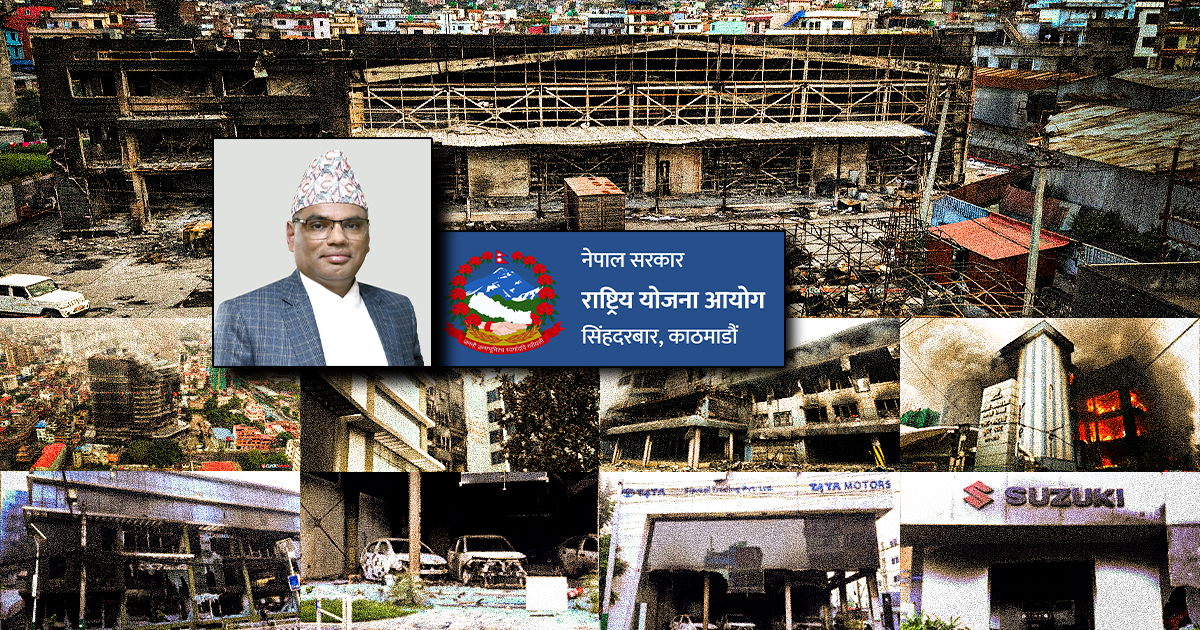

Kathmandu: A government-appointed committee has assessed nationwide losses from the violent Gen Z-driven uprising that rocked Nepal in September – at approximately 78 billion Nepali rupees (around US$ 580 million), significantly lower than earlier projections that ran as high as twice that amount.
The five-member panel, chaired by the secretary of the National Planning Commission and formed by the Cabinet in late September, is finalising its Loss and Damage Assessment Report. Preliminary findings show private sector losses accounting for Rs 36 billion of the total, with the remainder affecting public infrastructure.
The unrest, which erupted over corruption allegations, economic mismanagement and a controversial social media crackdown, impacted 51 of Nepal’s 77 districts. More than 2,900 buildings across 1,600 sites were damaged or destroyed, including federal, provincial and local government offices, private residences, factories, warehouses and commercial properties.
Organised private businesses have filed insurance claims totalling Rs 23 billion, mainly covering industries, hotels, vehicles and retail outlets. An additional Rs 8-10 billion in estimated losses fell on uninsured informal-sector enterprises, highlighting the need for targeted government relief and concessional rebuilding programmes.
Finance Minister Rameshore Khanal described the final figure as “considerably lower than we had braced for.” Speaking to reporters, he revealed that the ministry had proactively mobilised Rs 120 billion in contingency funding from the outset.
“With the actual damage now clearer, we are confident we can complete reconstruction within a single fiscal year by combining budgetary resources, insurance payouts and private investment,” Khanal said.
Private sector leaders, however, continue to dispute the official tally. Chandra Prasad Dhakal, president of the Federation of Nepalese Chambers of Commerce and Industry (FNCCI), insisted physical damage alone reached Rs 48 billion, with broader economic fallout pushing the total impact closer to Rs 88 billion.
The assessment drew on data collected through a dedicated online portal, field teams deployed to 44 districts and inputs from over 250 local governments, provincial authorities and central ministries. A separate coordination sub-committee, led by a joint secretary from the Planning Commission, oversaw the process.
The Gen-Z protests forced the resignation of former prime minister KP Sharma Oli and ushered in an interim government. While credited with accelerating political change, the movement’s violent turn left dozens dead and exposed deep vulnerabilities in public order and economic resilience. Officials now emphasise rapid rebuilding as key to restoring investor confidence and preventing long-term scarring.

Comment Here