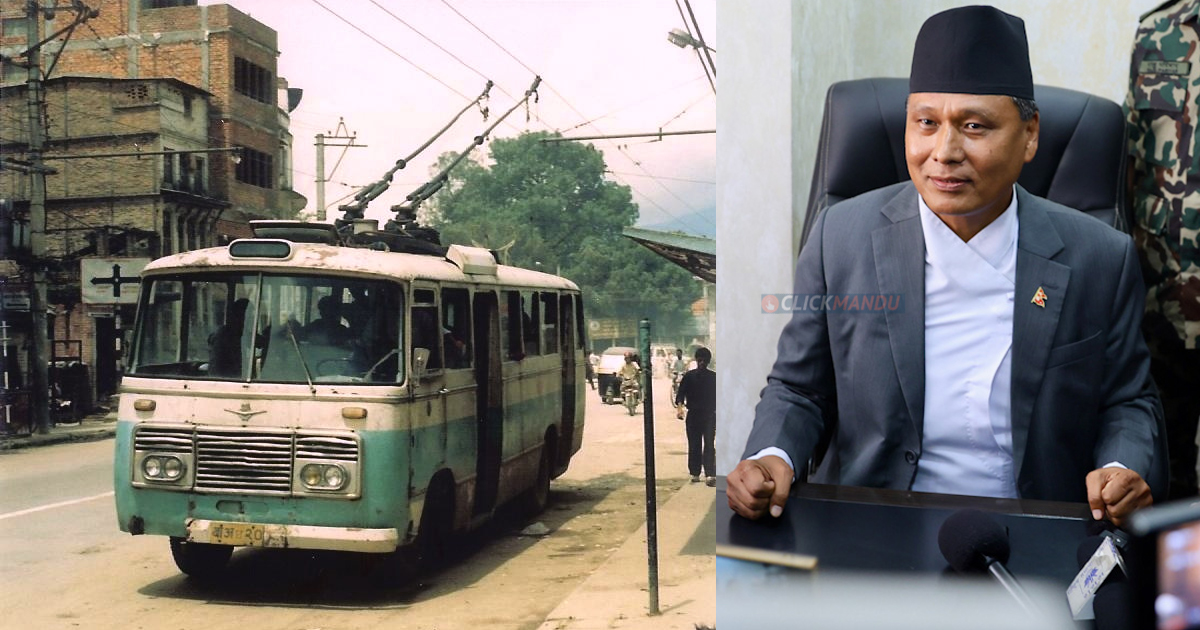

Kathmandu: – Minister for Energy, Water Resources and Irrigation (who also oversees Physical Infrastructure, Transport, and Urban Development), Kulman Ghising, has urged the Asian Development Bank (ADB) to fund a feasibility study for bringing back electric trolley buses on the Kathmandu Valley Ring Road and several expanding national highways.
During a meeting on Wednesday with ADB Nepal Resident Mission Chief Arnaud Cauchois and his team, Minister Ghising pitched the idea as part of broader efforts to promote sustainable urban mobility and boost domestic consumption of Nepal’s growing hydropower surplus.
“We are widening key corridors such as the Kathmandu Ring Road, Kathmandu–Dhulikhel, Pokhara–Mugling, Butwal–Narayan Ghat, Butwal–Bhairahawa, and Biratnagar–Dharan,” Ghising said.
“One dedicated lane on each of these roads could be used for trolley buses. To increase internal electricity consumption, we must prioritize electric public transport like trolley buses. We request ADB’s technical and financial support for the feasibility study.”
Trolley buses previously ran successfully in Kathmandu from 1975 (with Chinese assistance) between Tripureshwor and Suryabinayak in Bhaktapur, but the system was completely shut down in 2009 after years of neglect.
The proposal comes alongside a larger ADB-backed “Sustainable Urban Electric Mobility Project” that will focus on Kathmandu Valley, Pokhara Metropolitan City, and the Lumbini–Butwal–Siddharthanagar corridor. The project aims to introduce 250 electric buses along with charging stations, maintenance depots, dedicated infrastructure, and last-mile connectivity through bicycle lanes and non-motorized options.
The project concept has already been approved and a detailed feasibility study is underway. Implementation will be channelled through the Town Development Fund and Infrastructure Development Bank to the respective local governments. In Gandaki Province, authorities have proposed establishing a Provincial Public Transport Authority to operate the system in Pokhara.
Total estimated cost: US$ 160 million (approximately Rs 22.56 billion).
ADB will provide US$ 100 million as concessional loan and US$ 40 million as zero-interest credit.
The remaining amount will be covered by the Government of Nepal.
Reviving trolley buses, which run on overhead electric wires and produce zero tailpipe emissions, is seen as a low-operating-cost, high-capacity solution for Nepal’s polluted and congested cities, while helping absorb the country’s surging clean hydropower generation.

Comment Here