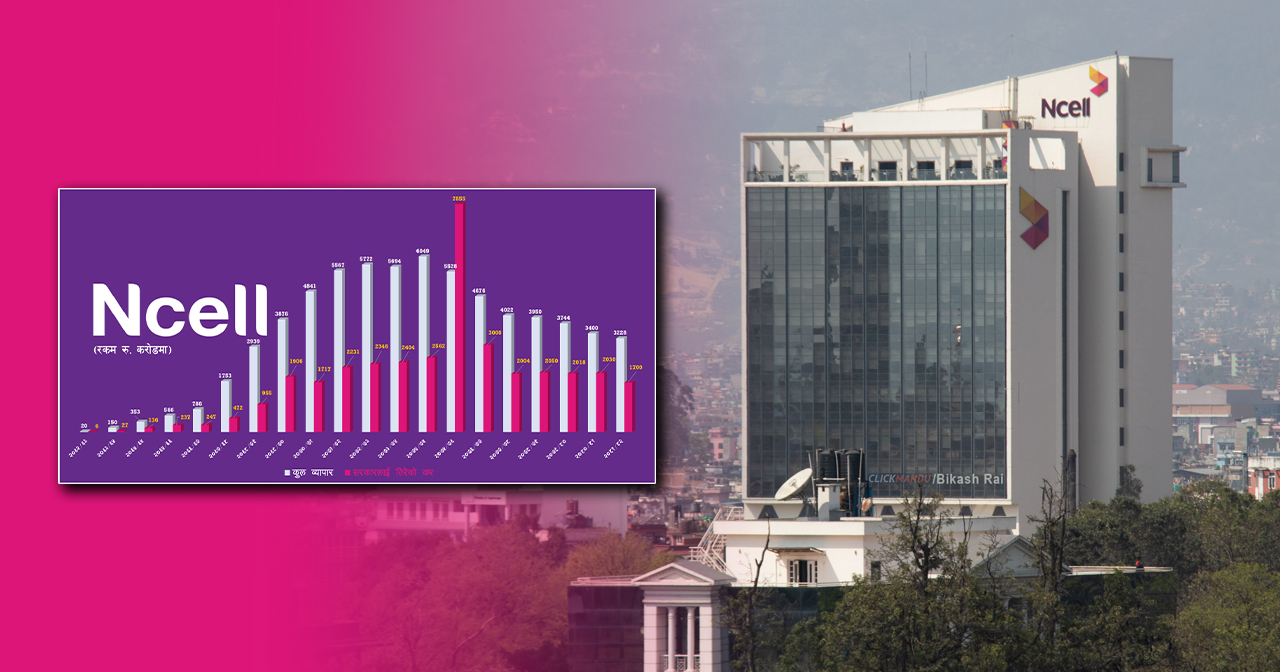

Kathmandu: Nepal’s leading private mobile operator, Ncell, has emerged as one of the country’s largest taxpayers since launching services two decades ago, contributing more than Rs 36 billion (approximately US$ 2.7 billion) in taxes, royalties, and regulatory fees to the government.
It far outweighs the roughly Rs 67 billion (US$ 500 million) in dividends it has sent abroad to foreign investors.
Over its 20-year history, Ncell has generated total revenue of around Rs 630 billion (US$ 4.7 billion), with an astonishing 57 percent of that — Rs 359 billion — handed directly to the state through various levies. This makes Ncell the highest-paying telecom company in Nepal, consistently outpacing even the state-owned Nepal Telecom in annual tax contributions.
In its peak year (FY 2018/19), Ncell paid a record Rs 78.55 billion in taxes and fees — more than its entire annual revenue of Rs 55.28 billion that year — after accounting for operational costs and a small allocation for social welfare programmes. That single-year contribution included frequency fees, rural telecom development funds, royalties, advance taxes, VAT, customs duties, and telecom service charges.
On average, Ncell remits about Rs 18 billion annually to the government, accounting for around 57 percent of its gross earnings when including all direct and indirect fees. This breaks down to roughly 30 percent corporate income tax, 13 percent VAT, 10 percent telecom service charge, plus 4 percent royalty and 2 percent rural development fund on total revenue — plus additional charges like license renewals, spectrum fees, and ownership duties.
Despite these heavy burdens, Ncell has distributed Rs 93.5 billion in total dividends, of which Rs 67 billion (about 80 percent, aligned with foreign ownership) has been repatriated overseas, while the rest went to local partners. For the 25-year license (set to require renewal three times), Ncell is on track to pay Rs 60 billion in renewal fees alone — a lump-sum model that experts criticize as outdated compared to global practices tying fees to a percentage of annual revenue.
Industry watchers and former regulators argue that Nepal’s high fixed fees and rigid rules have already driven four private telecom operators out of business, leaving only two major players. With Ncell’s license renewed for just five more years in 2024 (expiring in 2031) under conditions that could see government takeover afterward, experts warn the sector risks collapse. Revenues have been declining steadily due to OTT apps eroding voice income and slower data growth, dropping from over Rs 57 billion in FY 2015/16 to around Rs 32 billion recently.
Telecom expert Anand Raj Khanal cautions that without policy reforms — shifting to revenue-based fees and ensuring fair competition — Nepal could lose private investment entirely. “Ncell’s entry transformed connectivity; without it, even state-owned Nepal Telecom couldn’t meet today’s demand,” he notes.
Past government studies, including parliamentary committees, have recommended modernizing fees to sustain the industry rather than risking a monopoly that could cripple service quality.
As Nepal pushes for digital growth, Ncell’s story highlights a delicate balance: immense economic contributions from private players versus regulatory pressures that threaten long-term viability. Reforming telecom taxes could keep competition alive, boost innovation, and ensure affordable services for millions.

Comment Here