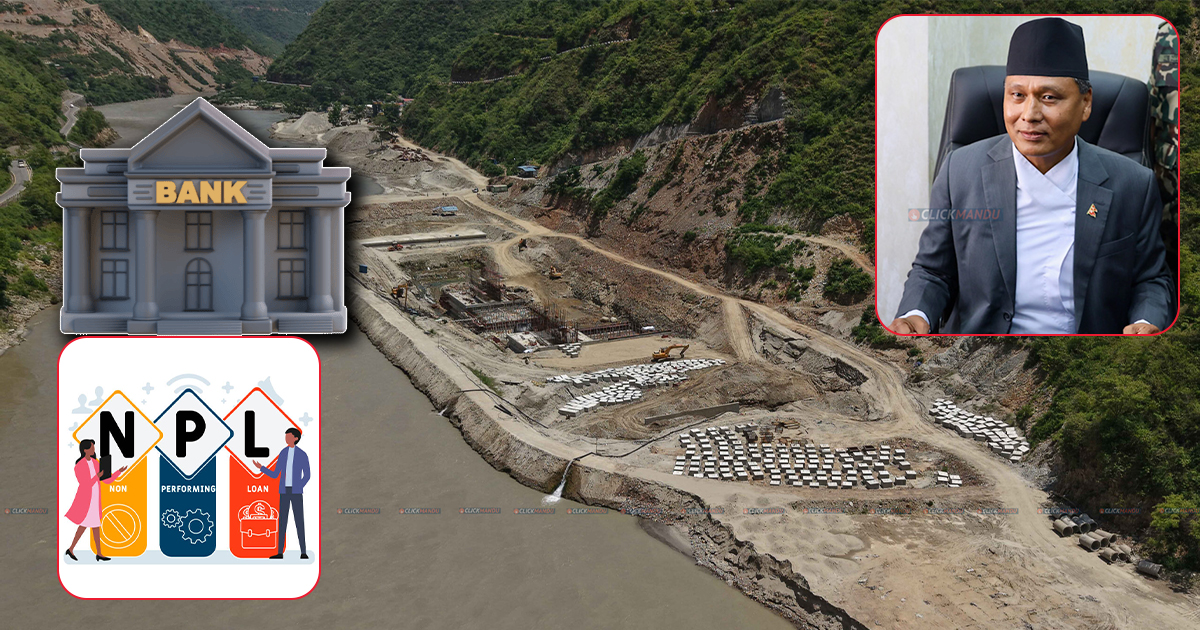

Kathmandu: Nepal government’s decision to terminate hundreds of long-delayed infrastructure contracts is delivering a fresh blow to an already struggling banking sector.
As the government moves aggressively to cancel “sick” projects that have languished for years, banks are suddenly facing claims on billions of rupees in performance guarantees they issued to contractors, driving non-performing loans even higher at a time when the economy remains sluggish.
For the past three years, Nepal’s banks have been battling rising bad loans amid slow growth and widespread repayment difficulties. Now a new threat has emerged: guarantees that were previously treated as off-balance-sheet liabilities are being converted into forced loans the moment the government invokes them. Bankers warn that if the current pace continues, non-performing loans could surge by another 70–80 billion rupees in the current fiscal year alone.
The push began after the fall of the previous KP Sharma Oli government in late August following the “Gen Z” protests. The new administration, with Kulman Ghising heading three key ministries, Physical Infrastructure and Transport, Energy and Water Resources, and Urban Development, quickly announced it would scrap contracts on projects that repeatedly missed deadlines.
Major schemes such as the Sunkoshi-Marin Diversion, Babai Irrigation, Mid-Hill Highway, and Postal Highway are among those in the crosshairs. Officials estimate more than 800 contracts worth a combined Rs 400 billion could eventually be terminated.
Whenever a contract is cancelled, the government immediately claims the performance bank guarantee (usually 5–10 percent of the contract value) and any advance payment guarantees. Banks have no choice but to pay the government and then book the amount as a loan to the defaulting contractor.
Under Nepal Rastra Bank rules, these forced loans must be fully provisioned (100 percent set aside as loss) within 90 days and classified as non-performing, further eroding capital adequacy ratios.
Senior bankers have privately warned ministry secretaries that proceeding without a phased approach or relief measures could destabilise the entire financial system.
One high-profile case already underway is the Sunkoshi-Marin Diversion multipurpose project. The government has sent letters to banks demanding Rs 3.6 billion in total guarantees, including Rs 2.4 billion from Global IME Bank alone. Similar claims are expected on dozens of other projects. Bankers estimate that around Rs 380 billion in non-funded guarantees are currently outstanding across the sector, and even if only 20 percent are invoked, the impact will be severe.
Senior bankers have privately warned ministry secretaries that proceeding without a phased approach or relief measures could destabilise the entire financial system. Nabil Bank is believed to have the largest exposure (around Rs 80 billion), followed by Prime Commercial, Prabhu, Global IME, Nepal Investment Mega, Himalayan, and Kumari banks.
According to the latest Nepal Rastra Bank data for mid-October 2025, commercial banks’ average non-performing loan ratio has already climbed to 5.03 percent, with the broader financial sector at 5.26 percent. Banks are also sitting on roughly Rs 50 billion in non-banking assets (mostly repossessed collateral) and continuing to write off bad debts. If the additional wave of forced loans materialises, analysts say the sector-wide NPL ratio could approach 7–8 percent by the end of this fiscal year, levels that would trigger serious concerns about stability.
Bankers acknowledge the need to clear stalled projects but argue the government is ignoring the collateral damage. “For years contractors couldn’t finish work because the government itself delayed payments and approvals,” one CEO said. “Now those same delays are being used to terminate contracts and hit banks with massive claims. If this isn’t handled carefully, the banking sector—and the wider economy—could face a shock we’re not prepared for.”

Comment Here