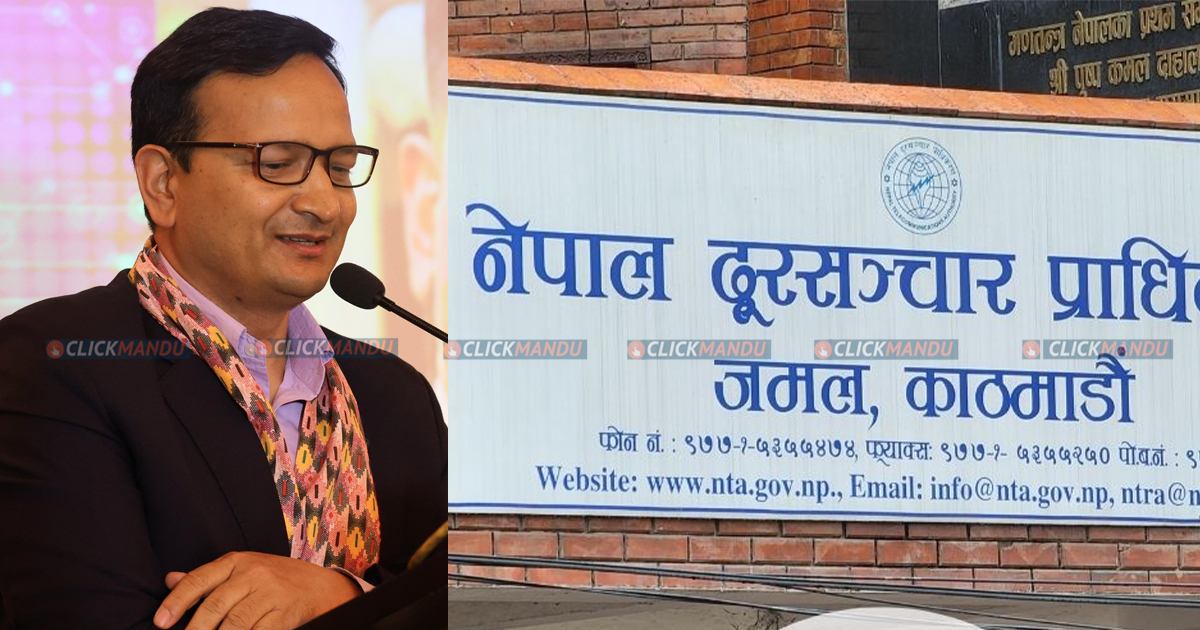

Kathmandu: Nepal’s telecommunications sector has virtually ground to a halt, largely due to the sluggish performance of the country’s telecom regulator, the Nepal Telecommunications Authority (NTA). Since Bhupendra Bhandari took over as chairman nearly two years ago, the industry has seen almost no meaningful development.
An internal progress report obtained by Clickmandu from NTA sources paints a damning picture: long-pending critical issues remain unresolved, major infrastructure projects are stalled, and the regulator has failed to make any significant long-term decisions. The report explicitly states that the sector’s stagnation is a direct result of Chairman Bhandari’s inability to lead effectively.
Bhandari was appointed on 18 February 2024, reportedly with strong backing from the then Minister for Communications and Information Technology, Rekha Sharma. Critics say that despite reaching the top post, he has operated like a routine bureaucrat, unable to take bold or decisive action. The entire telecom ecosystem is now paying the price for this leadership vacuum.
The most shocking revelation in the report: in the fiscal year 2023/24, the NTA achieved a miserable 1 percent progress on its development programmes and a staggering zero percent on 49 out of 49 planned annual initiatives.
Bhandari joined the Authority mid-year, right when the bulk of the budget needed to be spent. Yet even basic budget utilization failed spectacularly:
Nepal’s own satellite project (Rs 100 million allocated) – 0 percent progress
Free Wi-Fi in religious and tourist sites (Rs 120 million) – 0 percent
Microwave backbone network (Rs 13 million) – 0 percent
Optical fiber expansion along major highways (Rs 2 billion from previous year) – no spending
Broadband to local government units without connectivity (Rs 1 billion) – 0 percent
Mobile coverage in highways, border, and remote areas (Rs 1 billion) – 0 percent
Broadband continuity in community schools and health posts (Rs 250 million) – unused, programme dropped next year
Connecting underserved areas across provinces (Rs 2 billion for remote districts) – 0 percent
Even high-profile academic connectivity projects for Tribhuvan University and Nepal Sanskrit University campuses were abandoned after zero progress the previous year.
The NTA has tried to blame part of the failure on legal cases filed by the anti-corruption body against 15 percent of its staff. The Ministry of Communications, however, rejects that excuse, pointing out that the remaining 85 percent of employees should still have delivered results. “Zero progress across the board shows clear leadership failure,” a ministry source said.
Interestingly, the chairman’s own progress report for the following year (2024/25) highlights only routine administrative actions as “achievements”: cancelling a few expired internet licenses, handling consumer complaints, collecting royalties and fees from operators, and depositing mandatory contributions into government and rural telecom funds. Notably, the report published on the NTA website completely omits any mention of budgeted amounts versus actual expenditure.
The regulator also cites delays caused by service providers, prolonged tenders, investigations, staff shortages, and lack of cooperation from local governments. Yet sources point out a glaring contradiction: for the past two years, the NTA itself blocked infrastructure roll-outs and foreign exchange approvals for operators while only clearing a massive backlog of tower permissions on the very last day of the previous fiscal year after intense pressure from the ministry.
One long-running scandal further exposes the paralysis. The NTA has still taken no decision on Smart Telecom, a licensee it effectively shut down more than two-and-a-half years ago. Despite repeated protests from affected tower owners and former employees, Chairman Bhandari has failed to resolve the company’s status. It has left critical mobile infrastructure idle proving the critics who say that the regulator is incapable of handling even urgent crises in essential services.

Comment Here