
Kathmandu: Nepal’s anti-corruption watchdog, the Commission for the Investigation of Abuse of Authority (CIAA), on Wednesday filed a major corruption case against the Director General of the Civil Aviation Authority of Nepal (CAAN), Pradeep Adhikari, along with six other senior officials and a private construction company.
The accused face combined penalties and fines totaling Rs 135.7 million (approximately US$ 1 million), with each individual allegedly liable for Rs 13.57 million (around US$ 100,000).
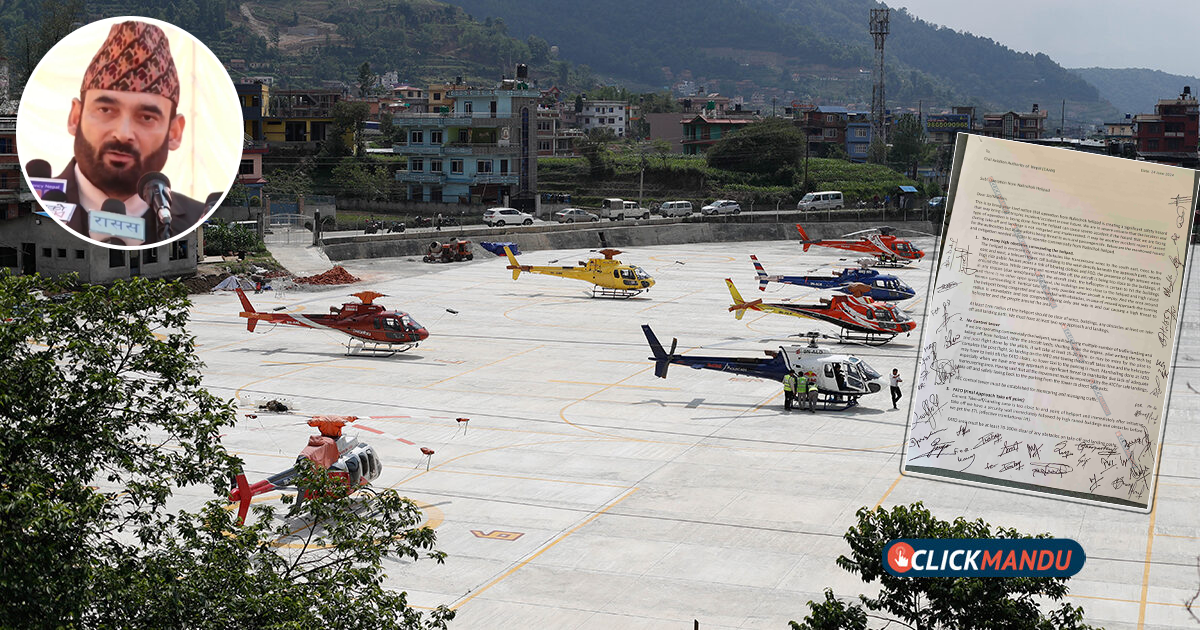
The case centres on the controversial heliport built at Nalinchok in Bhaktapur, just east of Kathmandu.
What is the Nalinchok heliport scandal?
In a rush to ease congestion at Tribhuvan International Airport, CAAN spent over Rs 115 million (roughly US$ 850,000) to hastily construct a heliport in the middle of a densely populated residential neighborhood without conducting the mandatory Environmental Impact Assessment (EIA), ignoring basic safety standards, and allegedly to secure kickbacks.
Although CAAN had initially budgeted Rs 150 million for a fully equipped facility, the authority claimed the project was completed for just Rs 115 million. Critics say the real motive was to fast-track construction and open the site for operations before essential infrastructure (fuel depot, fire-fighting unit, control tower, passenger terminal, hangar, etc.) was in place. It was rushed supposedly to create opportunities for commission payments on future contracts worth another Rs 150 million.
Director General Pradeep Adhikari, an engineer by training, personally pressured private helicopter operators to start landing and overnight parking at Nalinchok even before basic facilities existed. Operators were threatened with penalties if they continued using Tribhuvan International Airport.
Safety nightmare in a residential zone
Independent reports and pilot complaints highlight terrifying risks:
Tall buildings and a school only 20 meters away obstruct approach and departure paths,
A telecom tower sits directly in the final approach lane,
No refueling, firefighting, or emergency services,
Tiny parking area and narrow takeoff/landing zone, and
Surrounded by hills and houses on all sides.
Forty-seven helicopter captains jointly wrote to CAAN warning that forcing operations without minimum infrastructure “poses a serious threat to aviation safety.”
The site blatantly violates CAAN’s own 2018 guidelines for ground-level heliports, which require open space in all directions with no nearby structures or hills.
Environmental rules deliberately ignored
Nepal’s Environmental Protection Regulations explicitly require a full EIA including public hearings for any new airport or heliport. Authorities skipped the process because they feared locals would block the project once they learned helicopter noise would blast over homes and a nearby school daily.
Residents did protest and even won a temporary court injunction in early 2023. The High Court later allowed construction to continue only if community concerns were addressed, a condition CAAN largely ignored.
Forced inauguration and monopoly
On 22 June 2024, CAAN dragged the then Tourism Minister Hit Bahadur Tamang to inaugurate the unfinished facility. From that day, every helicopter company flying domestic routes was compelled to use Nalinchok for landings, takeoffs, and overnight parking. It effectively granted the site a monopoly despite its dangers.
The corruption case now alleges the entire project was rushed for personal gain, built in an unsuitable location, and operated unsafely all while flouting environmental, safety, and procurement laws.
The accused officials Director General Pradeep Adhikari, Directors Murari Bhandari and Samriddhi Shrestha, Managers Nal Bikram Thapa, Bijay Thapa, Gurudatt Adhikari, and the contracting firm Uma & Company will face trial at the Special Court in Kathmandu.

Comment Here