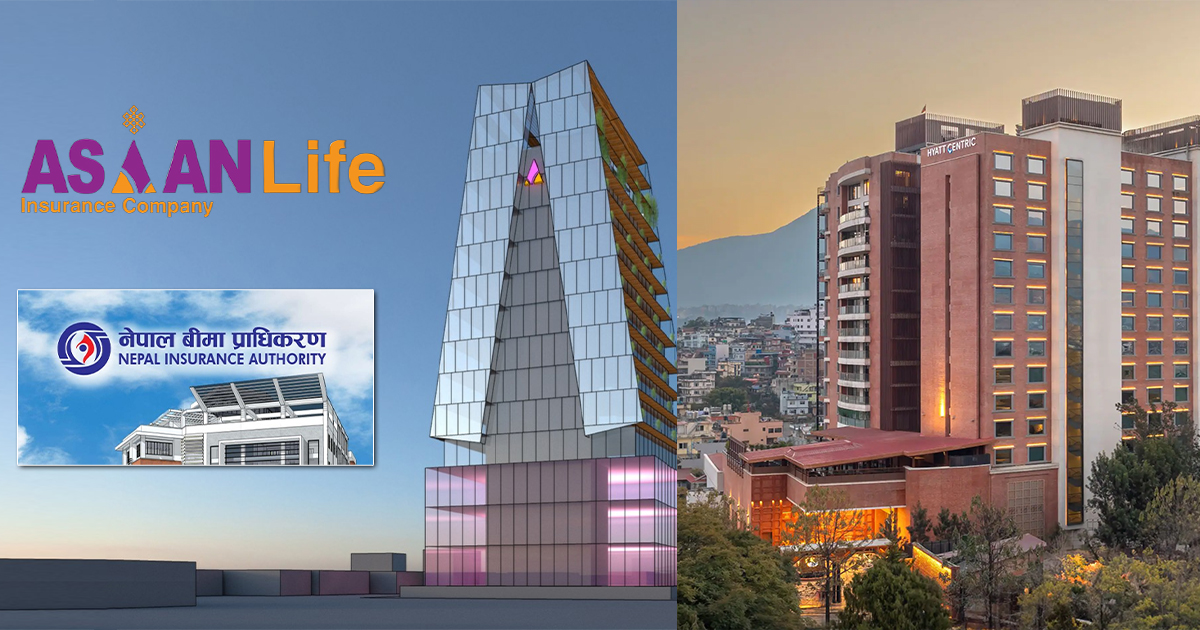

Kathmandu: Nepal Insurance Authority (NIA) has slammed Asian Life Insurance Company for a reckless response regarding its attempt to buy shares in City Hotel Limited, the operator of the Hyatt Centric in Tahachal, in clear violation of conflict-of-interest rules under the Insurance Act.
The move would have funnelled company funds into a business heavily controlled by its own top promoter, Shakti Kumar Golyan, raising serious questions about corporate governance in Nepal’s financial sector.
Asian Life’s board had greenlit the acquisition of 1.9 million shares in City Hotel through a book-building process, aiming to snap up undistributed rights shares at prices of Rs 306 and Rs 276 per share. But this decision hit a regulatory wall when the NIA stepped in, citing Section 67 of the Insurance Act 2022, which strictly prohibits insurers from engaging in joint ventures or acquiring assets linked to their directors, family members, major shareholders, or entities where they hold financial interests.
Golyan, who boasts the largest promoter stake in Asian Life with 1.8 million shares, equivalent to 5.31 percent, also chairs City Hotel’s board and controls a massive 48.78 million shares there, creating an blatant overlap that regulators deemed unacceptable.
In a stern letter, the NIA demanded a detailed explanation within seven days, probing why Asian Life would pursue such a self-dealing transaction that could undermine policyholder protections and expose the firm to undue risks. The company’s reply? A baffling admission of ignorance: it claimed the board was unaware of the potential conflict when approving the deal, only discovering the issue after the fact.
“We reached this decision because we weren’t aware that institutional investors on both sides could clash and create a conflict of interest,” Asian Life reportedly told the authority, according to senior NIA sources. Regulators dismissed this as utterly irresponsible, with one official noting, “This kind of ‘we didn’t know’ excuse simply won’t fly in a regulated industry like ours.”
The fallout was swift. Barely after receiving the NIA’s query, Asian Life convened an emergency board meeting and promptly reversed course, scrapping the share purchase entirely. The company notified Prabhu Capital Limited, the issue manager handling the book-building auction, that it was withdrawing its bid for the 1.9 million shares. In its formal response to the NIA, Asian Life reiterated the “lack of awareness” line but emphasized that it backed out immediately upon realization, attaching proof of the cancellation.
City Hotel had opened applications for 1.33 million rights shares from 23 to 30 October, with bids opened on 22 November; Asian Life’s aggressive play for nearly all the unsold portion, totalling over 2.15 million shares available through book-building, now stands nullified.
Under Section 67, the law leaves no gray areas: insurers cannot partner in businesses or link assets with insiders, and any pre-existing ties must be severed within six months of the act’s enforcement. Asian Life’s blunder not only flouted this but also highlighted broader vulnerabilities, especially as City Hotel grapples with ongoing losses while seeking capital boosts for loans and operations. Golyan’s dual role amplifies the red flags, his 29.14 percent stake in City Hotel’s undistributed rights shares alone underscores how intertwined the entities are.
With the dust settling, the NIA is now deliberating next steps, potentially including fines, deeper audits, or even board-level changes to prevent future lapses.

Comment Here