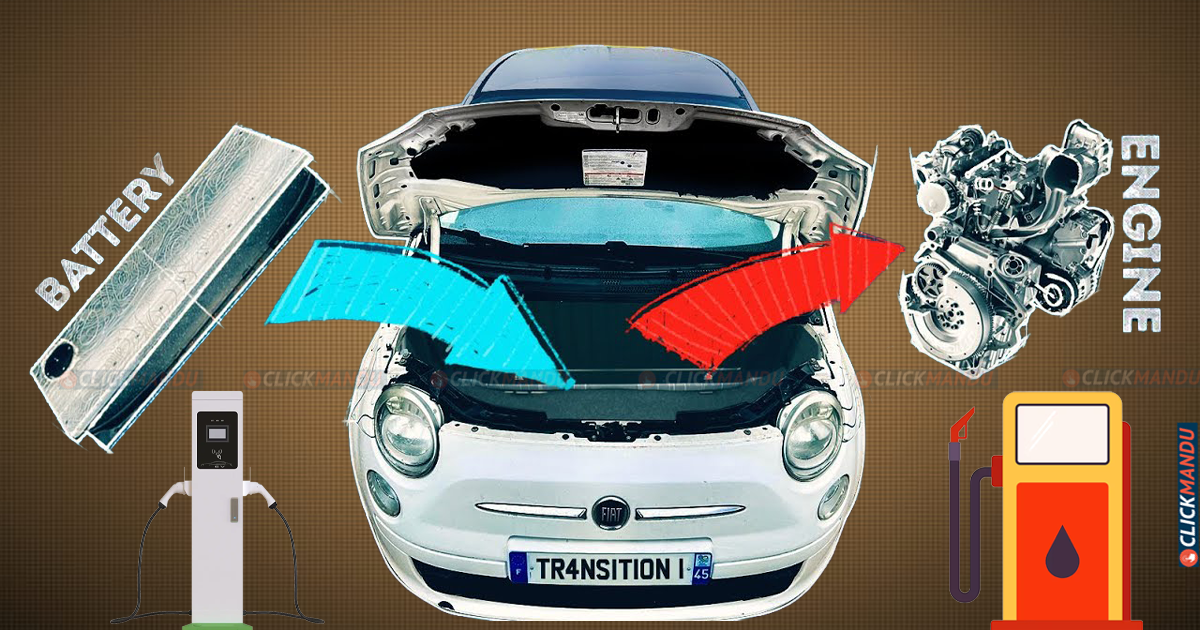

Kathmandu: In a major boost for green mobility, Nepal government has officially cleared the way for owners to convert their existing petrol and diesel vehicles into fully electric ones, effective immediately after a notice was published in the Nepal Gazette on Monday.
The Ministry of Physical Infrastructure and Transport has invoked special powers under Section 176 of the Vehicle and Transport Management Act 1992 to temporarily suspend for the next three years a restrictive clause in Section 39(2) that previously banned major engine modifications.
The exemption specifically applies to environmentally friendly upgrades that improve energy efficiency, paving the road for internal-combustion vehicles to be retrofitted with electric powertrains.
Under the current law, altering a vehicle’s engine, chassis, seating, or overall structure without permission is prohibited. While minor part replacements have always been allowed, swapping an entire petrol or diesel engine was strictly off-limits until now. The new three-year relaxation lifts that barrier exclusively for electric conversions.
“This is a temporary unlocking of the existing legal knot,” explained Krishna Raj Pantha, Under-Secretary at the Ministry’s Transport Division. “The same Act gives the government authority to suspend any provision for a limited period through a gazette notification, and that’s exactly what we’ve done to enable EV conversions right away.”
A new Vehicle and Transport Management Bill already under discussion permanently allows such conversions, but its passage through Parliament could still take considerable time. Rather than wait, the government has opted to use the existing Act’s flexibility and grant another three-year window, similar to a previous exemption that expired earlier.
The catch: detailed technical standards and safety guidelines for conversions are still being finalized. The Department of Transport Management has been tasked with drafting these rules urgently, and officials expect a workable framework to be ready within the next week or two. Once approved, owners will be able to apply for permission, undergo inspections, and pay a conversion fee equivalent to 50 percent of the regular vehicle registration charge.
This isn’t Nepal’s first attempt. A similar three-year window was opened in March 2022, but lack of clear standards meant almost no one used it. Pressure has since mounted from environmentalists, former lawmakers, and innovators who argue that converting the country’s aging fleet is far cheaper and faster than importing millions of new EVs, especially given Nepal’s abundant hydropower.
Some provinces, however, still impose their own restrictions. Certain provincial laws ban conversions on vehicles older than seven years, creating potential confusion that the central government will need to iron out.
Despite the hurdles, successful pilot projects already exist. In 2022, students at Kathmandu University famously converted a vintage Maruti Suzuki belonging to the former vice-chancellor into a fully electric car with help from the university’s Green Hydrogen Lab. Innovator Mahabir Pun’s National Innovation Centre is actively working on similar retrofitting solutions.
Back in 1993, a USAID-supported team led by engineer Dr Govinda Raj Pokharel successfully converted diesel three-wheelers (the iconic Vikram tempos) into electrics, laying the foundation for Nepal’s once-thriving Safa Tempo network that eventually replaced polluting diesel versions across the Valley.

Comment Here