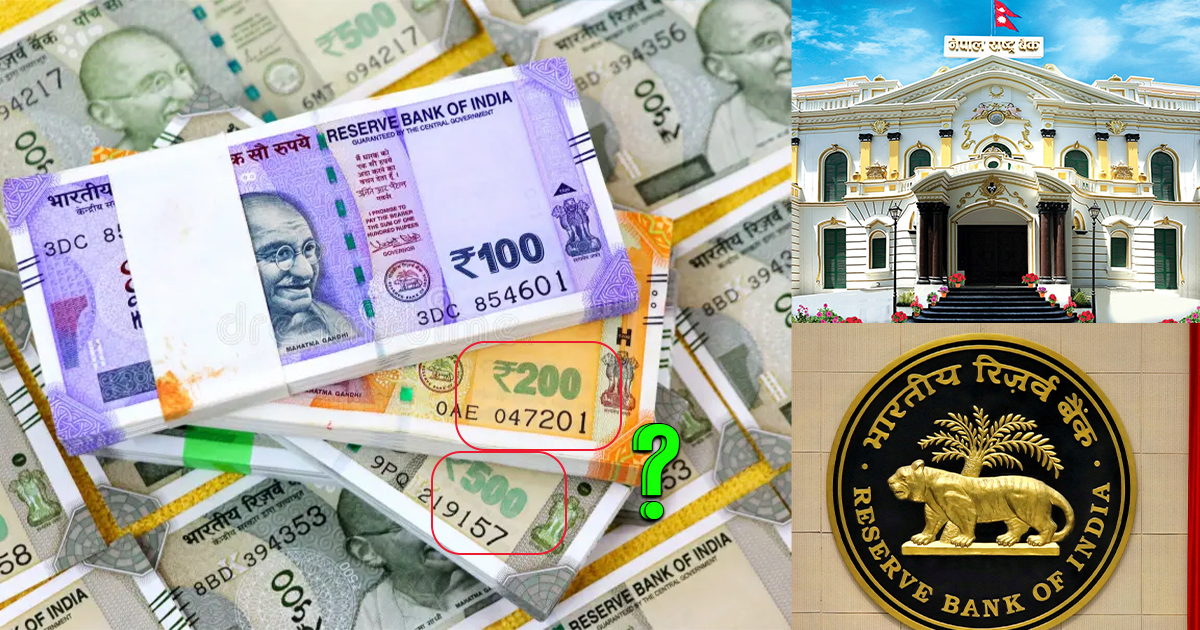

Kathmandu: Travellers moving between India and Nepal can now legally carry Indian ₹200 and ₹500 banknotes, bringing an end to nearly a decade of restrictions that caused widespread inconvenience at the border.
The Reserve Bank of India (RBI) has officially amended its foreign exchange rules, allowing individuals to carry up to ₹25,000 in these higher-denomination notes when entering or leaving India through the Nepal border.
The new provision, published in the official Indian gazette on 28 November 2025, applies to citizens of all countries except Pakistan and Bangladesh. Nepal and Bhutan are the only two neighbours granted this reciprocal facility.
The restriction dates back to 8 November 2016, when India suddenly demonetised its old ₹500 and ₹1,000 notes overnight. The following day, Nepal Rastra Bank (NRB) declared that Indian notes larger than ₹100 would no longer be legal tender or even permissible to possess within Nepal. For years, anyone caught with ₹200 or ₹500 notes at the border risked confiscation and lengthy questioning.
The change removes a major headache for the millions who cross the open border every year including Nepali migrant workers returning from India, Indian tourists visiting Nepal, students, pilgrims, and daily commuters. “This is a practical and welcome step from India,” said NRB spokesperson Guru Prasad Paudel. “People can now carry these notes for travel expenses without fear of breaking the law.”
However, the notes still cannot be used for everyday shopping or transactions inside Nepal. They remain invalid as currency in local markets. Travelers must exchange them at banks, authorised money changers, or the roughly 2,800 licensed institutions (hotels, airlines, malls, etc.) approved by NRB.
Paudel clarified that the relaxation is strictly for transit and authorised exchange purposes. “Carrying up to ₹25,000 in ₹200 and ₹500 notes is no longer illegal, but it does not mean these notes can freely circulate in Nepal’s markets,” he stressed. “The goal is to ease cross-border movement while protecting Nepal’s own currency system.”
For years, Nepal Rastra Bank had resisted one-way arrangements that would allow large Indian notes to flow in but not out, fearing an influx that could undermine the Nepali rupee. The breakthrough came only after India agreed to full reciprocity, notes can now move in both directions.
The decision is expected to bring particular relief to Nepali workers who earn and save in Indian rupees, Indian pilgrims heading to Pashupatinath and Muktinath, and the growing number of Indian visitors exploring Nepal’s mountains and heritage sites.
The new rule will take full effect in Nepal once the government formally notifies it in its own gazette and NRB issues a circular to banks and exchange counters. Until then, travellers are advised to continue exchanging higher-denomination notes before crossing the border to avoid any last-minute complications.

Comment Here