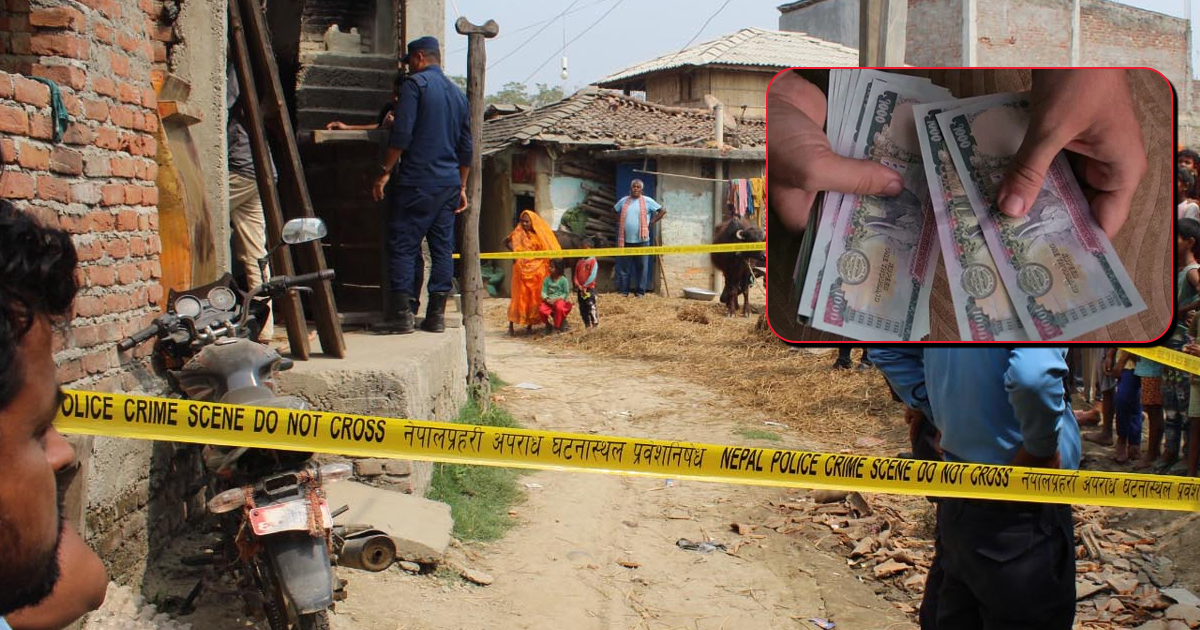

Kathmandu: In recent months, Nepal has seen a disturbing surge in violent crimes triggered by money. What once stopped at scams and fraud has now escalated to cold-blooded murder, and these stories are starting to feel disturbingly routine.
Disputes over cash that begin as arguments are increasingly ending in death. From petty debts to desperate medical bills, money – or the lack of it – has become a common thread running through many homicide cases.
A police sub-inspector who slaughtered his own four-month-old son because treatment for the baby’s brain hemorrhage had drained the family’s savings. A young man who strangled a woman with a shoelace and punched her to death over a 500-rupee drug debt. An elderly woman beaten and hacked to death with a sickle simply because she refused to lend gambling money. These are not isolated tragedies; they are symptoms of a deeper malaise.
On Sunday afternoon, 29-year-old Assistant Sub-Inspector Pushkar Karki killed his infant son Mahir. The baby had suffered a brain hemorrhage and, despite surgeries and hundreds of thousands of rupees already spent, doctors said he would remain severely disabled for life. That morning, Pushkar and his wife argued bitterly over the mounting bills. Hours later, the child was dead, his throat slit with a knife.
Just weeks earlier, near Gongabu bus park in Kathmandu, the body of Maya Magar was found wrapped in black plastic and a tarpaulin. The killer turned out to be 24-year-old Surya Thapa Magar. He had lent her 500 rupees to buy brown sugar. When she said she didn’t have the money to pay him back, a heated argument exploded into lethal violence: strangled with his shoelace, punched twice in the throat, and left for dead.
In Palpa, on October 20, 76-year-old Phulmaya Jisi was playing cards with her husband when 37-year-old Min Bahadur Bishwokarma, fresh from losing at gambling, asked to borrow money. When the elderly couple refused, he grabbed a sickle lying nearby and struck her repeatedly on the head. She died on the spot.
Nepal Police say they are treating every financially motivated murder with utmost seriousness. “We investigate the economic, social, and behavioral background of both victims and suspects in minute detail,” Central Police Spokesperson Abi Narayan Kafle told Clickmandu. “Money has become so central to people’s lives that disputes over it often turn deadly.”
Senior journalist Tirtha Koirala blames a deeper societal shift. “As Nepal modernizes, people have become obsessed with money. Traditional values, morality, and basic human decency are disappearing. When education and cultural grounding weaken, money fills the vacuum – and society turns ugly,” he said. Koirala believes widespread unemployment and lack of legitimate income sources are pushing more people toward crime, adding that a sense of responsibility and community could reverse the trend.
Former Deputy Inspector General Hemant Malla Thakuri points to another factor: a growing intolerance in society. “People have lost the ability to listen, to endure hardship, or to show patience,” he said. “When tolerance vanishes and morality erodes, money becomes the only thing anyone cares about – and petty disputes explode into irreversible violence.”
Both experts agree that unless the state strengthens investigation, creates jobs, simplifies legal processes for financial disputes, and restores basic civic values, the deadly link between money and murder will only grow stronger.

Comment Here