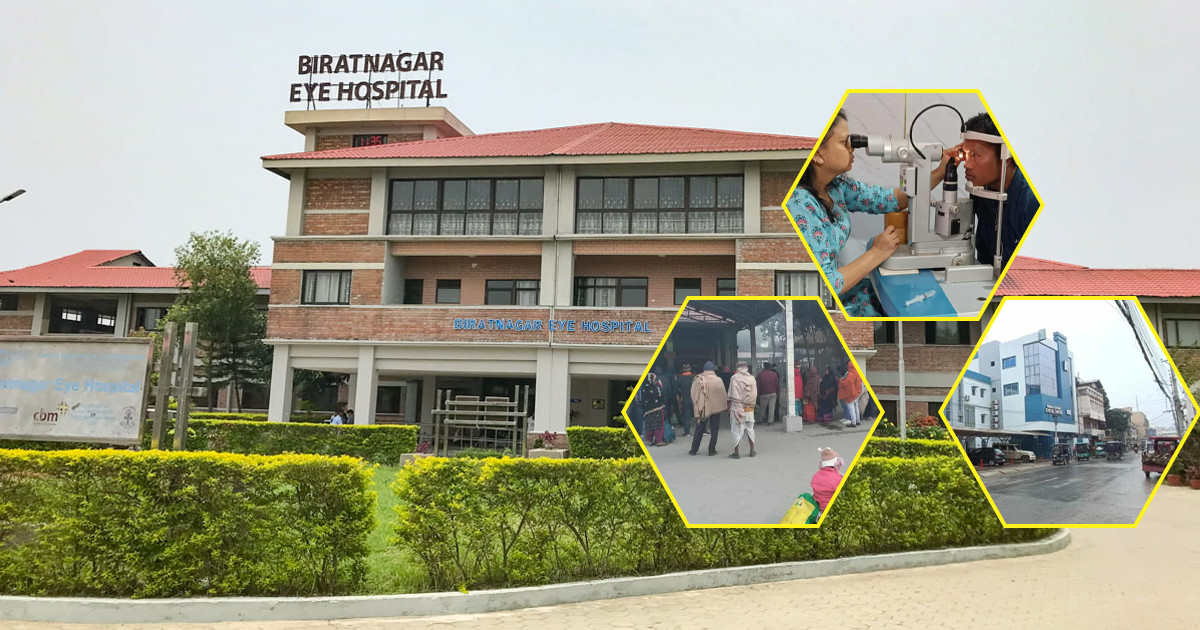

Biratnagar: Forty years ago, anyone in eastern Nepal needing eye treatment faced a tough choice: travel all the way to Kathmandu or cross the border into India.
Biratnagar, now the bustling capital of Koshi Province, had just a single eye hospital — the Ram Lal Golchha Eye Hospital — and private clinics were virtually nonexistent.
Today, the city has been transformed. Walk down almost any street and you’ll spot eye hospitals, clinics, and diagnostic centres within a kilometre of one another. What started as a basic service has exploded into a regional medical hub that now draws hundreds of thousands of patients every year — not only from Nepal, but predominantly from neighbouring India, as well as Bhutan and Bangladesh.
In the Biratnagar metropolitan area, which has 19 wards, at least 19 private eye hospitals are currently operating — far more than the eight officially registered with the municipality. Last year alone, these facilities treated close to one million patients, with roughly 60 percent coming from India and another 2 percent from Bhutan and Bangladesh.
The numbers are staggering. Biratnagar Eye Hospital, the city’s largest, saw over 704,000 patients in a single year, performing more than 72,000 surgeries — 80 percent of them cataract operations. Nearly half of its patients were Indian. The older Ram Lal Golchha Eye Hospital treated around 66,000 people and carried out 7,000 surgeries, with Indians making up about 40 percent of its caseload.
Administrators openly acknowledge the financial scale: one major hospital alone generates an average of more than Rs 600 million (around US$ 4.5 million) annually from eye care services. City-wide, the sector is believed to bring in billions of rupees each year.
Advanced technology has followed the boom. Services that once stopped at basic check-ups and cataract surgery now include laser treatments, retinal care, glaucoma management, and corneal transplants. For many Indians living just across the open border, Biratnagar offers quicker appointments, modern facilities, and significantly lower costs than private hospitals in Delhi, Siliguri, or Patna.
Yet the rapid growth has sparked unease. The sheer number of facilities has intensified competition, leading to aggressive marketing, complaints of unnecessary tests, and accusations that minor issues are sometimes presented as serious conditions to justify higher bills. Some residents now refer to Biratnagar as the “eye business capital” as much as an eye-care hub.
Senior ophthalmologist Dr Kripa Lopchan points out that rising rates of diabetes and hypertension across the region are genuinely driving up eye-related illnesses, and many patients only discover these underlying conditions when they arrive for vision problems. Still, critics argue that fierce commercial rivalry risks turning a vital health service into pure profit-making.
Despite the concerns, patients are undeniably benefiting from greater access, shorter waiting times, skilled specialists, and cutting-edge equipment. Local leaders and doctors insist that with stronger regulation, transparent pricing, and checks on unnecessary procedures, Biratnagar can balance commerce and care.

Comment Here