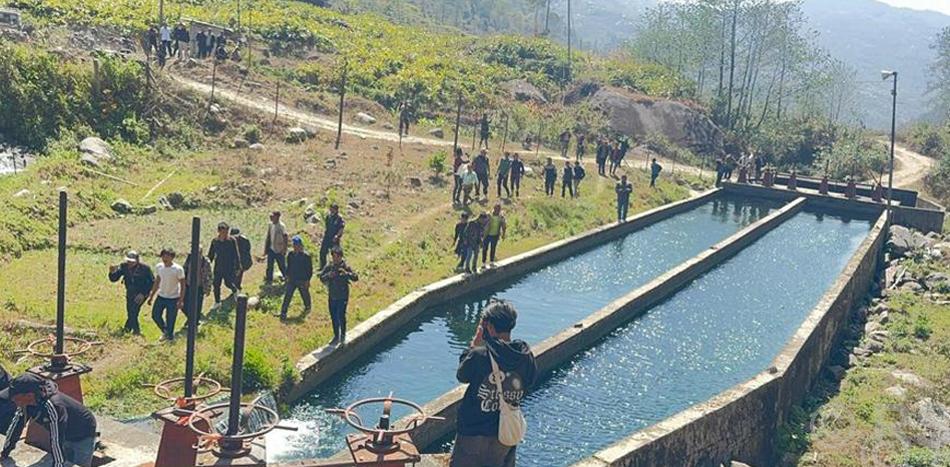

Khotang: Landowners in Nepal’s Khotang district have once more halted operations at the 3 MW Upper Rawakhola Small Hydropower Project, citing the developer’s failure to provide fair compensation for private land used in the facility.
Frustrated by the lack of payment for land occupied by transmission lines and pipelines—despite compensation having been paid for pole installations—locals diverted water away from the turbine starting mid-December, effectively stopping electricity generation.
An agreement reached earlier in the month between representatives of Rawa Energy Development Pvt. Ltd. and affected landowners promised compensation by late December, but the company did not follow through, prompting the renewed shutdown.
This marks the second disruption this year; a similar protest in early 2025 forced a temporary closure until a coordination committee was formed under local government facilitation, committing to resolve payments within 35 days.
The run-of-the-river project, located along the Rawakhola river bordering Sungdel and Kepilasgadhi rural municipalities, was connected to the national grid in late 2020 and has been operational for over five years.
Local resident Maitiraj Rai highlighted the ongoing grievances, noting that despite repeated assurances, including appeals to district authorities, no meaningful progress has been made on compensation or related issues.
Landowners are demanding independent valuation and prompt payment for all affected land, road maintenance and drainage improvements, mandatory release of 10-15 percent environmental flow during dry seasons, proper permits for public land use, and priority resolution for impacted communities.
Project committee member Rajan Dahal acknowledged some demands but stated that certain requests cannot be met, emphasizing prior coordination efforts through the local rural municipality.
Despite submissions to the district administration seeking intervention, locals report no follow-up action, underscoring broader challenges in Nepal’s hydropower sector where land acquisition disputes frequently delay or disrupt projects.

Comment Here