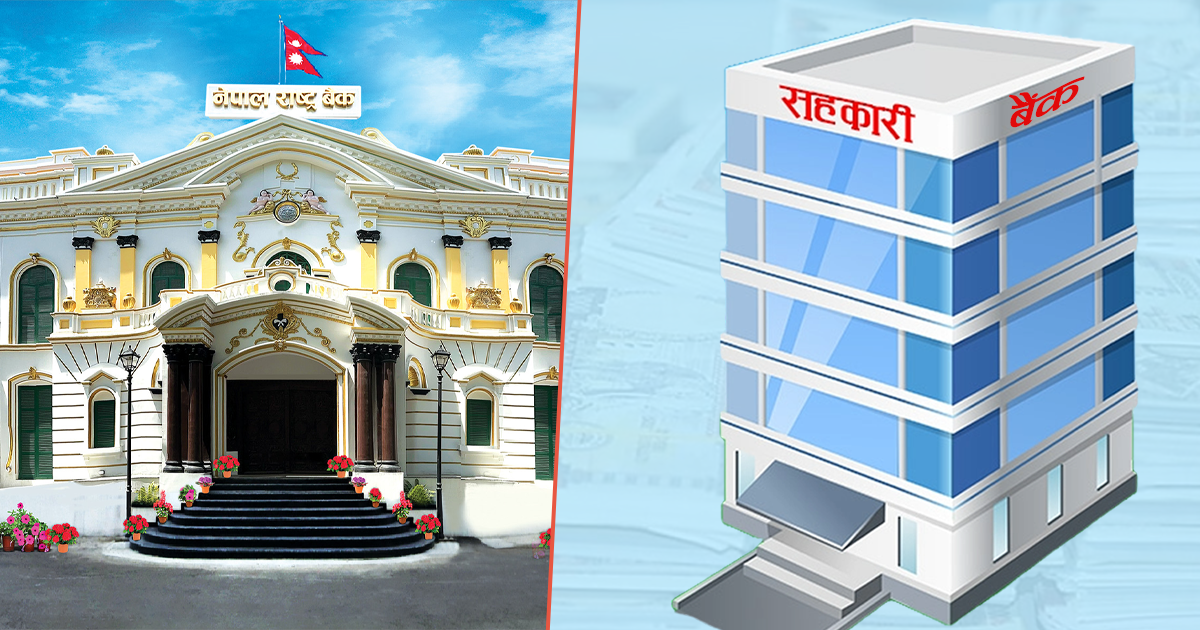

Kathmandu: Nepal Rastra Bank (NRB) has significantly tightened its oversight of cooperative banks, setting a new minimum paid-up capital requirement of Rs 2.5 billion. Under the central bank’s updated framework, these institutions are now required to maintain a core capital of 4 percent and a total capital adequacy ratio of 8 percent relative to their risk-weighted assets.
These mandates were introduced on Monday as part of the “Directives 2025” specifically tailored for cooperative banks authorized to conduct limited banking operations. The central bank has explicitly stated that the required Rs 2.5 billion paid-up capital must be composed entirely of ordinary shares.
The directive further clarifies that core capital (Tier 1) shall include paid-up capital, proposed bonus shares, general reserves, accumulated profits or losses, and any other free reserves created for general purposes. However, the NRB has specified that certain assets must be deducted from this core capital, including goodwill, deferred tax assets, and any investments in the shares or securities of other entities that violate central bank regulations. Supplementary capital (Tier 2) may include general loan loss provisions, asset revaluation funds and amounts accounted for as non-banking assets.
To ensure compliance, the NRB has outlined a series of escalating disciplinary actions for institutions that fail to meet these capital benchmarks. First and foremost, any cooperative bank falling short of the minimum capital requirements is strictly prohibited from declaring or distributing dividends.
For institutions with a capital shortfall of up to 25 percent, the central bank will intervene by reviewing improvement plans with senior management. During this phase, the bank will be barred from issuing cash dividends or bonus shares, opening new branches, and increasing the salaries, allowances, or benefits of its board members and top executives.
If the capital deficiency reaches between 25 percent and 50 percent, the restrictions will intensify. The NRB may impose caps on deposit collection and restrict the institution from borrowing or taking credit from other financial entities. Such banks will also be prohibited from launching new business activities and must seek prior approval from the central bank before acquiring or leasing any fixed assets. Additionally, staff incentives, performance bonuses, and severance pay increases will be frozen.
In more severe cases, where the capital fund is deficient by 50 percent to 75 percent, the central bank will halt the institution’s ability to accept new deposits and borrow from other banks. These cooperatives will be barred from issuing new loans or increasing existing credit limits. All salary and benefit hikes for employees will be suspended, and the bank will be prohibited from hiring or promoting staff without central bank consent. If the minimum capital is not restored within six months of these actions, the board of directors and the CEO may face legal penalties under the Cooperative Act of 2017.
In the most critical scenarios, where the capital fund is depleted by more than 75 percent, the NRB will officially declare the cooperative bank “problematic.” If the institution fails to rectify its capital status within six months of this declaration, its operating license may be suspended or revoked. These specific capital-related enforcement measures are slated to take full effect on 16 July 2028.
Beyond capital requirements, the central bank has aligned loan classification and provisioning rules for cooperative banks with those of commercial banks. Loans will now be categorized based on their delinquency: “Good” for payments overdue by up to three months, “Substandard” for three to six months, “Doubtful” for six months to one year, and “Loss” for any debt overdue by more than a year. Loans must also be classified as “Loss” if the collateral value is insufficient, if the borrowing member is blacklisted, or if the funds have been misappropriated.
Provisioning requirements have been set at 1 percent for “Good” loans, 25 percent for “Substandard,” 50 percent for “Doubtful,” and a full 100 percent for “Loss” category loans. This ensures that banks have adequate cushions against potential defaults.
The central bank also directed that loans with a maturity of more than one year must be issued on an installment-repayment basis, though this can apply to shorter-term loans as well. Furthermore, cooperative banks are required to ensure all lending to member institutions is backed by sufficient collateral, except where specifically exempted.
Finally, the NRB has placed a cap on credit exposure to prevent over-concentration. Loans to a single member or a group of related members cannot exceed 15 percent of the member institution’s total assets or 20 percent of the cooperative bank’s ordinary shares from the previous quarter, whichever is lower. Cooperative banks that currently exceed these limits have been given a deadline of mid-July 2026 to bring their lending portfolios into compliance.

Comment Here