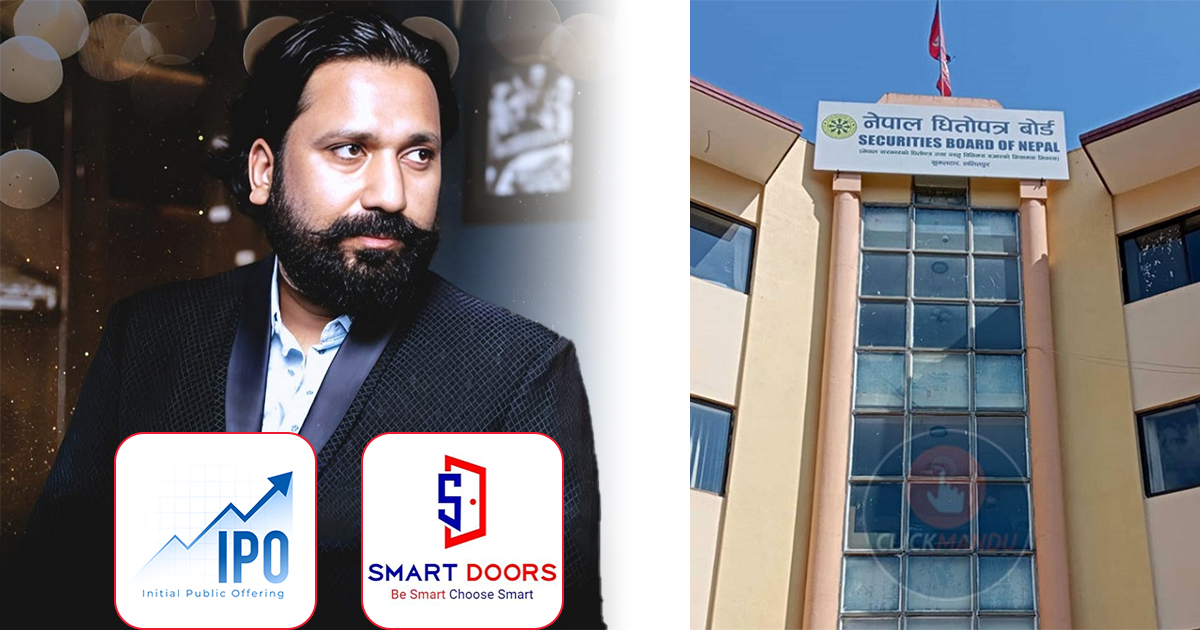

Kathmandu: In recent weeks, Dipendra Agrawal, a stock market activist who had become increasingly confrontational toward Nepal’s securities regulator, has found himself in police custody.
Central Investigation Bureau of Nepal Police arrested Agrawal on charges of manipulating share prices through fraudulent trading practices. His detention marks a dramatic turn in a saga that has unfolded publicly for months and has raised serious questions about market integrity, regulatory pressure and investor activism in Nepal.
According to an investigation by the Securities Board of Nepal, Agrawal systematically used social media platforms to encourage retail investors to buy specific stocks, while he himself allegedly made millions of rupees in profits from those trades. The regulator’s study concluded that he operated as many as 15 separate online trading system accounts under different names, executing artificial buy-and-sell transactions to push prices upward.
Investigators also found that Agrawal obtained unusually high trading limits from brokerage firms by submitting undated checks worth billions of rupees, allowing him to trade at volumes far exceeding normal limits. At the centre of these activities was a company called Smart Doors, which Agrawal had allegedly turned into a hub for sham transactions.
At the same time, Agrawal was aggressively preparing to launch an initial public offering for Smart Doors. He and his associates promoted the company as a future high-value stock that would soon trade at several thousand rupees per share in the secondary market. Through pre-IPO campaigns, they called on investors to participate, promising strong returns and portraying Smart Doors as a vehicle that would deliver tangible benefits to ordinary investors.
Smart Doors applied to issue an IPO nearly nineteen months ago, seeking approval to float 306,000 shares at a face value of 100 rupees per share, amounting to about Rs 30.6 million. However, the Securities Board did not grant approval within the timeframe Agrawal expected. The prolonged delay became a turning point. As months passed without clearance, Agrawal’s public posture toward the regulator and its leadership grew sharply hostile.
Over the past few years, Agrawal repeatedly targeted the Securities Board and its chairman, Santosh Narayan Shrestha, accusing them of corruption and incompetence. His attacks went beyond rhetoric. Even while in CIB custody, Agrawal staged a hunger strike demanding action against the chairman. Sources within the regulator say his anger stemmed primarily from the board’s refusal to fast-track approval of the Smart Doors IPO.
Investigators also found that Agrawal obtained unusually high trading limits from brokerage firms by submitting undated checks worth billions of rupees, allowing him to trade at volumes far exceeding normal limits.
Regulatory officials allege that under the banner of investor rights and capital market reform, Agrawal mobilized groups of mostly young investors, including so-called Gen Z activists, to protest outside the board’s offices. These actions ranged from public demonstrations to intimidation, including surrounding the regulator’s premises and issuing threats. According to board sources, such pressure tactics intensified after Santosh Narayan Shrestha assumed office as chairman, with Agrawal becoming increasingly aggressive both publicly and behind the scenes.
At one point, protests organized under the pretext of market reform escalated to the extent that board officials and staff were effectively confined inside their offices until late at night. Protesters demanded the chairman’s resignation, accusing him of blocking reforms. Regulatory sources maintain that the real objective behind these protests was to force approval of the Smart Doors IPO. From its inception, Smart Doors had been registered as a public company, a move that appeared designed to strengthen its case for a public offering from the very beginning.
Despite sustained efforts, Agrawal failed to secure IPO approval before or after Shrestha took over as chairman. This repeated rejection appears to have deepened his resentment. Gradually, his frustration spilled onto social media, where he portrayed the regulator as anti-investor and obstructive. What began as online criticism soon evolved into organized street protests, with Agrawal personally encouraging supporters to march on the regulator’s offices.
Sources say Agrawal maintained constant pressure on board officials through phone calls, meetings, and public agitation, all centered on securing IPO clearance for Smart Doors. Under the guise of protests and sit-ins for capital market reform, he attempted to create conditions in which approval would become unavoidable. When Gen Z-led demonstrations took place on September 23 and 24, the pressure intensified further, with Agrawal allegedly orchestrating the turnout and calling publicly for people to join the protests after approval was once again denied.
Smart Doors is chaired by Mita Murarka Agrawal, with Dipendra Agrawal serving as a director. Other shareholders include Kusum Devi Agrawal, Narendra Kumar Agrawal, and Jai Prakash Agrawal. Observers note that Dipendra Agrawal’s increasingly confrontational actions, carried out in the name of investors, strongly suggest a personal motive linked to pushing the company’s IPO through regulatory barriers.
Official records show that Smart Doors submitted another IPO application to the Securities Board on 15 April 2024, with Muktinath Capital appointed as the issue and sales manager. Yet the company remained stuck in a long pipeline of firms awaiting approval. Frustration peaked on October 26, when protests escalated to the point that demonstrators effectively prevented Chairman Shrestha from leaving the board premises for several hours. Large contingents of Nepal Police and Armed Police Force were deployed to maintain security as protesters demanded his resignation, blaming him for the lack of market reform.
Talks between protesters and officials failed, and demonstrations continued late into the night, with slogans echoing inside the board compound until around 10:30 p.m. Eventually, security personnel escorted the chairman and senior officials safely out of the premises. Agrawal, who had emerged as the face of the protests, declared that the agitation would continue until demands were met. Even afterward, he continued mobilizing protesters, repeatedly calling on young supporters to confront the regulator, a campaign sources describe as driven largely by personal vendetta.
Investigators now say that while pressing for IPO approval, Agrawal was also using Smart Doors as a vehicle for fraudulent trading. A preliminary investigation report from 2025 states that he disseminated misleading information to induce share purchases and created artificial price movements in the market.
The report concludes that both the buyer and seller were effectively under Agrawal’s control, meaning the transaction did not change real ownership and was designed solely to distort market prices.
The report documents a transaction on 29 April 2025, involving Corporate Development Bank shares, where Smart Doors purchased 20,000 shares worth nearly Rs 49 million in the final minutes of trading. Although the shares appeared to be sold by an individual named Jyoti Agrawal, investigators found that Dipendra Agrawal himself controlled that trading account.
The report concludes that both the buyer and seller were effectively under Agrawal’s control, meaning the transaction did not change real ownership and was designed solely to distort market prices. Such activity, investigators say, constitutes false trading under Nepal’s Securities Act.
The findings further allege that Agrawal used 15 different trading accounts to conduct artificial transactions, relied on undated checks worth over 3.5 billion rupees as collateral, and earned illegal profits, including nearly Rs 4.9 million from trades involving Joshi Hydro alone.
Financially, Smart Doors appears weak for a company seeking public investment. In 2024, it reported revenues of Rs 25 million, a 25 percent increase from Rs 20 million in 2023. According to CARE Ratings Nepal, its net profit stood at just Rs 4 million. The company has not been rated since, and even its website is reportedly inaccessible. While it claims a daily production capacity of 600 doors, its financial performance remains modest.
Promoters’ investment in Smart Doors rose sharply, from Rs 82 million at the end of 2023 to Rs 275 million by 2024. Founded three years ago in the Bhutkhel area of Tokha, Kathmandu, with paid-up capital of Rs 200 million, the company manufactures and sells a range of doors, including 3D doors, laminated doors, mica–Canadian doors, embossed doors and grilled doors.

Comment Here