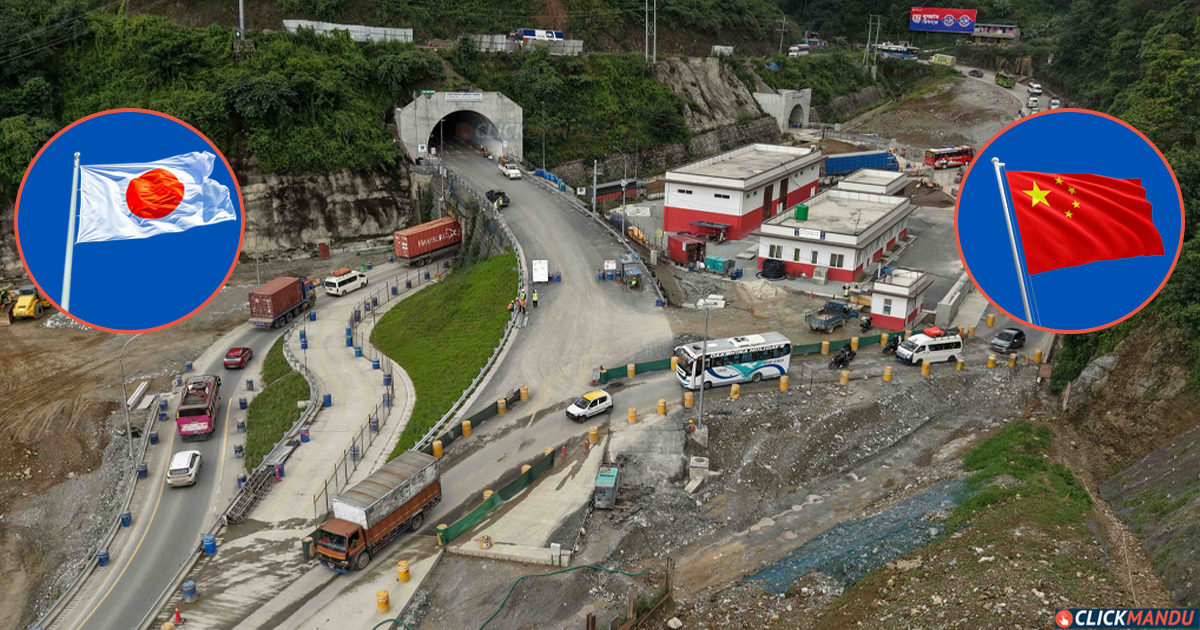

Kathmandu: The government has extended the deadline for opening bids to select a service provider required to operate the Nagdhunga Tunnel.
According to the Nagdhunga Tunnel Construction Project, the deadline for opening bids has been extended by 15 days based on the requests of the bidders.
Project Director Saujanya Nepal informed that the 15-day extension was granted following requests from participating bidders.
On 1 November 2024, the government invited international tenders to select a service provider for the operation and maintenance of the tunnel. The initial deadline for opening these bids was set for December 17. However, the date has now been rescheduled to December 31 after the 15-day extension.
While the project claims the extension was based on bidder requests, the reality is reportedly different. High-ranking officials from the Ministry of Physical Infrastructure and Transport have stated that there has been “significant pressure” from high-level Japanese officials behind the extension.
Japanese officials are making maximum efforts to ensure that a Chinese company does not receive the responsibility of being the service provider for the tunnel’s operation and maintenance.
To this end, the Japanese Ambassador to Nepal has recently exerted heavy pressure on high-level officials at the Ministry of Finance and the Ministry of Physical Infrastructure and Transport, insisting that the responsibility should not go to a Chinese firm.
Some Chinese companies have also participated in the global tender competition to secure the role of the service provider. Since Chinese companies showed interest and began the application process, Japanese officials have pressured the government to “edge out” Chinese companies from the competition by any means.
According to ministry sources, the project extended the bid-opening deadline by 15 days as a result of this pressure.
“Since it is being constructed with their loan assistance, Japan has taken the stance that, as far as possible, a Chinese company should not get the responsibility for the operation and maintenance of this tunnel,” a high-ranking ministry official said. “Contrary to Nepal’s existing laws, Japanese officials have pressured us to remove the participating Chinese companies from the competition.”
According to the official, after companies like China’s ‘China First Highway Engineering Company’ and ‘Poly Changda Engineering Corporation’ showed interest in applying, Japanese officials have been exerting formal and informal pressure to ensure that government-owned Chinese companies do not get the responsibility.
Japanese officials are making maximum efforts to ensure that a Chinese company does not receive the responsibility of being the service provider for the tunnel’s operation and maintenance.
Furthermore, the ministry official informed that Japanese officials have expressed the view that companies blacklisted by the World Bank and the Asian Development Bank should also not be given the responsibility.
Due to such heavy pressure from Japanese officials, there is even a risk that the service provider contract could be left in limbo. It is pointed out that while the tunnel construction is in its final stages of completion, this pressure could delay the operational process.
Under Nepal’s existing laws, any company from any country that meets the necessary procedures and criteria can be given the responsibility. The ministry maintains that the law allows companies from any country to participate in the bidding competition.
“However, Japanese officials pressured us, saying that the participating Chinese companies must not be given the operational responsibility at any cost,” the official said. “We have prepared to move the process forward according to legal provisions as much as possible. But Finance Ministry officials are exploring whether the issues raised by the Japanese side can be addressed in some way.”
According to the official, the geopolitical friction between China and Japan has also affected the Nagdhunga Tunnel.
Project Director Nepal clarified that they would follow the provisions of the Public Procurement Act.
“Any company that stays within the boundaries of the Public Procurement Act and Regulations and meets the procedures and criteria can get the operational responsibility,” Nepal told Clickmandu. “We cannot say we will give it to someone or deny someone just because of pressure; whoever meets the law, standards, and criteria will get it.”
According to him, the selection process through international bidding—including evaluation, letter of intent, and agreement—takes about two months. The selected service provider will handle the operation and maintenance of the tunnel for five years.
Japan’s restrictive activities during construction contract
Japanese officials also engaged in restrictive activities during the construction phase of the Nagdhunga Tunnel.
At that time, five Chinese companies had competed alongside one Japanese company for the construction of the tunnel.
However, the Japan International Cooperation Agency (JICA) had refused to grant the contract to Chinese companies, claiming that infrastructure structures built by Chinese construction firms were not of high quality.
Although the Public Procurement Act and Regulations mandate giving the contract to the lowest bidder, JICA’s intervention made it very difficult to select a Chinese company.
Under JICA’s pressure, Japan’s Hazama-Ando Corporation was allowed to participate with a price nearly Rs 700 million lower than what the Chinese companies had proposed, and the construction was eventually awarded to the Hazama-Ando JV.
According to the ministry official, JICA had threatened at that time to cut loan assistance if a Chinese company received the contract instead of a Japanese one.
Japan International Cooperation Agency (JICA) had refused to grant the contract to Chinese companies, claiming that infrastructure structures built by Chinese construction firms were not of high quality.
The Nagdhunga Tunnel is being constructed at a cost of Rs 22 billion. Of this, the Japanese government provided a concessional loan of Rs 16 billion for 40 years at an interest rate of 0.01 percent. The agreement specifies that the remaining Rs 6 billion will be covered by the Government of Nepal.
The Department of Roads signed the construction contract with Hazama-Ando Corporation on 23 September 2019. According to the agreement, construction was to be completed within 42 months (by 25 April 2023).
Deadline extended, preparations to open in April
According to the project, the deadline has been extended to April 2026 as some structural work remains.
Project Director Nepal stated that the six-month extension was granted because frequent new landslides near the Dhading entrance (Sisne Khola) damaged the portal, and the construction of the toll gate plaza and access roads in that area is still pending.
The government had previously extended the deadline twice—the first time for one year and the second time for 18 months—setting the completion date for 25 October 2025.
Factors such as the COVID-19 pandemic, frequent obstructions by local residents, the closure of crusher industries last year, and geographical complexities led to the first extension on 20 July 2023 and the second on 25 April 2024.
While the Department of Roads had planned to open the tunnel by December after finishing work within the last extension and selecting an operator, the department is now preparing for an April opening due to added variations.
Since the anchors required for landslide control are not available in Nepal, they have been ordered from India. It will take about one and a half months for those materials to arrive, after which landslide control work will begin.
According to official Panthi, the selection process through this tender—including evaluation, letter of intent, and agreement—will take at least two months.
A staff quota of 150 people has been proposed for the regular operation of the tunnel. These employees will work under the leadership of the Tunnel Operation and Maintenance Chief.
The breakdown includes 64 staff for the security management unit, 54 for toll collection, 14 for traffic facility monitoring and control, and 8 each for civil and other structural maintenance.
Since the anchors required for landslide control are not available in Nepal, they have been ordered from India. It will take about one and a half months for those materials to arrive, after which landslide control work will begin.
The project has also prepared a manual titled ‘Nagdhunga (Kathmandu)–Sisnekhola (Dhading) Tunnel Transport Operation’ for tunnel management.
The project consists of two tunnels: a 2,557-metre-long evacuation tunnel for emergency rescue and a 2,688-metre-long, two-lane main tunnel with a width of 3.5 metres for vehicle traffic.
There are seven cross-passages (entry gates) built into the evacuation tunnel, which runs parallel to the main tunnel.
The evacuation tunnel was built to rescue passengers in case of accidents, breakdowns, or other issues in the main tunnel. It is located 20 metres to the left of the main tunnel and is 4.5 metres wide and 5 metres high.
The government has already determined the toll fees (user charges) for vehicles using the tunnel.

Comment Here