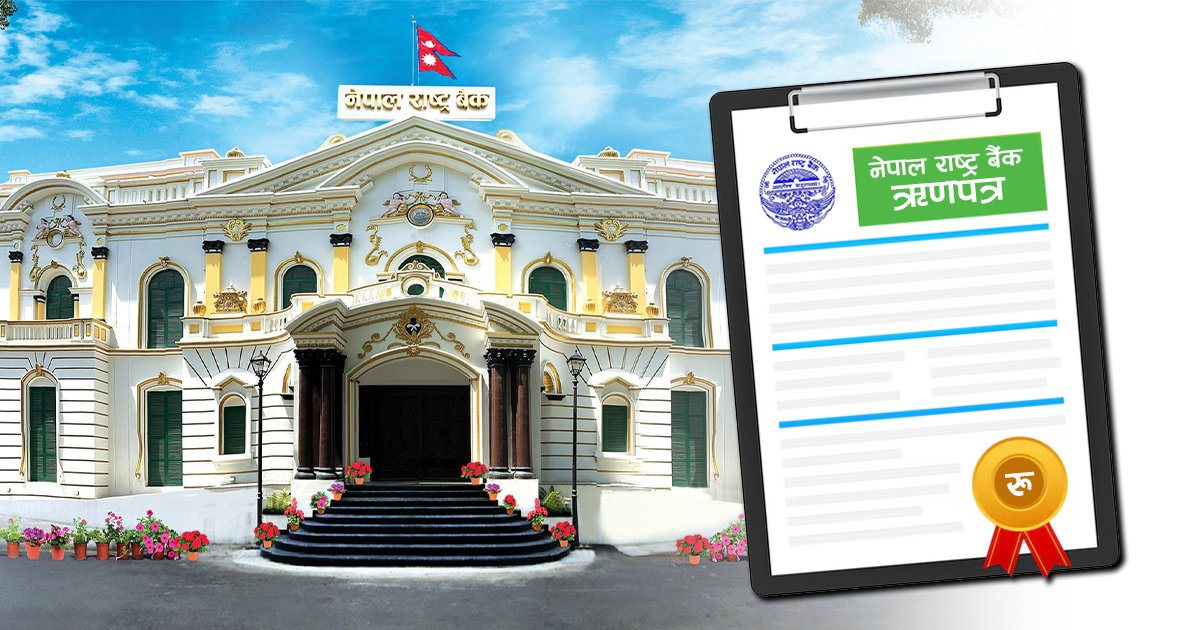

Kathmandu: The board of directors of Nepal Rastra Bank (NRB) has approved the issuance of “NRB Bonds” as part of a broader effort to absorb excess liquidity from the banking system. Deputy Governor Bam Bahadur Mishra said the board meeting held on Wednesday cleared the issuance of bonds worth up to Rs 2 trillion.
While the total approved amount stands at Rs 2 trillion, Mishra clarified that the bonds will not be issued all at once. Depending on liquidity conditions in the market, individual issuances will range from a minimum of Rs 20–25 billion to a maximum of Rs 50 billion at a time.
Nepal’s banking system has been grappling with persistent excess liquidity, driven by weak credit demand even as deposits continue to rise. To manage this, the central bank has been regularly mopping up liquidity through short- and medium-term instruments such as the standing deposit facility and deposit collection auctions.
However, as monetary policy transmission has remained ineffective due to what policymakers describe as a “liquidity trap,” NRB has decided to use NRB Bonds as a longer-term instrument to absorb surplus funds from the system.
The approval for issuing up to Rs 2 trillion in NRB Bonds has now been granted by the central bank’s board. The Open Market Operations Committee will next prepare an issuance calendar to operationalize the bond sales.
NRB had already announced in its current fiscal year’s monetary policy that it would use NRB Bonds to absorb excess liquidity. The policy also stated that open market operations would be conducted in a way that keeps the weighted average interbank rate close to the policy rate.
Despite these intentions, the target has not been achieved even as the second quarter of the fiscal year nears its end. Among the available open market tools, the central bank has relied mainly on the standing deposit facility and deposit collection auctions, but these have failed to effectively address the structural nature of excess liquidity.
When the monetary policy was unveiled in late June, NRB set the standing liquidity facility rate—representing the upper bound of the interest rate corridor—at 6 percent, and the deposit collection rate—its lower bound—at 2.75 percent. The policy rate was fixed at 4.5 percent, and the weighted average interbank rate was expected to hover around that level.
During the Dashain and Tihar festive season, when the central bank did not conduct deposit collection auctions or use the standing deposit facility, the weighted average interbank rate, which had been around 2.75 percent, failed to hold even near that level. In recent weeks, however, the interbank rate has again been hovering close to 2.75 percent.
Even so, this remains well below the monetary policy target. With interbank rates continuing to decline and deposit interest rates also falling, the central bank has moved ahead with its earlier commitment to issue NRB Bonds.
In its current monetary policy, NRB had stated that it would issue NRB Bonds as needed to more effectively manage structural excess liquidity in the banking system. Such issuance requires approval from the central bank’s board, which was granted at Wednesday’s meeting.
Excess liquidity in the market has been building steadily. For the past three fiscal years, NRB has been regularly absorbing surplus funds using the standing deposit facility and deposit collection auctions, both linked to the deposit collection rate of 2.75 percent. As a result, even with persistent surplus liquidity, the interbank interest rate has remained anchored around that level.
Banking sector experts say that once NRB begins absorbing liquidity through NRB Bonds, the weighted average interbank rate could rise. This may also prompt banks to increase savings deposit rates and help prevent further declines in overall interest rates.
According to NRB data as of January 22, banks had deposited Rs 880.15 billion with the central bank through deposit collection instruments and the standing deposit facility due to excess liquidity. By January 23, that amount stood at Rs 597.05 billion.

Comment Here