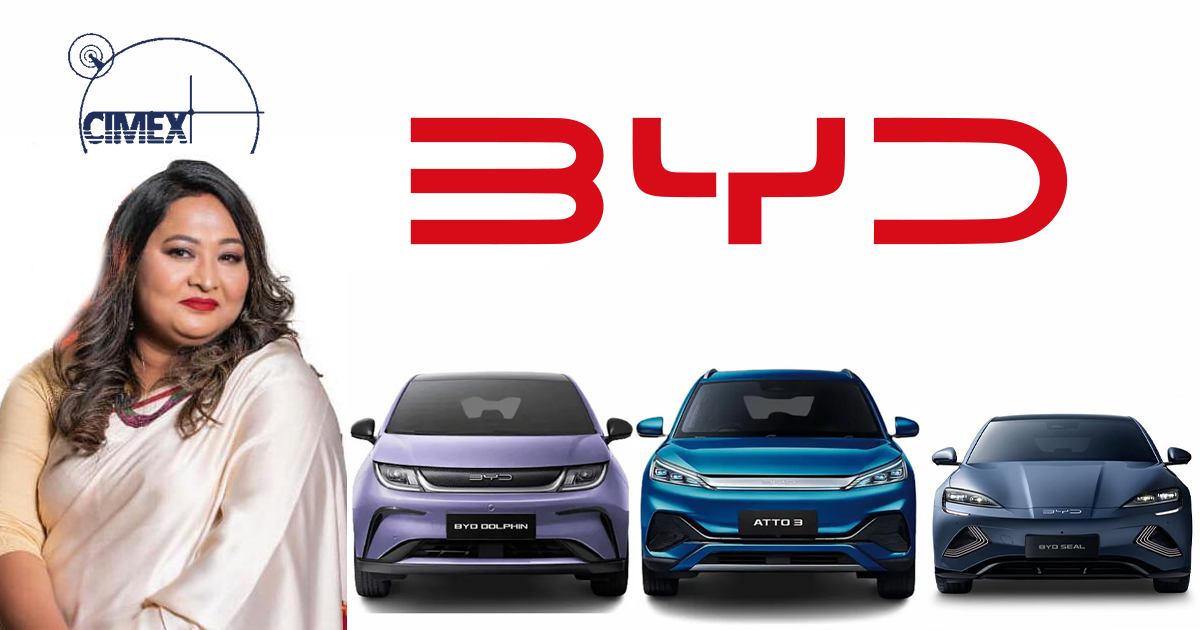

Kathmandu: BYD-branded cars appear to be steadily losing ground in Nepal, with the business of its official distributor, Cimex Inc, shrinking sharply. The company’s overall turnover has fallen by around 30 percent, signaling a significant weakening of BYD’s market position in just one year.
Cimex reported revenue of about Rs 16.5 billion in 2024, which dropped to roughly Rs 11.5 billion in 2025. This figure includes income from vehicle sales as well as after-sales services. The data clearly shows that BYD’s presence in the Nepali market has weakened substantially over the past year.
In absolute terms, Cimex recorded revenue of Rs 16.40 billion in 2024, compared to Rs 11.47 billion in 2025. For context, the company’s turnover stood at Rs 1.91 billion in 2023, Rs 441 million in 2022, and just Rs 69 million in 2021, highlighting how rapidly the business expanded—and then slowed—within a short period.
Founded in 2016, Cimex is the authorized distributor of BYD vehicles in Nepal. The company imports and sells both passenger and commercial vehicles, and currently operates 14 company-owned showrooms nationwide along with 64 charging stations.
The company is jointly owned by Yamuna Shrestha, who holds a 50.5 percent stake, and Anil Shrestha, who owns the remaining 49.5 percent. Cimex has obtained a credit rating for short-term borrowing of Rs 4.45 billion and focuses primarily on importing electric vehicles.
In 2025, the company’s business relied heavily on just two models. According to Cimex, nearly 90 percent of its revenue that year came solely from the Atto 3 and the Dolphin models. During the first quarter of the current fiscal year, the company introduced two new vehicles in an effort to revive sales.
Cimex has launched the Atto 2 and the lower-priced Atto 1, expressing hope that these new models will help improve business performance in Nepal’s highly competitive market.
Alongside declining sales, the company’s operating profit has also weakened. Its profit margin fell sharply from 11.1 percent last year to just 6.6 percent.
According to rating agency ICRA, Cimex is facing growing pressure on its working capital. The company’s working capital structure has changed significantly, with net working capital rising from just 5 percent of total revenue in 2024 to 31 percent in 2025. This shift is largely due to substantial advance payments made to manufacturers for importing new vehicle models, which has strained cash flows.
While the company has a relatively large limit for opening letters of credit, its actual cash credit utilization capacity is only about 42 percent of that limit. Analysts warn that if payment pressures intensify or if BYD reduces the credit support it currently provides, Cimex could face immediate cash flow challenges.
Another key risk is Cimex’s heavy dependence on just two vehicle models for most of its sales. Although the company has been operating since 2017, its major growth came only after 2023. Whether it can sustain that rapid rise in an increasingly competitive market remains uncertain.
Even minor policy changes by the Nepali government could have a significant impact on the company. For example, the loan-to-value ratio for electric vehicle financing has been reduced from 80 percent to 60 percent, meaning buyers now need to put up more cash upfront. Any unfavourable changes in customs duties or excise taxes could further hurt sales and profitability.
Compared to last year, both the company’s total revenue and operating profit have declined. ICRA notes that rising competition and market volatility are forcing Cimex to struggle to protect its margins.
Industry observers say BYD’s market in Nepal has reached a point of saturation, driven by several factors: electric vehicles becoming increasingly expensive and less accessible for middle-class buyers, intensifying competition in the EV segment, and over-reliance on a limited number of models.
As customers seek newer designs and features, a slowdown in sales of older models like the Atto 3 is hardly surprising. Over the past one to two years, many new Chinese brands have entered the Nepali market, offering vehicles that directly compete with BYD’s Atto 3 and Dolphin at similar or even lower prices, effectively fragmenting the customer base.

Comment Here