
Kathmandu: The courtyard and the walls of the house look the same. The morning sun rises just as it always has. But Santosh Bista is no longer the same man.
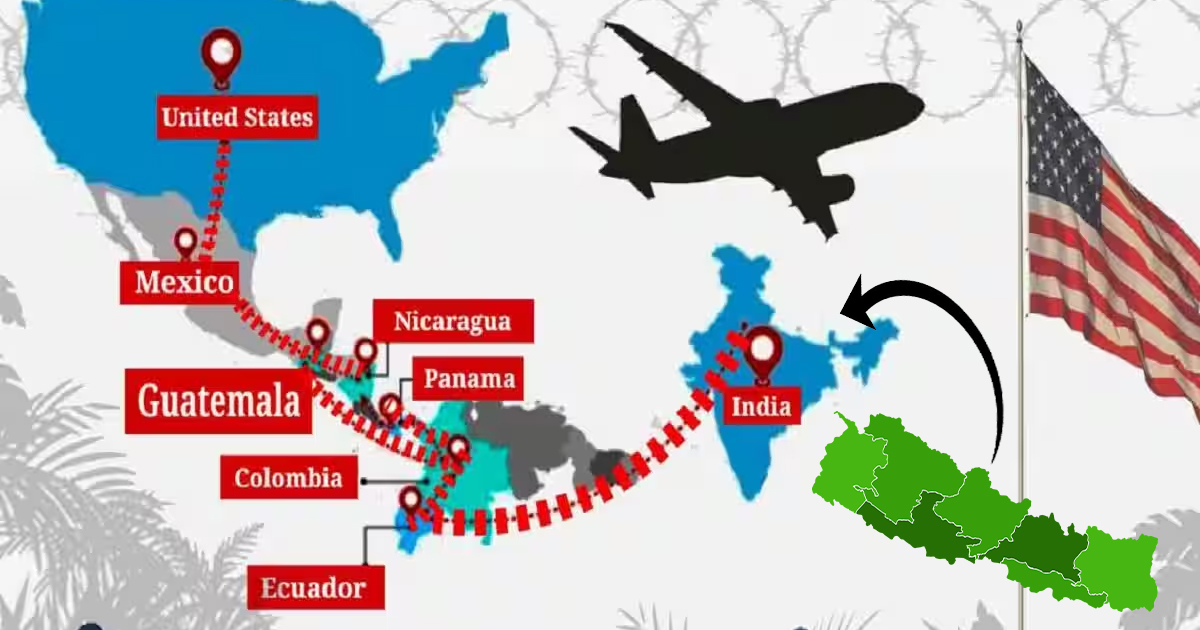
Eighteen months ago, the 36-year-old walked out of this very courtyard with a bag in his hand and a dream in his heart: to reach the United States, earn well, and build a comfortable life. Today, he has returned empty-handed and heavy-hearted. In those 18 months, he technically set foot on American soil—but never truly saw America. What he experienced instead were the jungles of Panama, threats from smugglers, months in US detention, and a debt of Rs 7.5 million.
“I reached America after 18 months,” Santosh says, visibly shaken. “But I spent six months in US custody and was sent back. America remained only a dream.”
Santosh is one of 75 Nepalis deported from the United States last Thursday on a chartered Omni Air flight. Seventy-two men and three women stepped back onto Nepali soil that day, all disappointed, all defeated. They came from different parts of the country, but their journeys were almost identical—illegal, dangerous, and financed by crushing debt.
Santosh had completed higher secondary education. Unable to see a future in Nepal, he became consumed by the idea of going abroad, especially to the United States. Friends who had made it there spoke of good money, new houses, and a glamorous life overseas. Their stories pulled him in. Determined to go at any cost, he contacted an agent on a relative’s advice. The agents were Nepalis themselves, operating from Dubai. The promise was simple and seductive: America for Rs 4.8 rupees.
There was an agreement but no paperwork. Only trust.
The plan was laid out clearly: Nepal to Dubai, Dubai to Brazil, then onward by land to the United States. After leaving Nepal, Santosh reached Dubai, where he was kept for a month and a half. From there, he flew to Brazil. It was there that reality struck. The agent demanded more money.
“What happens if I don’t pay?” Santosh asked.
“We’ll leave you here,” came the blunt reply.
Staying behind was not an option. He contacted his family, who scrambled to arrange money and sent it to accounts linked to the agents in Nepal. Loans were taken, often from people in the village, at interest rates of two to three percent per month, with land used as collateral.
The demands didn’t stop in Brazil. In Guatemala, and other transit points, new agents appeared, each asking for more money. Every country meant new threats, new payments, and no alternatives. By the time Santosh reached the US border, he had spent Rs 7.5 million.
The most terrifying part of the journey began in Colombia, through the Darién Gap in Panama. After buses, trucks, and boats, came days of walking through dense jungle. Groups of seven to ten people moved together—Nepalis, Africans, Asians, and Latin Americans, all chasing the same fragile hope.
In Guatemala, and other transit points, new agents appeared, each asking for more money. Every country meant new threats, new payments, and no alternatives. By the time Santosh reached the US border, he had spent Rs 7.5 million.
“People know what the Panama jungle means,” Santosh says quietly. “We walked from dawn. At night, we slept deep inside the forest—sometimes in tents, sometimes on bare ground.”
They walked hungry, surviving on biscuits and water from streams. Wild animals lurked. At every step, the fear of dying in the jungle was real. “We thought we might leave our lives there,” he recalls. “We had no idea what would happen next.”
After Panama came Costa Rica, Nicaragua, Honduras, Guatemala, and finally Mexico. At every stop, they were forced to wait—sometimes for a week, sometimes longer—crammed eight to ten people into a single room, sleeping on the floor, cut off from the outside world. It felt like house arrest. Agents controlled every movement. Without payment, the journey could not continue.
In Mexico, the U.S. felt close. Yet even then, Santosh could only wait until the agent decided the “right time” and place to cross. After more than a week, the signal finally came. Hope surged. Carrying his bag, Santosh walked toward the border, believing his suffering was about to end.
Instead, US border patrol officers detained the entire group almost immediately.
Panic set in. “It’s over,” he thought. They were loaded onto buses, their belongings taken away. Wearing only the clothes they had on, they were sent to detention camps. Santosh’s plan to earn quickly and transform his life collapsed instantly. He spent six months in US custody.
In the 18 months since leaving Nepal, he never once ate his fill. The dream of good food and comfort in America dissolved into hunger, both on the road and in detention. He found himself longing for simple meals from home—rice and fermented greens cooked by his mother. In the camps, food was limited to bread, beans, and occasional rice once a week.
He could see America through fences, but never touch it. The land of opportunity was right there, yet unreachable.
On the same flight back was 38-year-old Pradeep Bhandari from Tulsipur, Dang. He returned after 22 months away, including 11 months in US detention. His agent offered two options: an overland route for Rs 5.5 million or an air route through multiple countries for Rs 6.5 million. Pradeep chose the cheaper, more dangerous path.
His journey mirrored Santosh’s—Dubai, Brazil, threats, demands for money, months of confinement, and the brutal crossing through the Panama jungle. When he finally crossed into the US at 5 pm one evening, he felt victorious. The debt and suffering momentarily vanished from his mind.
But the joy lasted only hours. He was arrested and sent to a camp, later transferred between three facilities. The food was the same: bread, beans, and rice once a week.
Following stricter immigration enforcement under President Donald Trump, hundreds of undocumented migrants have been deported. Santosh and Pradeep are among them. Their return to Nepal was no less humiliating—handcuffed and shackled during the flight, with restraints removed only hours before landing in Kathmandu.
Santosh and Pradeep now drift in uncertainty. The agents have vanished. The debt remains. The visible shackles are gone, but the invisible chains of millions in loans still bind them.
Yet, despite everything, most deportees are unwilling to file complaints against agents. According to Nepal Police’s Human Trafficking Investigation Bureau, many migrants travel on the advice of relatives or acquaintances, and the agents themselves are often known to them. Loan sharks operate at village and district levels, offering money at high interest with land as collateral. Police say migrants from Dang, Rukum East and West, Salyan, and Banke are particularly affected.
Santosh and Pradeep now drift in uncertainty. The agents have vanished. The debt remains. The visible shackles are gone, but the invisible chains of millions in loans still bind them. What was meant to change their lives became a parasite that drained not just their property, but their peace of mind.
Over the past eight years, 669 Nepalis have been deported from the United States. Since January alone, 442 have been sent back. In 2025, US border enforcement intensified further, introducing fast-track deportations without court hearings. With increased cooperation with Panama and Mexico, major smuggling routes are now heavily monitored. As a result, the chance of receiving asylum has dropped to historic lows.

Comment Here