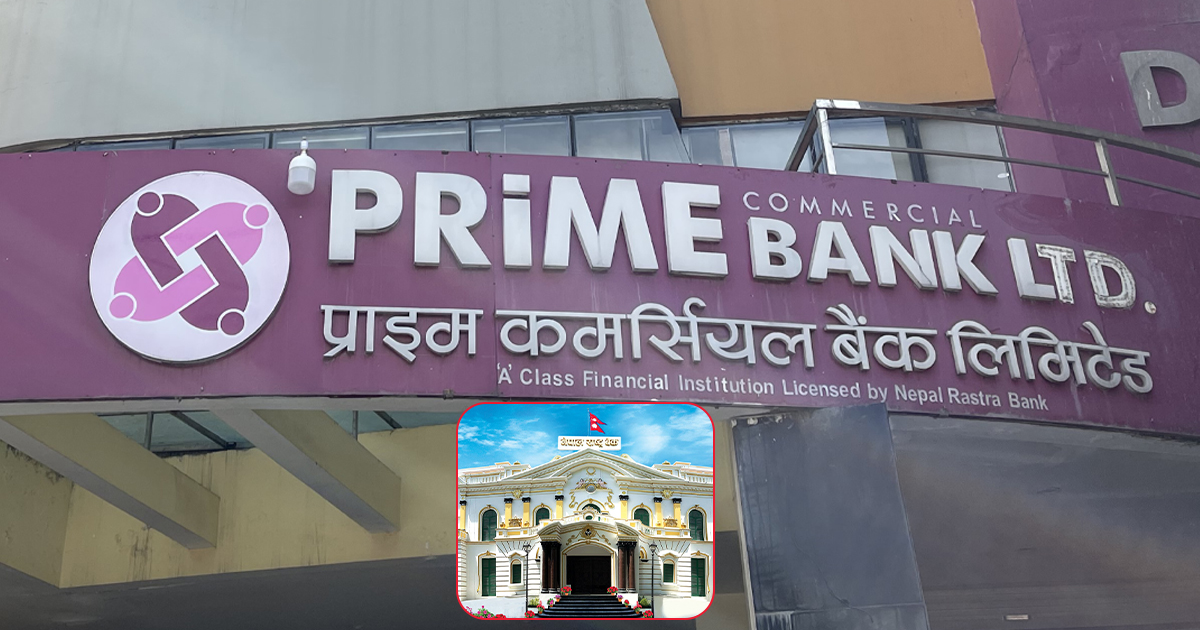

Kathmandu: Prime Commercial Bank’s profit has declined after Nepal Rastra Bank, the country’s central bank and banking regulator, required the lender to significantly increase its loan-loss provisions.
While approving the bank’s annual report for fiscal year 2024/25, the central bank directed Prime Bank to add Rs 1.30 billion in additional provisions, which led to a sharp reduction in reported earnings.
When the bank initially prepared its unaudited financial statements, it had set aside provisions totalling Rs 1.42 billion. However, following the final external audit and regulatory review, the total loan-loss provision was raised to Rs 2.72 billion in line with the central bank’s instructions.
In its unaudited disclosure for FY 2024/25, Prime Bank had reported a profit of Rs 4.02 billion. After the external audit and subsequent approval process at NRB, and following the increase in provisioning, the bank’s net profit was revised down to Rs 3.21 billion. The decline in profit is largely attributable to the higher level of loan-loss provisioning mandated by the regulator.
This reduction came despite an improvement in core income. During the final audit, the bank’s net interest income rose from Rs 8.82 billion to Rs 8.91 billion. However, the sharp rise in provisions more than offset this gain. As a result, the bank’s retained, distributable profit fell from Rs 2.78 billion in the unaudited statements to Rs 1.73 billion after audit and regulatory approval.
Following the final audit, the bank’s capital adequacy ratio stood at 11.33 percent. Non-performing loans, which were initially reported at 5.56 percent, increased to 5.81 percent after the final review.
As of mid-July, the bank’s credit-to-deposit ratio stood at 83.93 percent, while its interest spread ratio was recorded at 16.75 percent. Prime Bank had mobilized deposits of Rs 268 billion and extended loans totalling Rs 225 billion.
The bank’s balance sheet size reached Rs 316.49 billion after the final audit, compared to Rs 317.15 billion reported in the unaudited financial statements. According to the audited figures, Prime Bank’s earnings per share stand at Rs 16.50.
This is not the first time the bank’s profits have been adjusted downward following regulatory intervention. In fiscal year 2023/24, NRB had instructed Prime Commercial Bank to add Rs 390 million in loan-loss provisions. At that time, the bank had initially reported provisions of Rs 1.24 billion in its unaudited statements, which increased to Rs 1.64 billion after the external audit and regulatory approval.
Due to the higher provisioning in that year, the gap between profit figures before and after the audit amounted to nearly Rs 270 million. While the unaudited statements showed a profit of Rs 3.77 billion, the final audited profit was revised down to Rs 3.51 billion.
The recurring gap between profits reported before and after audits raises questions about the bank’s internal governance standards and its accountability to investors. It also suggests weaknesses in the bank’s implementation of regulatory requirements. The significant differences between pre-audit and post-audit profit figures indicate that investors in the stock market may have been making decisions without access to fully accurate information.
Beyond this, concerns have also been raised about the overall credibility and reliability of the financial statements published by the bank.

Comment Here