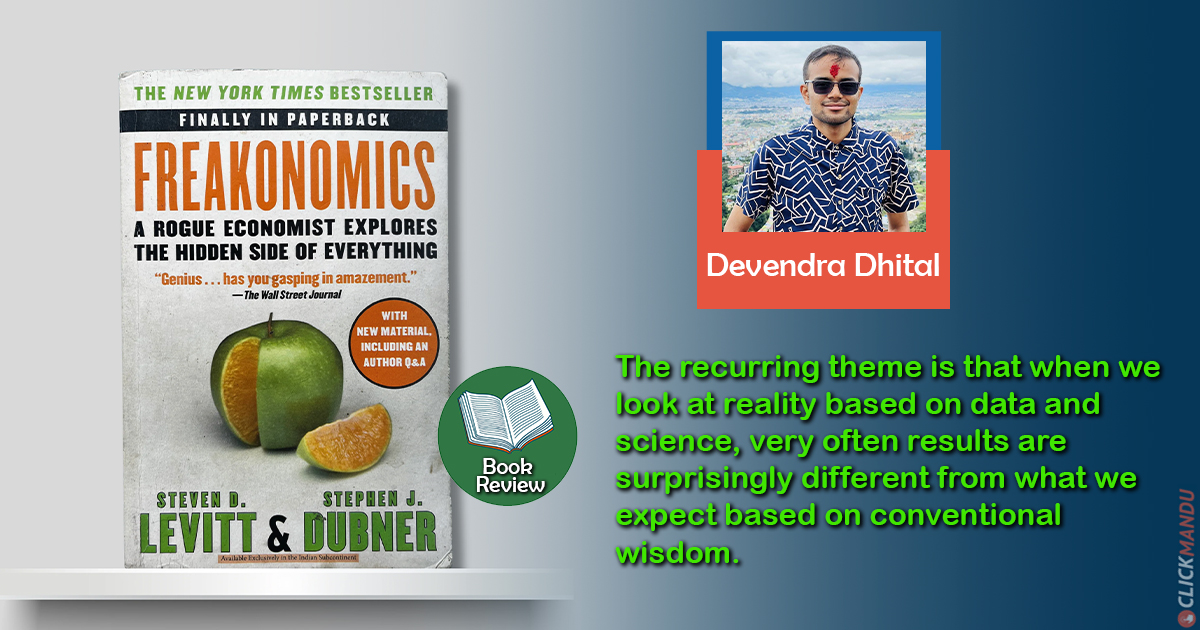

Freakonomics is co-authored by an economist and a journalist, and the success of this book has given rise to a subfield of the same name. The book explains some freakish findings that result when powerful statistical tools of economics are brought to bear on day-to-day interesting questions.
The book is based mainly on the scientific research of Steven Levitt, who is considered one of the sharpest young economists in the world. However, it also brings together other interesting results with relevance to the question being asked.
Cheating is a special focus area of the research that Levitt conducts, and thus is the concern of many questions that the book explores. It would be only a slight overstatement to say that most of us will cheat if the incentives are right. We would like to think that we and the people we know are morally upright persons who would never stoop low enough to cheat.
However, scientific researches regularly prove that belief to be an illusion. Teachers in Chicago public schools, Sumo wrestlers in Japan, where the game is viewed with religious-like devotion, and corporate employees on Wall Street have one thing in common. Many of them cheat when the incentives are right.
Besides the outcome that these studies have provided, the method by which the data has been generated and processed to come to the conclusion is also interesting and ingenious. In case of teacher cheating, Levitt fed a large volume of multiple-choice question results of hundreds of thousands of students from many classes of different Chicago Public Schools to a computer-based algorithm.
These algorithms were trained to detect the sequence of answers that were similar among many students in the class. Such a sequence would hint at the existence of cheating. Suspicion of cheating would be even stronger if the sequence happens to be among relatively harder questions, and students who have got the easier questions incorrect suddenly seem to get that particular sequence of hard questions right.
As suspected, it was indeed found that there was widespread cheating going on, with teachers themselves correcting the answers after paper submission by students in most cases. Why would teachers do so? Because teachers’ performance and the school’s funding were evaluated based on students’ results.
During the 1990s, crime rates in the US declined rapidly in a complete reversal of the trend from the last few decades, when they were increasing sharply. Many renowned experts who forecasted the upcoming doom were proven wrong. But what was the cause of it? Better policing strategy, an increase in the number of prisons and police, harsher sentencing of criminals, a rapidly growing economy, and thus lower unemployment? Each of these appears to be a likely reason.
However, Levitt argues that all of them combined still do not explain the reduction as much as another unexpected factor does. That factor is the legalization of abortion that took place about 20 years back through a landmark Supreme Court verdict known as Roe vs Wade. Due to that verdict, women got easy, safe, and relatively cheap access to abortion, which resulted in unwanted babies not being born. It is well established that unwanted babies are at high risk of engaging in criminal behaviour. Just when the kids that would have been born, if not for the verdict, would have been at their most crime-prone year, the crime rates started to plunge.
Though still not universally accepted, this theory was proposed with substantial supporting data. It is also presented as evidence of the fact that causes of complicated occurrences are often not obvious and may exist far removed in time and space. It goes against the normal train of thinking to imagine that crime reduction today happens not because of something happening today or some time back, but because of something that did not happen 20 years ago, i.e., unborn babies.
Another well-accepted fact challenged in the book concerns born babies and the kind of adults they turn into. Everybody knows that parenting matters a great deal in what kind of adult the child will be. From that knowledge stems the worry of parents about every minor detail of how they engage in their parenting, the blame of parents by society, some therapists, and even children themselves.
But what does the data say? It says that conventional wisdom and what everybody knows is plain wrong. The most impactful things that parents give to their children in the genes contained in the sex cells exchanged at the moment of conception. Other than that, within a healthy range, little else seems to matter. Whether the mother goes to work or stays home till the child grows bigger, whether parents take children to the museum or to the cinema, whether they read to the child on a daily basis or leave them watching TV, whether lots of playthings are brought home indoors or the child is taken outdoors on a regular basis, it does not seem to matter much. Of course, if a child is not fed enough, is beaten regularly, or the mother consumes alcohol while pregnant, it does matter.
However, as a thought experiment, in a decent locality, if all newborn healthy infants were swapped randomly among parents, it would make very little difference to the personality and capacity of adults compared to if no swap had taken place. It seems almost unbelievable, but this is exactly what much scientific research has shown, and this book gives reference to another widely renowned book, The Nurture Assumption, which brought the scientific finding to the public consciousness.
Other areas that book explores in detail are crack cocaine gangs in the US and how they were run in principle similar to big corporations, naming of children in different societies and if it matters to their life outcome (briefly, it does not), workings of real estate agents who might not have the best interest of their client at heart (they do not, just like everybody, they value their own interest primarily).
The recurring theme is that when we look at reality based on data and science, very often results are surprisingly different from what we expect based on conventional wisdom. It is a highly readable book with many powerful insights and is written in easy language.

Comment Here