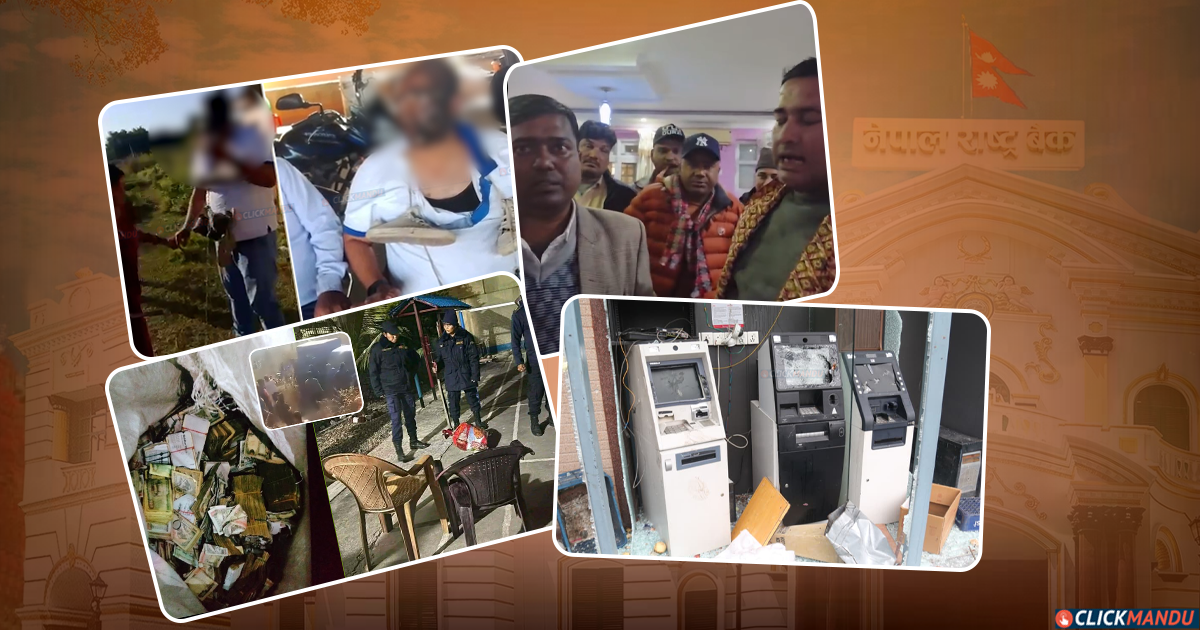

Kathmandu: Attacks on banks and banking staff in Nepal have risen sharply in recent months, as employees attempting to recover overdue loans increasingly face threats, beatings and intimidation. What was once limited to harassment and physical assaults has now escalated into outright criminal violence, highlighted by Tuesday night’s armed robbery of a Nepal SBI Bank branch in Sindhuli.
A group of robbers stormed the bank’s Hayutar branch in Bastipur, Ghyanglekh Rural Municipality, late on Tuesday, brutally beating and hacking security guard Rudra Karki with a machete before restraining him and looting more than 31 million rupees in cash from the counter. Four suspects have since been arrested and about 18 million rupees recovered, much of it found dumped in a nearby forest. The criminals had even hired a vehicle from Banepa to carry out the attack.
The robbery has deepened anxiety across Nepal’s banking sector, which has already been under pressure from organised campaigns encouraging borrowers not to repay their loans. Bankers say groups linked to businessman-activist Durga Prasai have been openly targeting banks, urging defaulters to resist repayments and warning institutions not to auction collateral.
What began as a movement claiming to protect small borrowers has now expanded to include large-scale defaulters owing billions of rupees. One of the most prominent figures is Dinesh Kumar Mahato, known locally in Janakpur as the “Ambani of Madhesh,” who has not repaid nearly three billion rupees borrowed from four different banks for more than three years. Despite being blacklisted by the Credit Information Bureau, Mahato continues to operate factories, petrol pumps and other businesses.
Bankers allege that Mahato routinely intimidates loan recovery teams by invoking his political connections, showing photographs with ministers, lawmakers, police chiefs and senior bureaucrats to block auctions of his mortgaged assets. According to senior bankers, he has relied more on influence and pressure than on business performance to avoid paying back what he owes.
Recently, a group led by Prasai’s close associate Devi Sangraula publicly rallied in support of Mahato, accusing Kumari Bank and Himalayan Bank of wrongdoing and issuing open threats. In videos obtained by the media, Sangraula is seen warning that the banks would not be spared “even underwater” unless they removed Mahato from the blacklist, restructured his loans and allowed his businesses to operate. She also called on local officials not to issue the mandatory recommendations required for auctioning collateral, effectively blocking the legal recovery process.
In one video, a ward chairperson is heard agreeing not to provide the documents needed for auction, while Sangraula urges similar resistance across all 753 local governments in the country. Mahato, in the same footage, claims that banks and engineers deliberately undervalued his property, while Sangraula goes further, telling him to physically stop valuation engineers if they attempt to assess his land.
Bankers say many of these cases go unreported or unprosecuted because of fear, political pressure and a lack of support from local authorities. Social media campaigns portraying banks as enemies of the people have further inflamed tensions
Despite these threats, Mahato has continued to send the videos directly to bank chief executives, creating intense psychological pressure and warning them against proceeding with asset seizures. Everest Bank has already tried to auction vehicles he purchased with loan money, but even police assistance was reportedly denied, forcing the bank to consider claiming insurance instead.
The Sindhuli robbery came against this backdrop of mounting hostility. Over the past six months alone, bankers say there have been at least ten attacks on financial institutions and their staff. In Janakpur, a ward chairperson physically assaulted employees of Janaki Finance who had come to request approval for auctioning collateral. During the Gen Z protests in September, multiple bank branches and ATMs were vandalised and burned, and cash and gold were stolen from a state-owned bank branch in Kathmandu.
In Rautahat, loan recovery staff were threatened with being set on fire, while in Saptari, employees of Jyoti Bikas Bank were beaten, smeared with black paint and humiliated with garlands of shoes in the presence of local representatives. Similar attacks and threats have been reported in Dhanusha, Dang and Itahari, including an incident in which a borrower entered a bank branch carrying a bottle of petrol and splashed it on himself and staff.
Bankers say many of these cases go unreported or unprosecuted because of fear, political pressure and a lack of support from local authorities. Social media campaigns portraying banks as enemies of the people have further inflamed tensions, making routine loan recovery increasingly dangerous.
As violence and intimidation spread, banking employees have warned they may shut down branches altogether if the government fails to guarantee their safety. After a recent attack in Dang, staff unions even threatened to hand over bank keys to the central bank and the finance ministry in protest.
This week, senior government officials, including representatives from the Prime Minister’s Office and the finance and home ministries, met with the Nepal Bankers’ Association to discuss the crisis. Bankers told the government that the activities of groups linked to Durga Prasai have made it nearly impossible to do their jobs. The government has promised to hold talks with those groups and, if necessary, to take legal action against those engaging in lawlessness.

Comment Here