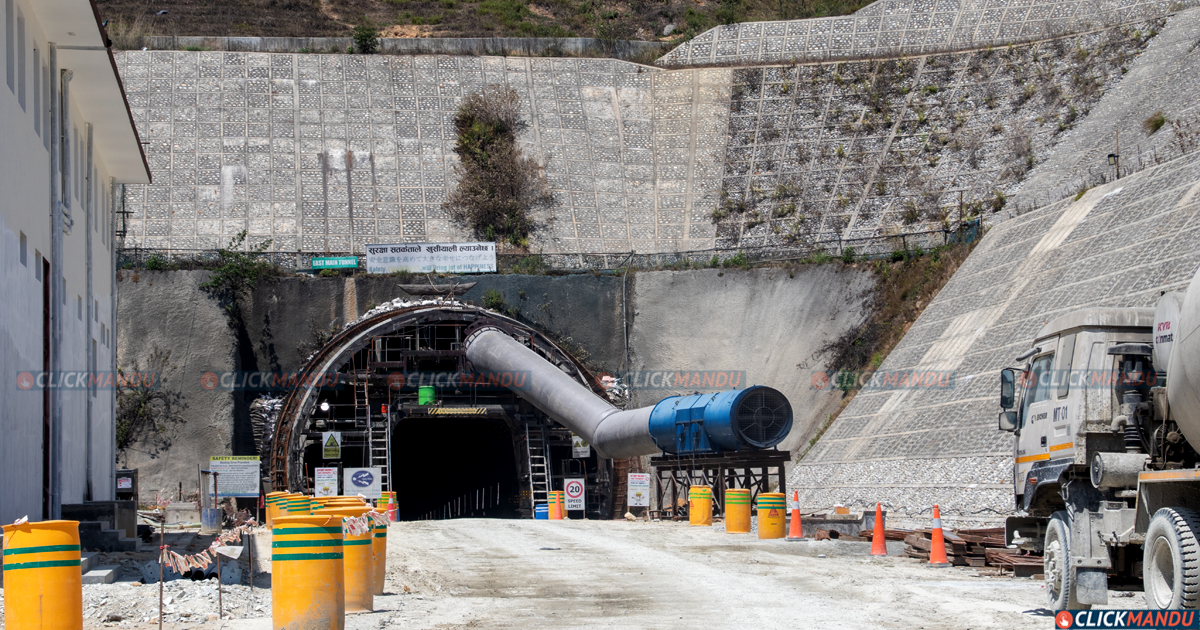

Kathmandu: Ten international companies, in partnership with Nepali firms, have entered the global tender competition to become the service provider required for the operation of the Nagdhunga Tunnel Road.
According to Sanjay Panthi, Senior Divisional Engineer of the Nagdhunga Tunnel Construction Project, by the final deadline for bid submission, 10 foreign companies, in collaboration with Nepali companies, had participated in the competition.
Among the bidders, six Chinese companies, three Indian companies, and one Turkish company have participated through joint ventures with Nepali companies. No company from Japan has participated in this competition.
The project had last extended the deadline by 14 days on December 31, setting January 14 as the date for opening the bids. Initially, the project had invited international tenders on November 2, with December 17 fixed as the bid-opening date for selecting the service provider.
As only a few companies participated within the initial deadline, the bid submission period was extended by 15 days, up to December 31, at the request of interested companies.
According to Panthi, based on the bids opened on January 14, the Indian competitors include Nepali company Swachhand Construction Service Pvt. Ltd. in partnership with Segmental Infrastructure Development Limited; Nepali company Babari Construction Pvt. Ltd. in partnership with Tunneltech Solutions Pvt. Ltd.; and Nepali company Pashupati Shivaji Construction Pvt. Ltd. in partnership with Ilsamex Maintenance Services Limited.
Similarly, from the Chinese side, Nepali company Kasthamandap Construction Pvt. Ltd. has partnered with Gansu Hengtong Road and Bridge Engineering Co. Ltd.; Bright Bull Nirman Sewa has partnered with Shaanxi Road and Bridge Group Corporation Ltd.; and Dafey Construction Company Pvt. Ltd. has partnered with Jiangxi Tianfeng Construction Group Co. Ltd. to compete.
Likewise, Nepali company Samanantar Nirman Sewa Pvt. Ltd. has partnered with China First Highway Engineering Company Limited; ART Construction has partnered with Chongqing Yuxin Road and Bridge Development Company Limited; and Bhedansi Infrastructure Limited has partnered with Ranken Railway Construction Group Company to participate in the competition.
Panthi also informed that Nepali company Kumar Shrestha Construction Service Pvt. Ltd. and Bhageshwari Construction Pvt. Ltd. have jointly competed in partnership with Turkey’s Altinok Consulting Engineering Company Limited.
After China First Highway Engineering Company and Poly Changda Engineering Corporation expressed interest in applying for the service provider role, Japanese officials continued to create formal and informal pressure to prevent state-owned Chinese companies from obtaining the responsibility.
Senior Japanese officials had made maximum efforts and exerted pressure to ensure that a Chinese company would not be awarded the responsibility of operating and maintaining the tunnel.
For this purpose, Japan’s Ambassador to Nepal, Toru Maeda, in recent times exerted strong pressure on senior officials of the Ministry of Finance and the Ministry of Physical Infrastructure and Transport, urging that Chinese companies should not be given the service provider role.
After China First Highway Engineering Company and Poly Changda Engineering Corporation expressed interest in applying for the service provider role, Japanese officials continued to create formal and informal pressure to prevent state-owned Chinese companies from obtaining the responsibility.
In addition, Japanese officials conveyed the view that companies blacklisted by the World Bank and the Asian Development Bank should not be awarded the service provider role, according to a ministry official. Despite Japanese pressure, the project has allowed interested Chinese companies to participate in the competition in accordance with the criteria set by the Public Procurement Act and Regulations.
According to Panthi, over the next 22 days, the letters of intent submitted by all 10 companies will be evaluated. This will be followed by a 15-day review of the technical and financial details of the letters of intent. After the review, a seven-day notice related to the letters of intent will be published, and finally, a 15-day notice for contract signing will be issued.
“All these processes may take at least 60 days. After that, once some remaining infrastructure works are finalized, we are preparing to formally bring the tunnel into operation from April,” Panthi said.
According to the project, as some structural works remain incomplete during construction, the deadline has been extended until April 2026. Repeated new landslides near the Sisnekhola portal on the Dhading side caused damage to the entrance, and as the construction of the approach road along with the toll gate plaza at that location is still pending, the deadline has been extended by six months.
Panthi said that during the extended period, anchors required for landslide control are not available in Nepal, and the process of importing them from India has begun. Once these materials arrive, landslide control work will start, and construction of the western-side toll gate will also be completed. He added that construction of the eastern-side toll gate has already been completed and testing has been carried out.
Under this tunnel project, two tunnels have been constructed. These include a 2,557-metre-long auxiliary emergency evacuation tunnel for rescue purposes and a two-lane main tunnel measuring 2,688 metres in length and 3.5 metres in width for vehicular traffic.
Seven cross passages (entry gates) have been constructed in the emergency tunnel built parallel to the main tunnel. This parallel tunnel was built to rescue passengers in case of accidents, vehicle breakdowns, or other emergencies occurring in the main tunnel.
The emergency tunnel, built parallel on the left side at a distance of 20 metres from the main tunnel, has a width of 4.5 metres and a height of 5 metres. Cross passages have been constructed at intervals of 300 to 350 meters to connect it to the main tunnel. The government has also already fixed the toll (user fee) for vehicles using the tunnel.
The Nagdhunga Tunnel Road is being constructed at a cost of Rs 22 billion. Of this, the Japanese government has provided Rs 16 billion as a concessional loan for 40 years at an interest rate of 0.01 percent. The remaining Rs 6 billion will be borne by the Government of Nepal, as stated in the agreement.
The Department of Roads signed a contract agreement with Hazama-Ando Corporation on 23 September 2019. According to the contract, construction was to be completed within 42 months, by 25 April 2023.
The annual operating cost for regular operation of the Nagdhunga–Sisnekhola Tunnel Road will be around Rs 4 billion.
According to Panthi, the government had previously extended the deadline twice. The first extension was for one year, and the second for 18 months, setting 25 October 2025 as the revised completion deadline.
Due to the COVID period, repeated obstructions by local residents, the closure of crusher industries last year, geographical complexities, and other factors, the first one-year extension was granted on 20 July 2023, and the second 18-month extension on 25 April 2024.
Although the Department of Roads had planned to complete construction within the final extended period, select the operation and management company, and bring the tunnel into operation by Poush, additional variations have led the department to now prepare for operation starting from April.
According to Panthi, the annual operating cost for regular operation of the Nagdhunga–Sisnekhola Tunnel Road will be around Rs 4 billion.
Most of this operating cost will be spent on skilled manpower management and electricity. He said electricity costs will also be high, as the tunnel will regularly consume at least 2 megawatts of power.
“At present, we do not have skilled Nepali manpower to work in tunnel operations. Therefore, we are prioritizing foreign manpower and will develop Nepali manpower with their support,” Panthi said. “Because foreign manpower has to be employed, manpower costs will be somewhat higher in the initial years. As Nepali manpower is developed, these costs will gradually decrease.”

Comment Here