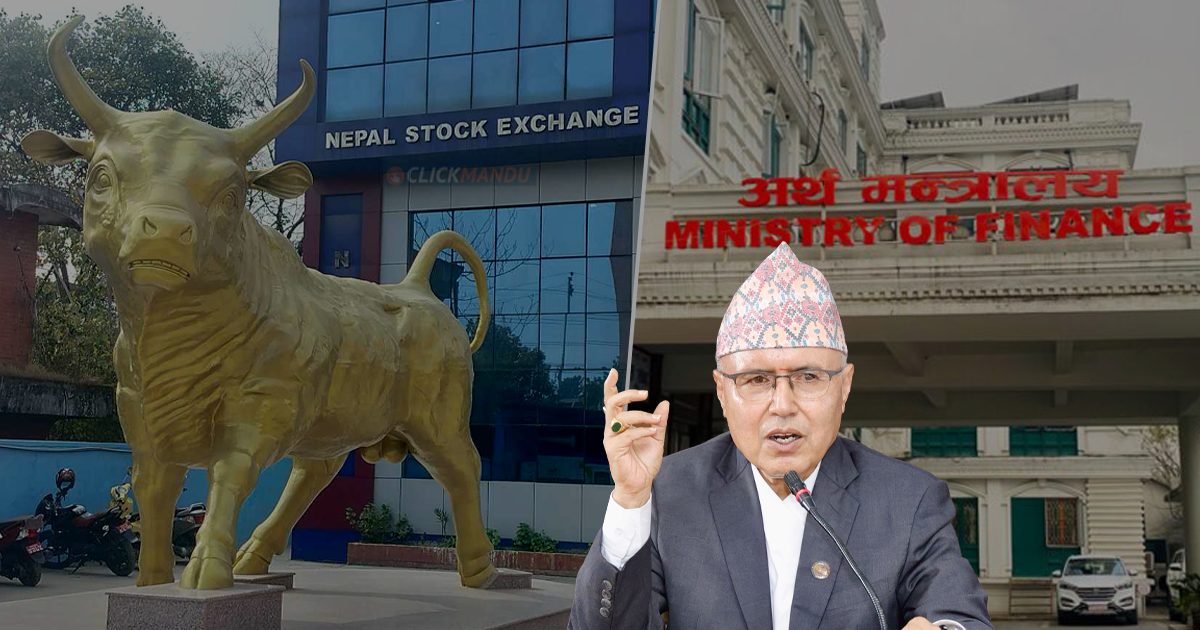

Kathmandu: Nepal’s long-running effort to restructure the Nepal Stock Exchange (NEPSE) has hit yet another dead end, with the latest, and eighth, official study report now all but certain to be shelved, repeating a pattern that has dragged on for nearly two decades.
The most recent push came under Minister of Finance Dr Rameshwar Khanal, who had sought to finally resolve the politically sensitive issue of NEPSE’s ownership structure, particularly the government’s dominant 58.66 percent stake.
A five-member expert committee led by former Accounting Board chair Prakash Jung Thapa submitted its recommendations after 50 days of work, but officials say the report failed to deliver the clear roadmap the minister had demanded on how, to whom, and at what price the state would divest its shares, and what the post-sale structure would look like.
Instead, the committee offered broad and cautious suggestions that effectively preserved continued government ownership, frustrating a reform drive aimed at reducing state control and professionalizing the exchange.
Sources say the minister was dissatisfied with what he viewed as a vague, non-committal document, making implementation unlikely.
Political timing has further weakened prospects: the government is now focused on upcoming parliamentary elections and operating in a caretaker mode, a period when major policy decisions are typically avoided.
The report itself proposed raising NEPSE’s paid-up capital to around Rs 3 billion, bringing in a world-class strategic partner from among leading global exchanges with a 15–25 percent stake and a long lock-in period, gradually divesting government shares under either partial or full exit models, and overhauling the board to reduce political influence and strengthen independent, professional oversight.
It also suggested that non-government shareholders could sell first to ease the entry of a strategic investor and called for international-standard asset valuation.
While the committee argued such reforms could modernize technology, governance, and investor confidence in Nepal’s capital market, the absence of a firm divestment blueprint which is the minister’s central demand appears to have doomed the report.
NEPSE’s ownership remains concentrated among state entities, including the central bank, public pension funds, and state-controlled banks, alongside a few private banks.
With multiple earlier studies since the mid-2000s having met a similar fate, this latest report now seems destined for the same bureaucratic limbo, underscoring how structural reform of Nepal’s only stock exchange continues to be derailed by politics, institutional caution, and a lack of decisive policy follow-through.

Comment Here