
Kathmandu: A long-awaited report on restructuring the Nepal Stock Exchange (NEPSE) has run into immediate political headwinds after Finance Minister Rameshwar Khanal reportedly expressed dissatisfaction, saying the document failed to provide clear answers on the government’s exit from the bourse.
The recommendation committee, led by former Accounting Standards Board chair Prakash Jung Thapa, submitted its 50-day report to the minister in late January. But instead of a green light, the proposal appears headed for the shelf, becoming the eighth reform report on NEPSE unlikely to see implementation.
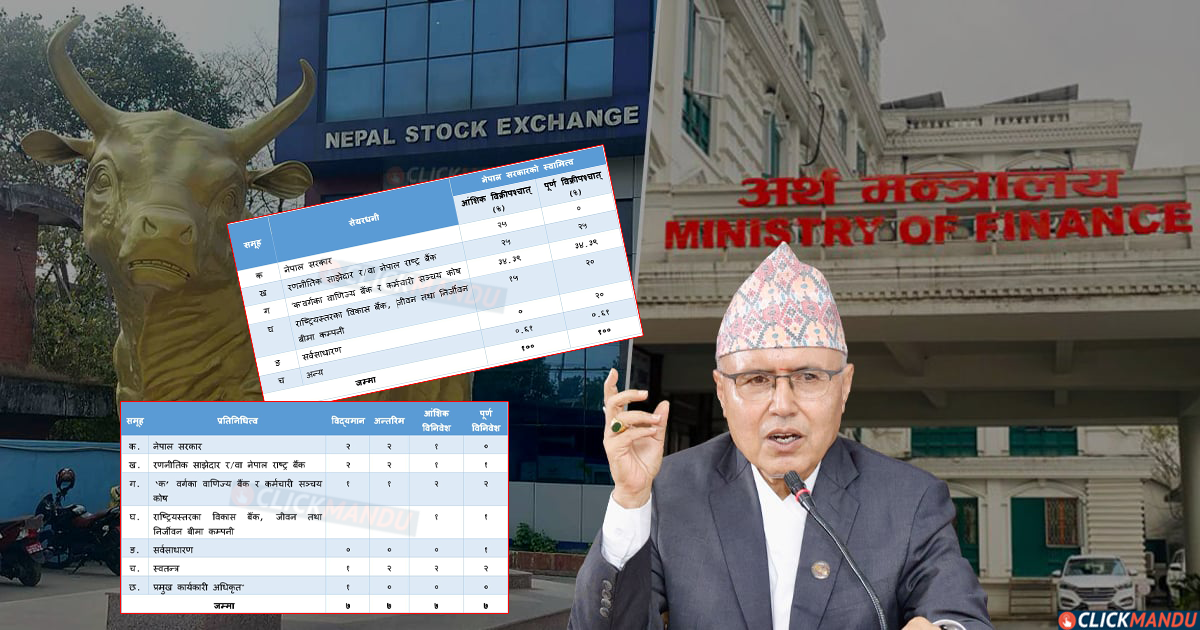
According to officials familiar with the discussion, the finance minister had specifically asked the panel to spell out how the government would divest its 58.66 percent stake in NEPSE, through what process, to whom the shares would be sold, at what price, and what the post-divestment ownership structure would look like.
However, the report stopped short of firm recommendations on those points. Instead, it suggested that the government should not fully withdraw and that at least a quarter stake should remain in public hands, echoing the cautious tone of previous studies. That perceived ambiguity triggered frustration at the top, as the minister had sought a more decisive roadmap.
The committee did recommend increasing NEPSE’s paid-up capital to meet regulatory requirements and support investments in technology, human resources and infrastructure. It proposed issuing bonus shares to reach the mandated capital threshold and, if further expansion funds are needed, raising money through rights or additional share issuance. But it stressed that clarity on bringing in a strategic partner should come before any capital restructuring.
A key plank of the report is the entry of an international strategic partner to help modernize the exchange. The committee argued that NEPSE lacks the technical depth, management expertise and advanced systems expected of a modern exchange, and that a foreign partner could fill these gaps. It proposed offering such a partner 15 to 25 percent ownership, with a lock-in period of at least 10 years.
The partner should be among the world’s top exchanges by trading volume, have at least two decades of operating experience, be a member of the World Federation of Exchanges, and demonstrate the ability to deliver advanced trading technology and products. The strategic investor would also be guaranteed representation on NEPSE’s board.
On government divestment, the report acknowledged weaknesses typically associated with state-dominated institutions and said Nepal’s broader policy trend favors gradual disinvestment. It suggested that government shares could eventually be sold to a mix of the strategic partner, regulated financial institutions such as commercial banks and insurance companies, and the general public, based on an internationally benchmarked asset valuation.
However, it warned that a full and immediate government exit could undermine investor confidence, weaken self-regulation and reduce the state’s ability to support the market in times of stress. As a result, it floated both partial and full divestment models, without firmly endorsing one.
Governance reform is another focus. The committee recommended restructuring NEPSE’s board to reduce the dominance of government representatives and increase the number of independent expert directors. It called for clearer criteria for director selection, performance-based remuneration and the formation of specialized board committees to strengthen institutional governance.
Technology gaps were highlighted as a major constraint. The report said NEPSE lags global exchanges in trading systems, surveillance tools and cybersecurity. It urged the adoption of an internationally standard trading platform with automated market surveillance, a comprehensive system audit, stronger in-house IT capabilities, tighter cyber risk management and real-time integration between trading and settlement systems. Establishing a standards-compliant data centre and disaster recovery site was described as urgent.
Despite the breadth of these recommendations, the absence of a concrete, time-bound blueprint for reducing state ownership appears to have overshadowed the rest. With the finance minister unconvinced and no new committee planned, the reform effort risks stalling once again, prolonging uncertainty over the future structure and modernization of Nepal’s sole stock exchange.

Comment Here