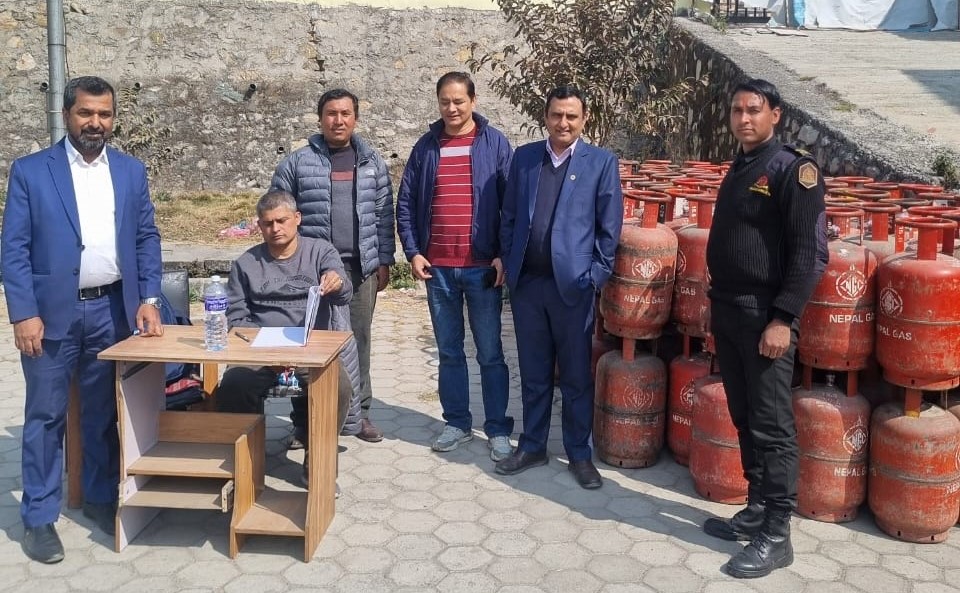

Kathmandu: In response to a recent shortage of cooking gas in the market, the Nepal Oil Corporation (NOC) has begun selling LPG cylinders from three major brands directly from its Teku depot in the capital.
The move, carried out in coordination with gas producers, will remain in place until normal supply conditions are restored. Cylinders from Nepal Gas, Sugam Gas, and Everest Gas are now being distributed from the Teku premises to stabilize the market.
According to Binita Mani Upadhyay, head of NOC’s LPG and Aviation Department, supply disruptions involving the three leading brands were triggered by technical issues and worsened by panic buying. Rumours of scarcity led many consumers to hoard more cylinders than necessary, creating artificial shortages in Kathmandu Valley. To restore normal circulation in the market, NOC arranged for direct sales from its Teku office, allowing consumers to purchase cylinders based on actual need.
The intervention follows discussions held between NOC, gas dealers, and industry representatives aimed at improving supply management. For the period from mid-February to mid-March, NOC has requested a quota of 52,000 metric tons of LPG from Indian Oil Corporation (IOC), taking into account regular household, hotel, restaurant, and industrial demand, as well as a seasonal rise in consumption ahead of upcoming elections. IOC has approved a monthly allocation of 49,500 metric tons for Nepal.
Despite imports exceeding normal levels in recent months, consumers in Kathmandu experienced shortages of certain brands between the second and third weeks of the Nepali month of Magh. NOC spokesperson Manoj Thakur said that in January alone, Nepal imported about 2,500 metric tons more LPG than average monthly consumption. While the country typically consumes around 45,000 metric tons per month, imports reached 47,264 metric tons in November 2025, 48,531 metric tons in December, and 47,304 metric tons in January 2026.
NOC stated that it has deliberately increased supply beyond normal demand to counter artificial scarcity, and the market situation is gradually improving. The corporation also cited maintenance work at India’s Barauni refinery about six weeks ago, which temporarily disrupted loading schedules and affected supply to the Kathmandu market. Additionally, winter demand, election-related consumption spikes, and reduced transportation capacity contributed to the shortage. Nearly 25 percent of Indian-registered LPG bullet tankers, around 1,750 vehicles, had curtailed transport operations, further straining distribution.
Authorities also indicated that some industry players may have attempted to create artificial shortages to pressure for higher transportation rates ahead of the elections. LPG imports into Nepal are sourced from four Indian refineries, Barauni, Haldia, Mathura, and Paradip, under monthly quotas set by IOC. Based on these allocations, NOC issues Product Delivery Orders (PDOs) to gas companies, which then coordinate with Indian transporters to bring supplies into Nepal.

Comment Here