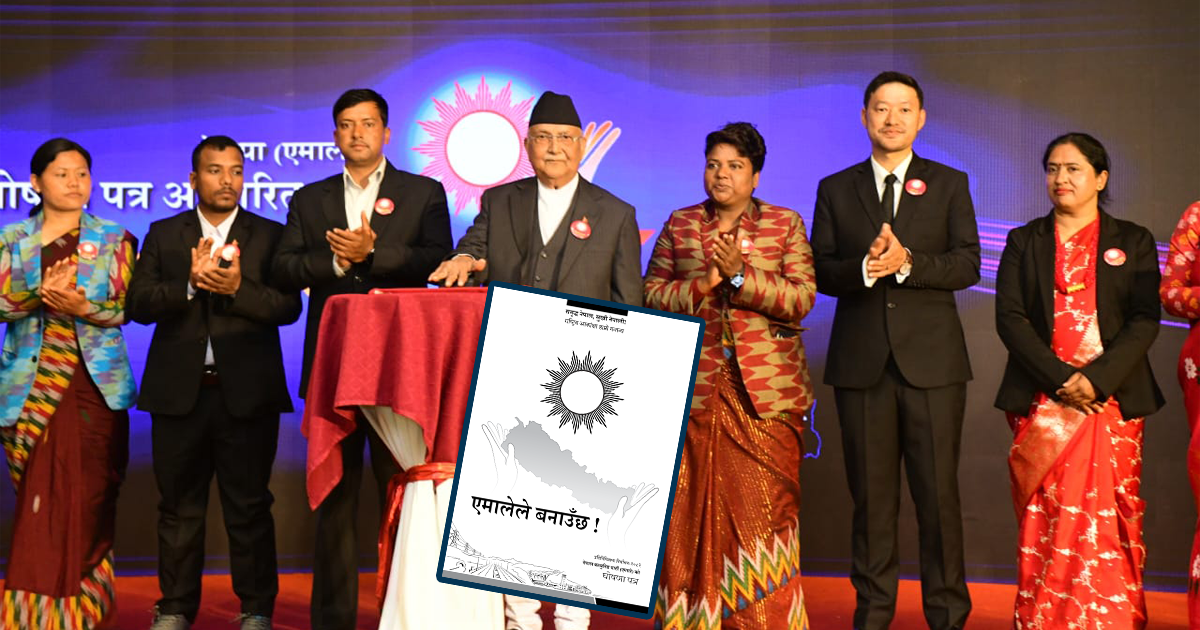

Kathmandu: Communist Party of Nepal (Unified Marxist–Leninist), has released an expansive and highly ambitious election manifesto for the February 21 parliamentary polls, promising sweeping welfare programmes alongside bold economic targets.
The 80-page document, unveiled on Thursday to coincide with Nepal’s 75th National Democracy Day, combines large-scale cash transfers and subsidies with plans to dramatically expand the size of the national economy over the next decade.
The party has pledged to double the country’s economic output to 100 trillion rupees within five years and to 200 trillion rupees within ten. It is targeting annual economic growth of 7 to 9 percent and aims to raise per capita income to US$ 3,000 within five years, more than double the current level of roughly US$ 1,456, according to the government’s latest Economic Survey.
By comparison, Nepal’s economy is estimated to have grown by just 3.87 percent last fiscal year, and growth above 7 percent has been rare outside the post-earthquake reconstruction period. Achieving such acceleration would require a dramatic expansion of productive industries and investment capacity.
At present, Nepal’s total gross domestic product stands at around 61 trillion rupees. Nearly doubling that within five years would demand significant improvements in capital expenditure efficiency and private-sector investment.
The manifesto also promises to generate domestic employment to curb youth migration and reduce reliance on remittances, which currently account for roughly 25 to 30 percent of GDP. However, with hundreds of thousands of young Nepalis leaving annually for overseas work and imports making up about 90 percent of total trade, the practical path to reversing these trends remains unclear.
Party chairman KP Sharma Oli defended the manifesto at its launch, arguing that ambitious goals are not unrealistic and that aspiring to prosperity should not be dismissed as fantasy.
A major feature of the manifesto is its emphasis on direct benefits and subsidies. The party says its first Cabinet meeting would immediately approve 11 headline measures, including a 20,000-rupee childbirth grant for every newborn, free monthly 10GB data packages for young people aged 18 to 28, and an increase in the minimum wage to 25,000 rupees.
It also proposes expanding social security allowances, raising annual stipends for female community health volunteers to 20,000 rupees, writing off up to 25,000 rupees in bank loans for families officially classified as poor, and offering interest-free education loans of up to 2 million rupees for technical studies.
Additional pledges include providing young entrepreneurs with dollar cards worth up to US$ 10,000 and offering free life insurance coverage of 500,000 rupees for pregnant women. While such commitments could place further strain on public finances in a country already struggling to cover recurrent expenditures from revenue, the UML argues that these measures are essential investments in raising living standards.
On infrastructure, the party has reiterated long-standing mega-project ambitions: completing the East-West Electric Railway within ten years, finishing the Pushpalal, Madan Bhandari and Hulaki highways within five years, and delivering the Kathmandu-Tarai Fast Track on schedule. It also vows to implement its “Digital Nepal” vision by ensuring high-speed internet access in all 77 districts and fully digitizing government services.
While the manifesto projects a vision of transforming Nepal into an upper-middle-income country, economists note that the combination of sluggish growth, structural weaknesses in production, and heavy fiscal commitments makes many of the targets appear highly ambitious.

Comment Here