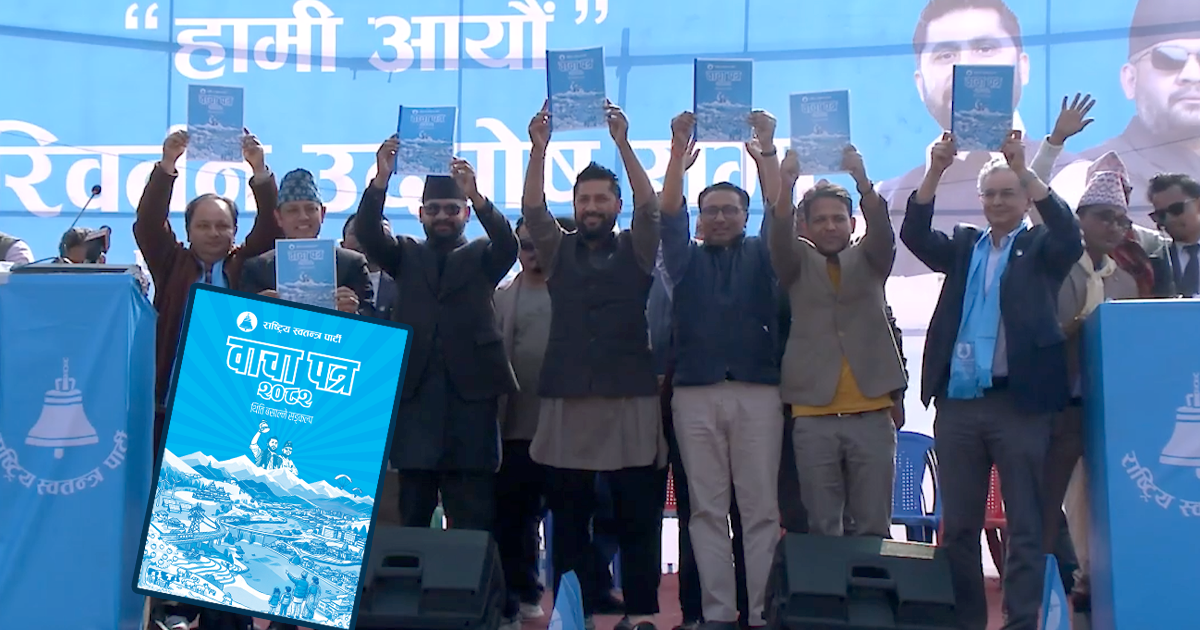

Kathmandu: The Rastriya Swatantra Party (RSP) has unveiled its election manifesto ahead of the February 21 parliamentary elections, presenting an ambitious roadmap focused on transforming Nepal’s traditional economy into one powered by technology, production and job creation.
The document, made public at a mass gathering in Surkhet, Karnali Province by senior party leaders, outlines sweeping reforms centered on governance, investment climate improvements and structural economic change.
Framing good governance and policy reform as prerequisites for growth, the party has set a headline goal of turning Nepal into a middle-income country. It aims to establish conditions for sustaining an average annual economic growth rate of 7 percent within five years, pushing per capita income beyond US$ 3,000 within five to seven years and expanding the size of the economy to nearly US$ 100 billion.
A central pillar of the plan is the development of the information technology sector as Nepal’s second major economic engine after remittances. The RSP wants to increase software and IT service exports from the current US$ 1.5 billion to US$ 30 billion within a decade. To achieve this, it proposes creating an autonomous IT Promotion Board, building a global technology hub, and establishing advanced digital parks across provinces to generate 500,000 direct jobs.
In the energy sector, the party has pledged to raise Nepal’s installed hydropower capacity to 30,000 megawatts over the next decade. It plans to restructure electricity tariffs to encourage greater domestic consumption and target annual per capita electricity use of 1,500 kilowatt-hours by 2035. Long-term energy trade agreements with India and Bangladesh also form part of the strategy.
The manifesto also promises sweeping reforms to the tax system and investment framework. The party says it will repeal or amend around two dozen laws that increase production costs and complicate business operations. It proposes revising income tax thresholds based on family burden and allowing deductions for education, healthcare and childcare expenses, aiming to create a more equitable and investment-friendly environment.
On governance and fiscal discipline, the RSP plans to cap the number of federal ministries at 18 and introduce the concept of appointing subject-matter experts as ministers. It has also pledged to investigate the assets of individuals who have held key public offices since 1990, confiscate illicit wealth and nationalize unlawfully acquired property as part of an aggressive anti-corruption drive.
In the financial sector, the party proposes establishing a second-tier regulator under the direct supervision of the Nepal Rastra Bank to oversee cooperatives and microfinance institutions. Cooperatives with annual transactions exceeding 500 million rupees would be brought under stricter central bank-style regulation. The manifesto also defines predatory lending practices, locally known as “metre interest,” as an economic crime and vows to dismantle such networks within five years through fast-track legal mechanisms.
Tourism is another priority area. The party aims to double both tourist arrivals and per capita tourist spending within five years, while extending average stays. It plans to leverage digital platforms for promotion and develop hill stations in the Himalayan region to diversify tourism offerings.
To attract foreign investment and tap into the Nepali diaspora, the RSP proposes simplifying profit repatriation rules, enabling concessional loans backed by intellectual property, and creating a “National Knowledge Bank.” It also envisions easier access to dollar accounts and legal guarantees for repatriating returns for non-resident Nepalis.
Overall, the RSP manifesto distinguishes itself by emphasizing production-oriented growth, technological modernization and institutional reform over direct cash distribution, presenting a vision of a more competitive and policy-stable economy.

Comment Here