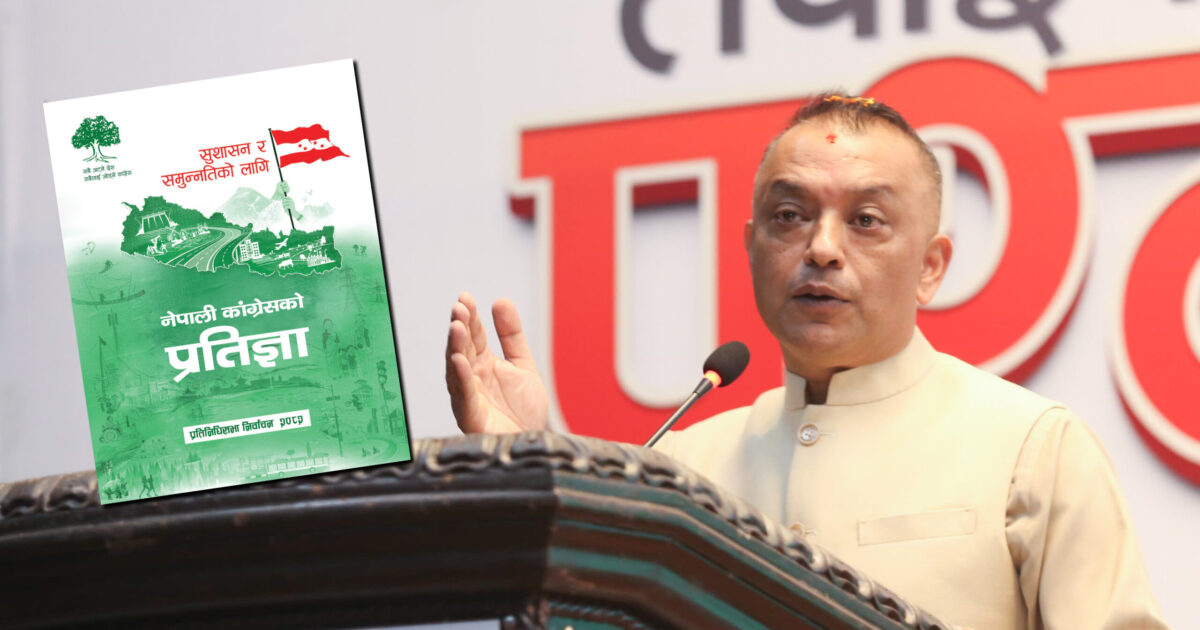

Kathmandu: Nepali Congress has pledged to almost double the size of the country’s economy within the next five years, setting a target to raise gross domestic product to 115 trillion rupees.
In its election manifesto for the March 5 parliamentary polls, the party outlined what it describes as an ambitious blueprint to transform the national economy under the guiding principle of building a “liberal, production-driven and equitable economy.” It has branded the coming five years as a “half-decade of economic revival.”
According to the manifesto, the party aims to lift per capita income to US$ 2,500 while nearly doubling the current size of the economy. To achieve this, it plans to mobilize investments totalling 137.5 trillion rupees over five years, with 80 percent expected to come from the private sector. The state, it says, will act primarily as a facilitator rather than a dominant market player. Inflation would be kept under five percent during this period.
Addressing rising unemployment and large-scale youth migration, the Nepali Congress has promised to create 1.5 million new jobs within five years. With the slogan “Work for every hand, dignity in every job,” the party says it will provide meaningful domestic employment for the 300,000 to 500,000 people entering the labor market annually.
The party has placed particular emphasis on the information technology sector, projecting 4 trillion rupees in IT service exports over five years and the creation of more than 100,000 high-quality jobs in that field alone. It also plans to expand agro-based industries through a “farm to factory” drive and provide collateral-free project-based loans ranging from 500,000 to 5 million rupees, along with seed capital, to innovative youth and women entrepreneurs.
Recognizing the private sector as the engine of growth, the manifesto promises a more investment-friendly climate, including legal stability guarantees for investors. It also proposes forming a high-level commission to investigate the assets of senior public officials and pledges to curb policy-level corruption.
On infrastructure and public services, the party vows to digitize and simplify government services, making them paperless and cashless. It aims to increase electricity generation capacity to 14,000 megawatts within five years and raise per capita electricity consumption to 750 units, positioning hydropower as the backbone of an industrial push to reduce reliance on imported petroleum.
To ease the burden on middle- and lower-income households, the party proposes exempting individuals earning up to 1 million rupees annually from income tax. It also targets attracting 3 million tourists per year. Overall, the manifesto seeks to appeal strongly to young voters and the private sector, presenting a vision of a production-led economy that the party says it will pursue if it forms the next government.

Comment Here