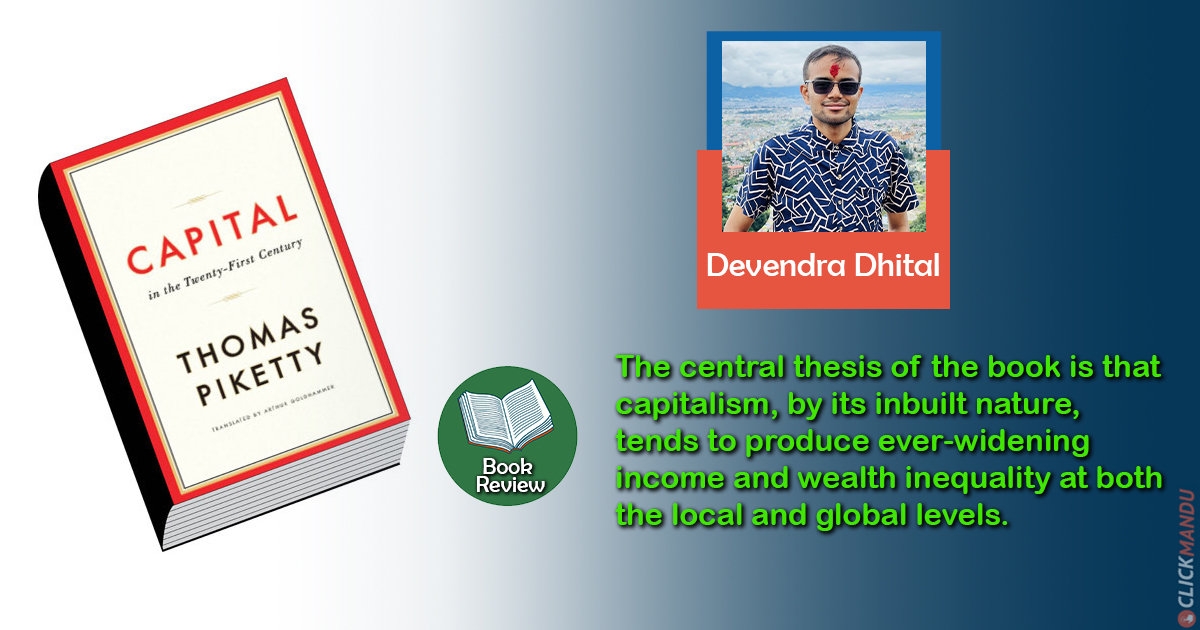

A book featured on dozens of bestseller lists and praised by renowned figures worldwide, including famed economists, while being hailed as “possibly the most important economics book of the decade” by a Nobel laureate, naturally carries an aura of authority.
As a reader, I felt challenged to live up to the hype of “Capital in the Twenty-First Century” and prove myself worthy of gleaning its wisdom by diving into its mre than 700 pages. I braced myself for a dense, technically challenging read, which is what one typically assumes is required to learn something worthwhile. It was surprising, therefore, to find the book highly fluent and even delightfully stylish at times, despite being packed with economic concepts, data, charts, mathematical formulations, and three centuries of flowing history.
Piketty illuminates the value of bringing together multiple disciplines to understand economic trends and problems and to formulate effective policies. The book primarily focuses on the history of wealth and income trends in Europe and America and, where data allows, the rest of the world, while analysing distribution across the very rich, the very poor, and those in between.
He demonstrates how these data points and concepts tie economics together with history, politics, society, culture, and interestingly, if unexpectedly, literature. He regularly quotes and references great popular literary works, such as Jane Austen’s Pride and Prejudice, as reliable sources for understanding how people in the 19th century perceived and lived the day-to-day economic realities of their lives.
As an example, it was taken for granted in these novels that to live a comfortable aristocratic life, a protagonist had to earn 30 to 50 times the average wealth of the day. Another economic reality was that inflation was negligible enough to be considered non-existent throughout history until the 20th century. This is why these novels used monetary values as a definite marker of reality, knowing that 50 pounds would hold the same meaning regardless of when the novel was read.
That changed in the 20th century when, for the first time in history, the “heat” of inflation eroded the capacity of a specific monetary quantity to represent something concrete. Consequently, novelists of the later period stopped using quantitative monetary values to reflect the standard of living of their characters.
The central thesis of the book is that capitalism, by its inbuilt nature, tends to produce ever-widening income and wealth inequality at both the local and global levels. Piketty differentiates between income based on how it is earned: income from labour (such as salaries and wages) and income from capital. Capital, or wealth, refers to assets such as land, real estate, and financial assets (like bank deposits and shares), as well as assets held by firms (like machines and office equipment), from which income can be earned in the form of rent, interest, or dividends.
The main reason why privately owned capital under capitalism produces ever-increasing inequality is that the rate of return on capital (r) tends to be significantly higher than the growth rate of output and income (g). Thus, when even a small amount of wealth is accumulated, which is bound to happen through brilliant entrepreneurial ideas or inheritance, the owner of that wealth will earn and accumulate at an ever-increasing rate, continuously widening the gap between them and wage earners.
The central thesis of the book is that capitalism, by its inbuilt nature, tends to produce ever-widening income and wealth inequality at both the local and global levels
Furthermore, larger capital holdings tend to earn at a higher rate than smaller ones because of better management and economies of scale. Thus, large wealth owners earn at a high rate (r) and keep increasing the gap between themselves and the majority of people who sell their labour, whose income grows only at the paltry rate of g.
This theory is supported by an in-depth analysis of economic data spanning almost three centuries and various parts of the world, to the extent that data is available. Piketty shows that in the developed countries of Europe and the USA, wealth and income inequality peaked on the eve of World War I, when the top 1 per cent of wealth owners held around 50 per cent of total wealth, while the bottom 50 per cent owned less than 5 per cent.
In the inter-war years, the economic recession known as the “Great Depression,” followed by government policies for funding World War II and the subsequent recovery, acted as a great equaliser, bringing inequality to historically low levels.
However, beginning around the late 1970s, inequality in the developed world started rising again, with growth rates remaining very low while returns on capital were much higher. Despite structural changes, such as the creation of a large middle class, the levels of inequality are approaching those seen prior to WWI and, if left unchecked, are likely to exceed them. Piketty argues that the world wars likely only delayed the unavoidable tendency of capital to diverge and concentrate in a few hands by a few decades.
Piketty argues that the dangers of massive inequality include the disruption of social harmony and the fostering of resentment against the institutions of liberal democracy, which are founded upon the ideals of equality and justice. He does not explicitly side with extreme socialism, where private property is seen as the cause of all ills; instead, he argues for strong regulation and the taxation of capital.
The philosophical basis for this proposal is the view enshrined in the 1789 Declaration of the Rights of Man during the French Revolution: “social distinctions may be founded only upon the common good.” Thus, inequality is permissible not for the sake of the liberty of the super-rich to own as much as they like, but only if it is a necessary condition for the benefit of the population as a whole.
He also views capital taxation as a solution to economic problems such as the European debt crisis, declining economic growth rates, and the poor quality of education, health, and other public services. Furthermore, it could finance adaptation to the climate crisis, all of which require increased government revenue. The ultimate goal, which he admits is a difficult ideal to achieve, is a global progressive tax on the ownership of capital. This would be based on transparent, shared data of individual capital ownership worldwide, thereby neutralising the risk of capital flight toward tax havens with low regulation.
Piketty argues that the dangers of massive inequality include the disruption of social harmony and the fostering of resentment against the institutions of liberal democracy, which are founded upon the ideals of equality and justice
Although the book focuses primarily on the economic history of developed countries, policymakers in a country like Nepal can learn many lessons from this world history. Additionally, the book offers superb explanations of mathematical and statistical concepts pertaining to economic behaviour.
One such lesson is that the greatest force of convergence, which helps poor countries and societies grow and reduce the gap with rich ones, is the dissemination of knowledge and skills. Investment in quality education is, therefore, of paramount importance for growth. Another lesson is that growth, once initiated, is a self-sustaining and reinforcing process. Due to compounding, countries that are able to sustain high growth rates for years can reduce the gap with rich countries (which tend to grow slowly) very quickly.
Indeed, growth itself is a relatively recent phenomenon when viewed from a long historical perspective. For almost all of human civilisation (until the 18th century), growth in output resulted only from population growth, which provided more hands to work the fields. Since the population tended not to grow much (as Malthus observed), economic growth was almost non-existent. The miracle of growth since the 18th century is primarily the result of factors that began with progressive ideas (the Enlightenment), followed by science and technology, and culminating in the Industrial Revolution.
Unsurprisingly, given the nature of the ideas it tackles, the book has faced significant criticism. A powerful critique made by Steven Pinker, among others, is that Piketty falls for the “lump fallacy.” He views wealth or capital as a fixed “lump,” with the only decision being how to distribute it. Critics argue this ignores the fact that total wealth is increasing; even if the share of the bottom half remains constant, they are still better off than they were previously.
While Piketty does not entirely ignore this fact, critics point out that he gives it too little weight while overvaluing the impact of inequality. Some economists have challenged the technical foundation of his r > g framing, while others have called for a differentiation of capital based on its type and usage. Most critics make valid points, and Piketty, a firm believer in the value of an open society searching for truth, continues to address them, making for a fascinating debate.
Bill Gates, who is criticised by Piketty in the book, has read it and recommends it to others for the wisdom it contains, despite his own disagreements with certain parts. For my part, besides the history of distribution, I learned a lot about basic economic concepts like national income, GDP, and inflation, as well as new ways of interpreting them.
Unsurprisingly, given the nature of the ideas it tackles, the book has faced significant criticism
I also learned that the ideas of great economic thinkers of the past make much more sense when explained in the context of the world they lived in. For example, Malthus was not a “stupid” person for failing to see the potential for massive economic growth; he was a highly intelligent man living in a time when there was almost no growth in population or the economy. He was also an anxious aristocrat worried that population growth might trigger a revolution in England, similar to the one in neighbouring France.
For these reasons and many more, I recommend this highly influential book to everyone, particularly students and practitioners of economics and commerce. Finally, I dearly hope that policymakers, bureaucrats, business leaders, and political figures who aspire to be prime ministers or lawmakers will read it; I believe their judgement and decision-making would benefit greatly from the knowledge it contains.

Comment Here