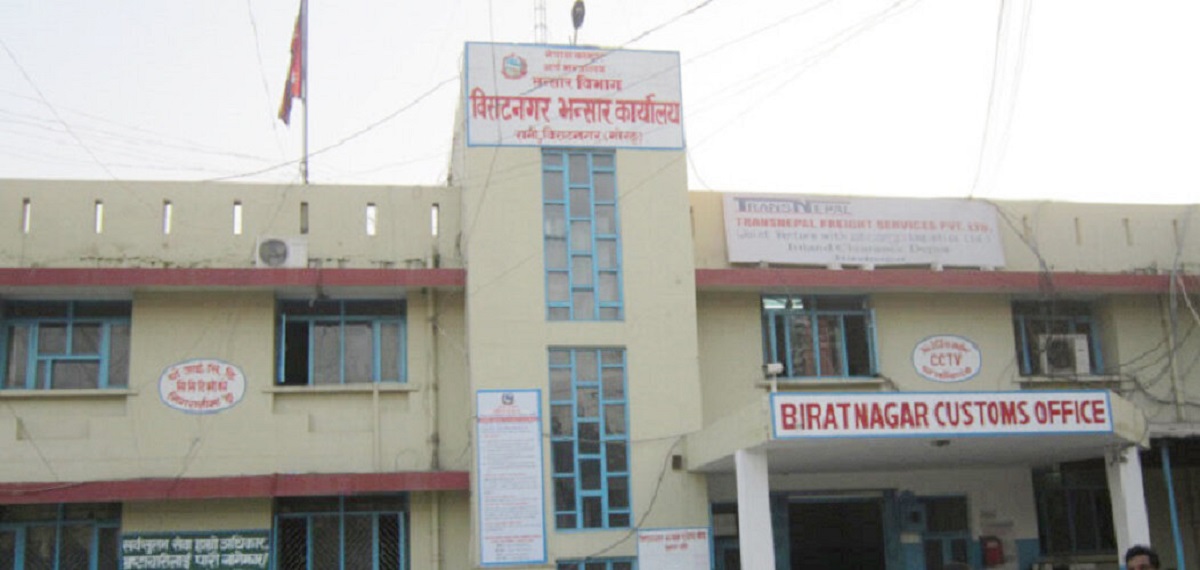

Biratnagar: As election activity intensifies in eastern Nepal, trade flows through the Biratnagar–Jogbani border crossing have begun to recover, providing a boost to government revenue collection. The customs office in Biratnagar, one of the country’s key commercial gateways with India, exceeded its monthly revenue target in the Nepali month of Magh for the first time in five years.
According to Chief Customs Officer Umesh Shrestha, a modest revival in trade following the Gen Z protest movement, combined with increased economic activity linked to the upcoming elections, has led to higher imports and exports of industrial goods and raw materials. This, in turn, has translated into improved customs revenue. While imports of everyday consumer goods—often linked to informal cross-border trade—have remained steady, recent gains have been driven largely by higher imports of industrial raw materials, iron and steel products, and crude oil.
The Biratnagar customs office had set a daily revenue target of 120 million rupees. In Magh, against a monthly target of Rs 3.23 billion, it collected Rs 3.33 billion, achieving 102 percent of its goal. Officials describe this as the first time in five years that the office has surpassed its monthly target. In preceding months, revenue collection had consistently fallen short, reaching only 93 percent of target in Poush, 83 percent in Mangsir, 55 percent in Kartik, 82 percent in Ashoj, 80 percent in Bhadra, and 78 percent in Shrawan. The annual revenue target for the current fiscal year stands at Rs 41.34 billion.
Historically, the office has struggled to meet annual goals as well, achieving 88.45 percent of target in fiscal year 2017/18, 81.41 percent in 2018/19, 55.20 percent in 2019/20, 59.72 percent in 2020/21, and 80.92 percent in 2021/22.
Industry representatives say the recent uptick reflects a broader recovery in production. Nandakishor Rathi, president of the Morang Trade Association, estimates that industrial output in the Sunsari–Morang corridor has increased by at least 20 percent in recent months, leading to higher imports of raw materials and improved customs performance. He noted that during the height of political unrest and amid what businesses describe as inconsistent industrial policies, factories in the region were operating at only 50 to 60 percent of capacity.
However, concerns over smuggling persist. Business leaders say that informal cross-border trade in daily consumer goods remains widespread and may even intensify during election periods, when security agencies are focused on polling logistics. One trader alleged that smuggling has long operated with tacit protection from elements within state institutions and tends to increase during elections, potentially undermining further gains in official revenue collection.

Comment Here