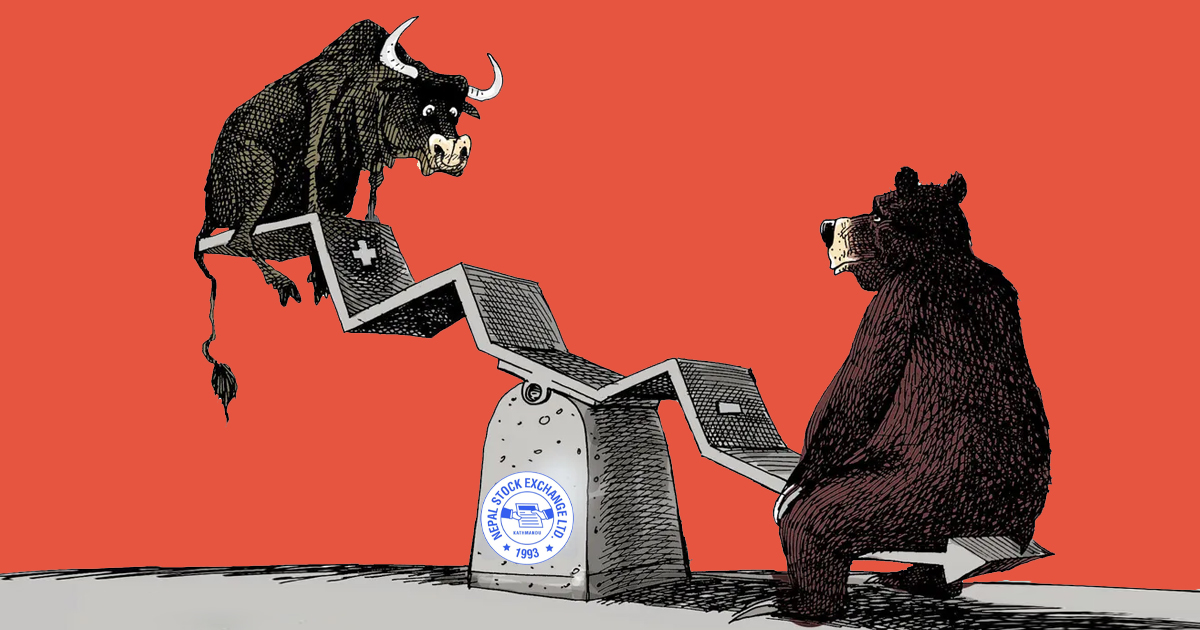

Kathmandu: Six months ago, on 27 August 2025, the benchmark index of the Nepal Stock Exchange (NEPSE) surged 53.01 points in a single day to close at 2,819. The following session it briefly touched 2,822 before retreating sharply to 2,781 by the close. Since then, the index has failed to reclaim the 2,800 mark.
Instead, volatility has defined the past half-year. On 16 November 2025, NEPSE slipped to 2,487, its lowest level in six months. Overall, the index has swung 332 points during this period, trading between a high of 2,819 and a low of 2,487. Although sentiment briefly improved on 25 January, when the index climbed to 2,772, it has since trended downward again, standing at 2,642 as of 17 February.
Turnover data reflects similar fluctuations. On the day the index stood at 2,769 (16 November 2025), total trading value exceeded Rs 16.19 billion, the highest in six months. By contrast, when the index closed at 2,819 six months earlier, turnover was Rs 7.59 billion. Despite periodic optimism driven by political developments, the market has been unable to break decisively higher.
With national elections scheduled for March 5, major political parties have unveiled their manifestos, each addressing capital market reform in varying degrees. Across the board, parties have pledged stronger regulation, structural reform, transparency, and better protection for small investors. The shared narrative is to transform Nepal’s capital market into a transparent, secure, technology-driven, and inclusive platform that can underpin long-term economic growth.
Bharat Ranabhat, former president of the Stock Brokers Association of Nepal, views the prominence of capital markets in party manifestos as a positive shift. He noted that earlier elections rarely gave the sector such priority, suggesting the change signals growing recognition of its economic importance.
Among the major parties, the Nepali Congress has pledged to expand financial access through mobile-based participation, including for migrant workers and non-resident Nepalis. It proposes advanced surveillance systems to curb insider trading, strengthening the Investor Protection Fund, developing a dedicated SME platform, granting full autonomy to the securities regulator, restructuring NEPSE and the central depository, and integrating financial literacy into school curricula.
The Rastriya Swatantra Party has promised sweeping regulatory reforms, restructuring of the Securities Board, introduction of intraday trading, short selling, futures and options under a clear legal framework, IPO system reform, stable and investor-friendly tax policies, bond market expansion, and zero tolerance for insider trading and market manipulation. It also advocates enabling non-resident Nepalis to trade, operationalizing a commodities exchange, mandating automated reporting for listed companies, and decentralizing market access beyond Kathmandu through digital systems.
Meanwhile, the Communist Party of Nepal (Unified Marxist–Leninist) has emphasized effective regulation and expansion of capital markets to mobilize equity and long-term debt. Its manifesto highlights investor protection, stronger oversight of institutional savings funds, and the development of alternative financing instruments such as venture capital, private equity, blended finance, green bonds, diaspora bonds, and climate finance to support higher economic growth.
For investors, however, manifesto promises are only part of the equation. Much will depend on the post-election political landscape, which party forms the government and who leads economic policy. Given Nepal’s stock market history of sharp reactions to political developments, many believe the next decisive move in NEPSE will hinge less on campaign commitments and more on the stability and direction of the incoming administration.

Comment Here