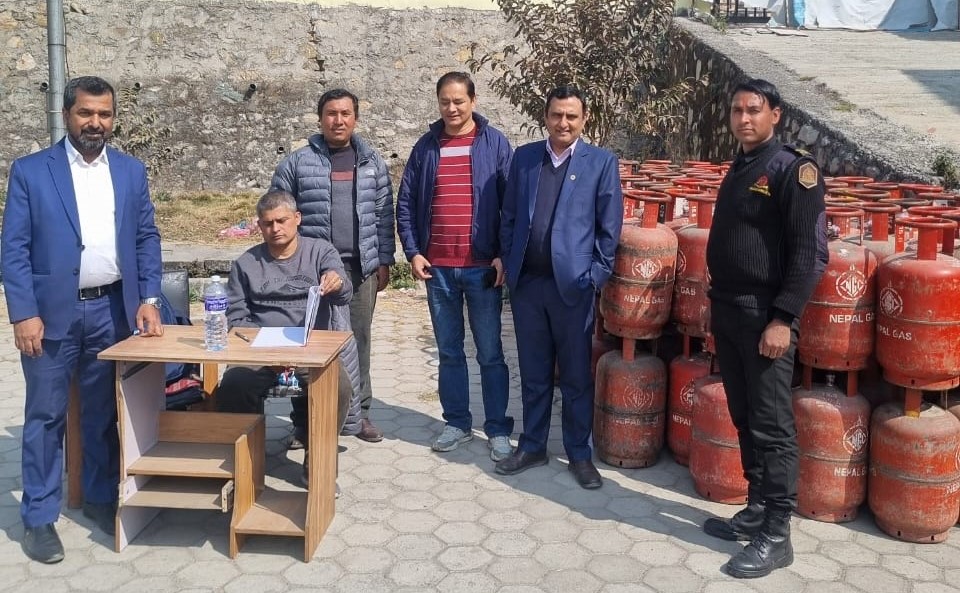

Kathmandu: Cooking gas is an essential commodity, and in principle, strikes or supply disruptions should never be allowed to affect it.
Yet in Nepal, artificial shortages of liquefied petroleum gas (LPG) have become an almost annual occurrence, leaving ordinary consumers to bear the brunt.
The latest episode saw supply constraints re-emerge under various pretexts, even as the state-owned Nepal Oil Corporation (NOC) insisted there was no real shortage in the market.
Paradoxically, private LPG cylinders were being sold from within NOC’s own premises in Teku, Kathmandu.
In effect, the government-owned corporation has taken on the role of facilitating the sale of privately produced gas cylinders. Critics argue that NOC itself shares significant responsibility for recurring crises.
By leaving the entire production and storage system in private hands, Nepal has created structural vulnerabilities in a sector that is both strategic and highly sensitive. Residents of the capital faced acute shortages as recently as mid-winter, and even now, consumers often wait between two weeks to a month to obtain a refill.
The state has virtually no presence in LPG production or storage. Across the country, 59 private bottling and refilling plants operate with a combined storage capacity of 10,000 metric tons.
Meanwhile, NOC incurs annual losses of roughly Rs 12 billion by subsidizing each cylinder at Rs 198, even as the LPG market generates an estimated Rs 55 billion in annual turnover. Daily consumption stands at around 105,000 cylinders.
Although NOC had previously floated plans to bottle and sell LPG under its own brand, an initiative that could have reduced dependence on private players, the proposal has languished for over 15 years. Instead, the corporation continues to facilitate private-sector distribution. NOC spokesperson Manoj Thakur maintains that the corporation has merely provided space at its Teku office to help stabilize the market, denying that it is directly marketing private gas brands.
Nepal’s heavy reliance on private operators contrasts sharply with practices in several neighboring countries. In India, three state-owned oil companies dominate the LPG sector: Indian Oil Corporation (Indane), Bharat Petroleum (Bharat Gas), and Hindustan Petroleum (HP Gas).
Together they operate 211 bottling plants and produce over 23 million metric tons annually, with last year’s sales reaching 31.2 million metric tons. Government ownership exceeds 99 percent of the domestic LPG market, and access to cooking gas now covers nearly 99.8 percent of India’s population. Since 2016, India’s flagship Pradhan Mantri Ujjwala Yojana has provided free LPG connections to women from low-income households, promoting clean energy and improving public health.
When an essential and strategic commodity like cooking gas is left almost entirely to private interests without strong state participation or regulation, consumers ultimately pay the price
China follows a similar model, with about 90 percent state ownership in the LPG sector through companies such as China National Petroleum Corporation and Sinopec. In Sri Lanka, the government holds an 80 percent market share through the Litro brand, while private operator LAUGFS accounts for the remaining 20 percent.
By contrast, Bangladesh’s LPG market is roughly 98 percent private, Pakistan’s is dominated by more than 200 private firms, and Bhutan and Afghanistan have no government ownership in the sector. International reporting suggests that these countries frequently grapple with supply instability, price volatility, black marketing, cartelization, quality concerns, and safety risks—challenges that mirror Nepal’s experience.
The pattern is clear: when an essential and strategic commodity like cooking gas is left almost entirely to private interests without strong state participation or regulation, consumers ultimately pay the price. Ensuring price stability, reliable supply, quality control, and safety appears to require at least some level of government investment or decisive regulatory intervention.
NOC has not entirely abandoned ambitions to enter LPG production. Over the years, proposals have surfaced to build bottling plants in Dhalkevar, Charali, and Sarlahi, but these plans have repeatedly stalled. More recently, attention has turned to developing a cross-border LPG pipeline modeled on the successful petroleum pipeline project.
According to NOC, the proposed pipeline would run from Motihari in India to Netra Ganj in Sarlahi district, where a government-owned bottling and refilling plant would be established. The plan has entered formal discussion under a Nepal–India Joint Working Group framework. Indian Oil Corporation has already submitted a preliminary engineering survey.
The proposed Motihari–Sarlahi LPG pipeline would span approximately 130.95 kilometres, 32.65 kilometres in India’s Bihar state and 98.3 kilometers in Nepal’s Madhesh Province, including around 45 kilometers through forested areas. The entry point would be the Motihari refinery terminal in India, with the endpoint at a gas terminal in Sarlahi. NOC has already acquired over 15 bighas of land in Sarlahi for storage and bottling facilities at a cost exceeding Rs 300 million.
Once operational, the pipeline could save NOC an estimated Rs 6 billion annually in transportation costs. More importantly, it would reduce the risk of supply disruptions triggered by strikes or protests at private bottling plants. At present, such disruptions can swiftly halt cylinder distribution nationwide, forcing consumers into long queues and deep uncertainty.

Comment Here