
Kathmandu: After hovering close to 1 percent in recent months, inflation in Nepal has begun to tick upward, with data from the Nepal Rastra Bank showing a modest rise in consumer prices ahead of the recent elections.
Annual point-to-point consumer inflation reached 3.25 percent in the Nepali month of Magh (mid-January to mid-February 2026). Although this is lower than the 4.16 percent recorded in the same month last fiscal year, it marks an increase compared to earlier months of the current fiscal year when inflation consistently remained below 2 percent.
Despite the uptick in the inflation rate, the overall consumer price index suggests that price pressures have not risen significantly. The index stood at 106.50 in Mangsir and returned to the same level in Magh after dipping slightly to 106.29 in Poush, according to the central bank. By contrast, in the previous fiscal year the index had been steadily declining during the same period, falling from 105.20 in Kartik to 104.79 in Mangsir, 103.78 in Poush, and further to 103.16 in Magh.
Food and beverage prices rose by 2.50 percent year-on-year in Magh, while non-food items and services recorded a higher inflation rate of 3.66 percent. A year earlier, food inflation had been significantly higher at 4.95 percent, while non-food inflation stood at 3.74 percent. This indicates that food price pressures have eased recently, while inflation in services and non-food categories has remained relatively stronger. Overall, average inflation during the first seven months of the current fiscal year 2025/26 has remained low at just 1.92 percent.
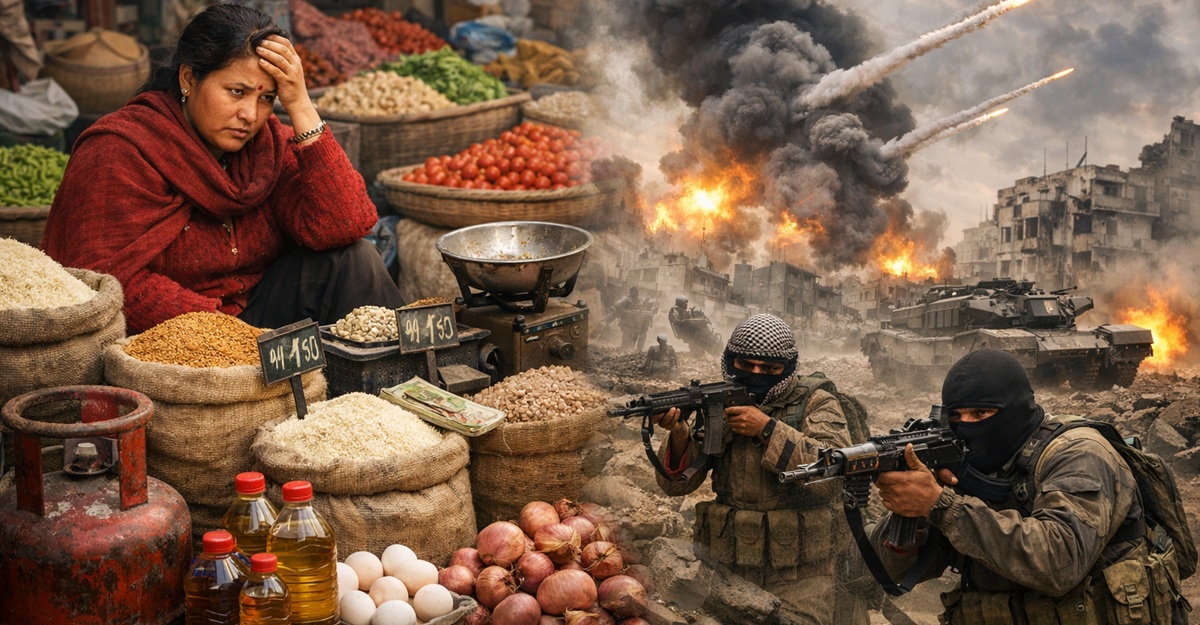
The central bank expects inflation to stay within its 5 percent target for the fiscal year. However, with seven months already completed, the rate remains well below that ceiling. According to Dr. Ram Sharan Kharel, head of the Economic Research Department at the Nepal Rastra Bank, geopolitical tensions in the Middle East could create additional inflationary pressure if they persist. He noted that the slight increase in Magh was also driven by election-related spending and a gradual recovery in aggregate demand.
Kharel said that if tensions in the Middle East subside, the impact on Nepal’s inflation would likely remain limited. However, prolonged instability could affect global petroleum prices, which would eventually feed into domestic inflation. He added that Nepal’s direct trade exposure to the Middle East is relatively small, about 2 percent of exports and around 5 percent of imports, so the immediate effect is limited. The bigger risk lies in India: if inflation rises there, Nepal is likely to feel the spillover given the close economic ties between the two countries.
Within the food category, vegetable prices saw the sharpest rise, increasing by 11.63 percent year-on-year in Magh. Ghee and oil prices rose by 7.61 percent, while fruit prices increased by 7.41 percent. These subgroups had seen either low inflation or price declines last year but recorded notable increases this year. Meanwhile, prices of pulses and legumes fell by 5.19 percent, processed food products by 2.97 percent, and spices by 2.61 percent.
Among non-food and service categories, prices surged most sharply in the miscellaneous goods and services subgroup, which rose by 21.98 percent. Education costs increased by 7.46 percent, clothing and footwear by 5.28 percent, tobacco products by 4.15 percent, and alcoholic beverages by 3.85 percent. The communications category was the only major subgroup to see a slight decline, with prices dropping by 0.08 percent.
Regionally, consumer prices increased faster in urban areas than in rural regions. Rural inflation stood at 2.52 percent, while urban inflation reached 3.51 percent in Magh. Among provinces, Madhesh recorded the highest inflation at 5.14 percent, followed by Koshi at 3.53 percent, Bagmati at 3.10 percent, Lumbini at 3.29 percent, and Gandaki at 2.42 percent. Inflation remained comparatively low in Karnali at 1.62 percent and Sudurpashchim at 1.64 percent. By geographic region, inflation in the Kathmandu Valley was 3.48 percent, compared with 3.66 percent in the Tarai, 2.68 percent in the hills, and 2.58 percent in the mountainous areas.
Wholesale prices have risen more sharply. Annual wholesale inflation reached 6.21 percent in Magh, up from 3.47 percent a year earlier. Consumer goods wholesale prices rose modestly by 0.72 percent, while intermediate goods and capital goods increased by 9.83 percent and 3.21 percent respectively. The wholesale price index for construction materials also climbed by 2.04 percent.
Inflation in India stood at 2.75 percent in January 2026. Economists say that if prices begin rising more rapidly in India, Nepal is likely to experience higher inflation as well due to its strong dependence on imports from its southern neighbour.

Comment Here