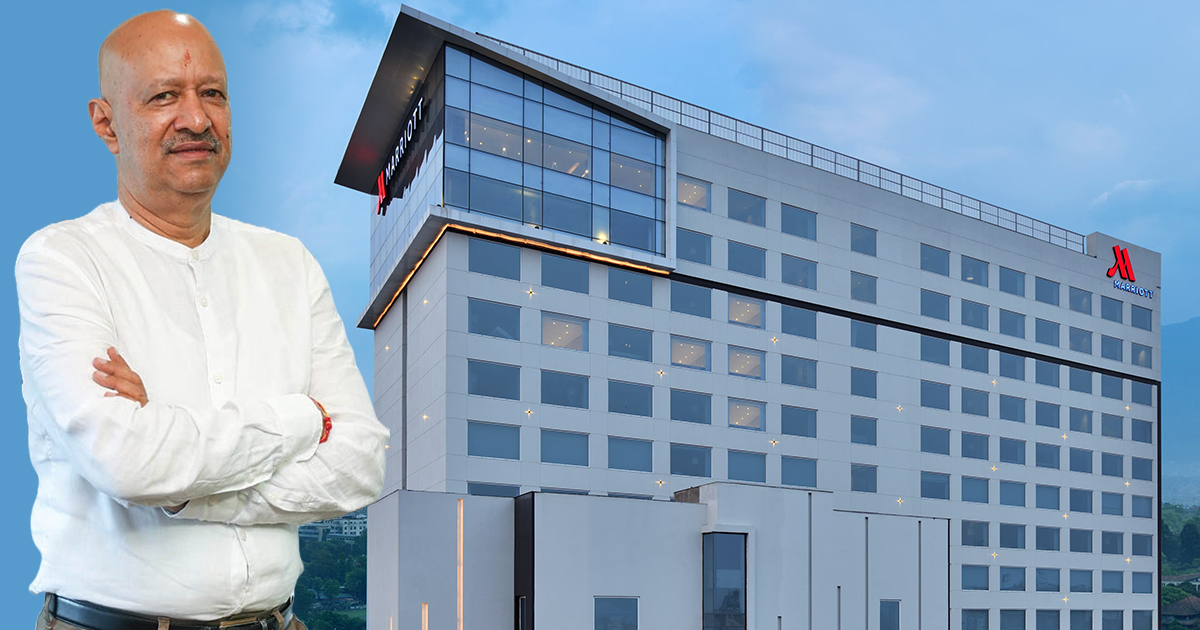

Kathmandu: Business has slowed at the five-star Kathmandu Marriott Hotel, where revenue fell by about 10 percent amid growing competition among luxury hotels in the Nepali capital. Financial data show that several key business indicators for the property, located in Naxal, have weakened over the past year.
The hotel is operated under the Marriott brand by Everest Hospitality and Hotel. According to recent figures, its revenue declined by 10.7 percent in fiscal year 2025 compared with the previous year. The hotel generated Rs 1.79 billion in revenue in 2024, but that dropped to Rs 1.62 billion in 2025. In 2023, the property had recorded revenue of Rs 1.70 billion.
The downturn is mainly attributed to lower average room revenue and a decline in occupancy. Average revenue per room fell from Rs 19,699 in 2024 to Rs 18,153 in 2025. Occupancy also slipped from 67 percent to 61 percent over the same period. As a result, the hotel’s operating profit margin narrowed from 34.39 percent to 32.22 percent.
Despite the fall in revenue, the company has steadily reduced its debt burden. While it previously maintained bank facilities worth Rs 1.74 billion, that figure has now been cut to Rs 1.43 billion, indicating that the company has been paying down its loans.
Financial indicators, however, remain strong. The company’s gearing ratio (debt-to-equity) improved from 1.03 in 2024 to 0.75 in 2025, meaning its debt is now lower than its equity. Its debt coverage ratio also strengthened from 3.34 to 4.21, indicating that operating profits exceed annual debt obligations by more than four times. The company also holds around Rs 287 million in cash reserves, suggesting healthy liquidity.
Affiliation with the globally recognized Marriott International brand, backing from the experienced MS Group led by businessman Shashikant Agrawal, and the hotel’s location in one of Kathmandu’s key commercial districts are seen as major strengths.
Still, the company faces both internal and external risks. A growing number of new five-star hotels in Kathmandu is intensifying competition. In addition, Everest Hospitality’s investment is concentrated in a single property, leaving it more exposed to market fluctuations. Interest rate volatility and foreign exchange risks also pose challenges, particularly because some of the hotel’s loans are denominated in US dollars, though foreign currency earnings help offset part of that exposure.
The company was established in 2013 and converted into a public limited company in 2022. Spread across 1.35 hectares, the hotel features 214 rooms. The property is primarily backed by the MS Group of Companies. Sumit Kumar Agrawal serves as chairman, while Gaurav Agrawal is the managing director and oversees the group’s hotel operations.
Looking ahead, industry observers expect the sector to recover in the medium term. The government has declared 2023–2033 as Nepal’s “Tourism Decade” and introduced several incentives for the hotel industry through the national budget. For the Marriott property, however, the immediate challenge will be boosting occupancy and increasing average room revenue.
Despite the decline in revenue, the company’s strong financial position and experienced promoters have helped it retain its existing credit rating from CARE Ratings Nepal. The agency reaffirmed a BBB+ rating for Rs 1.33 billion in long-term loans and an A2 rating for Rs 100 million in short-term borrowing under the company’s total bank facility of Rs 1.43 billion.

Comment Here