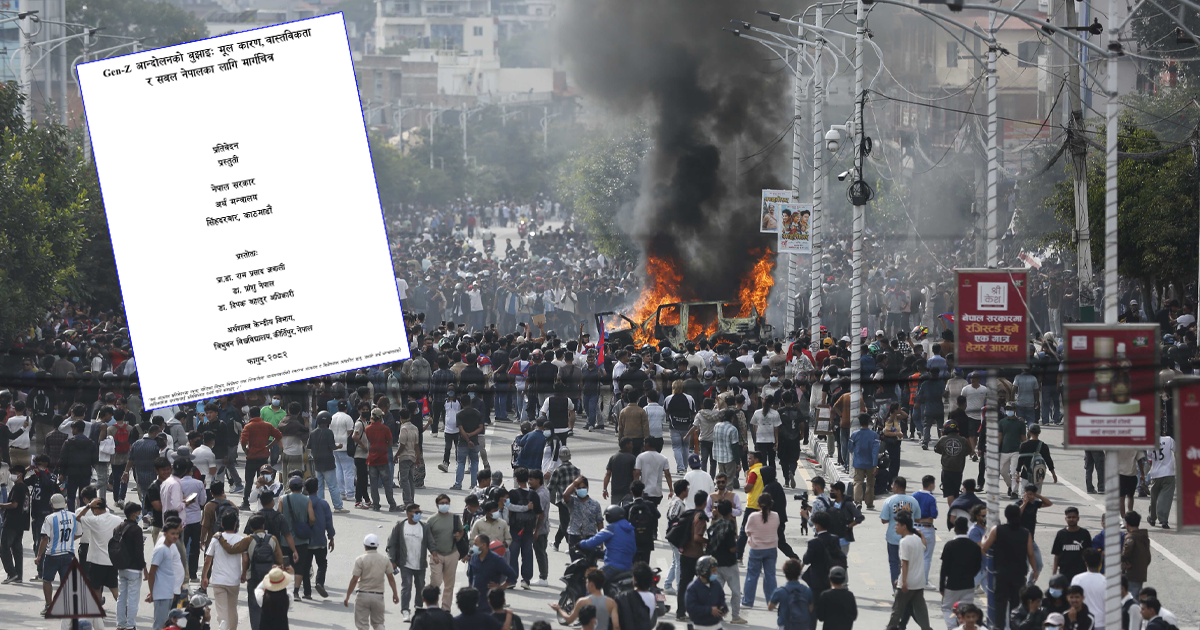

Kathmandu: The Ministry of Finance has released a report titled “Understanding the Gen Z Movement: Root Causes, Reality, and a Roadmap for a Stronger Nepal.” The study was prepared by a research team from the Central Department of Economics at Tribhuvan University, led by Prof Dr Ram Prasad Gyawali, along with Dr Pranshu Nepal and Dr Dipak Bahadur Adhikari.
According to Prof. Gyawali, the primary objective of the study was to identify the social, economic, and administrative causes behind the Gen Z movement. The second objective was to understand the perspectives of the Gen Z generation regarding the digital economy, corruption, and governance. The third was to examine the movement’s impact on the economy, while the fourth focused on identifying ways to bring young people into the national mainstream and offering policy recommendations based on the findings.
Gyawali said the research team conducted surveys with more than 400 respondents across all seven provincial headquarters in Nepal. The committee was formed by Finance Minister Rameshwar Khanal to carry out the study.
The researchers also conducted qualitative interviews with business leaders, representatives of the Federation of Nepalese Chambers of Commerce and Industry, security agencies, administrative officials, and local government representatives. The report mainly reflects the sentiments of young people under the age of 35. It includes more than 50 recommendations.
“One of our main recommendations is that political parties must reform their character,” Gyawali said. “Politics should be treated not as a profession but as a sacred duty of public service and national responsibility.” Another key recommendation focuses on restoring the declining confidence of the private sector by reassuring businesses and improving the investment climate.
The report also stresses prioritizing the reconstruction of physical damage caused during the protests. According to the study, 53 percent of the damages occurred in the government sector, 40 percent in the private sector, and 7 percent in community infrastructure. Rebuilding these losses is seen as essential for restoring market confidence and revitalizing economic activity.
Gyawali noted that poor governance and rising bribery in public service institutions such as courts, land revenue offices, transport offices, and municipal offices were identified as major triggers behind acts of vandalism during the protests. As a result, the report emphasizes the need for significant improvements in public service delivery and stronger measures to control corruption.
The study also found that the lavish lifestyles displayed on social media by political leaders and their family members have contributed to growing frustration among young people. Gyawali said political figures must demonstrate greater accountability and moderation in their public image.
He added that the private sector also needs to act responsibly by paying taxes on time and investing in ways that benefit ordinary citizens. “When businesses invest in ways that connect with the grassroots, people develop a sense of ownership,” he said. “Politics and business should also remain separate. Those engaged in business should focus purely on commercial activities so that political anger does not turn business entities into targets.”
As an example, Gyawali cited India’s Tata Group, which enjoys strong public trust because of its investments in education, healthcare, and infrastructure. He said that if Nepal’s private sector contributes meaningfully to poverty reduction and social services, the public will naturally support and protect it. The report stresses that the private sector should not be seen as an adversary of the economy but as its primary partner, responsible for around 70 percent of total investment.

Comment Here