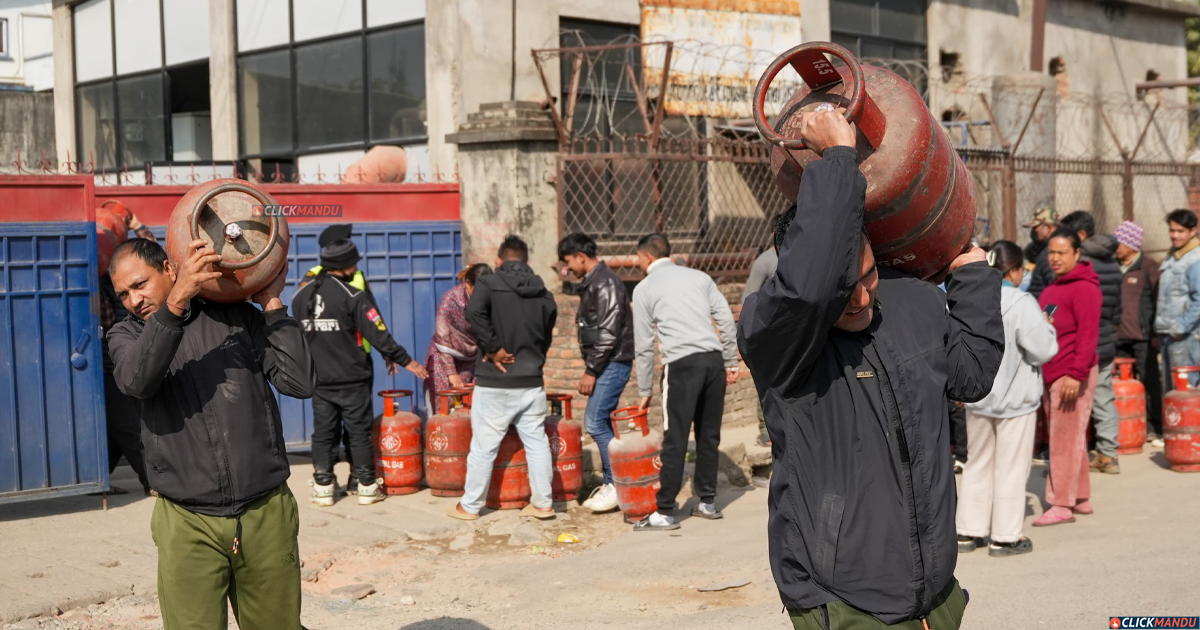

Kathmandu: As ongoing US–Israel–Iran tensions disrupt global energy supplies, consumers across Asia, including Nepal, are facing acute shortages of petroleum products and liquefied petroleum gas (LPG).
Despite years of policy promises, Nepal’s government has failed to implement its plan to replace liquefied petroleum gas (LPG) with electricity, leaving households with few alternatives and increasing hardship.
The “LPG displacement” agenda has long featured prominently in national plans, annual budgets, and energy strategies, including the 14th periodic plan and the National Energy Efficiency Strategy. These policies envisioned a gradual shift from gas to electric cooking. However, a lack of political will and follow-through has kept these commitments largely on paper, forcing consumers to endure recurring shortages and long queues for gas cylinders year after year.
The global crisis has only intensified the pressure. LPG prices have surged sharply, with Asian benchmark rates reaching around US$ 611 per metric ton in early March 2026. Factoring in transportation, bottling, taxes, and distribution, the effective cost per cylinder in the international market has climbed to over Rs 4,400.
Prices have also risen in neighbouring countries: in India, subsidized cylinders recently increased, while Pakistan and Sri Lanka have reported similar hikes.
In Nepal, however, retail prices have remained unchanged since 2022, despite rising import costs. As a result, the Nepal Oil Corporation is incurring a loss of about Rs 217 per cylinder, translating into an annual deficit of roughly Rs 14 billion, even as daily consumption stands at around 105,000 cylinders.
Amid the crisis, the Prime Minister’s Office has once again announced plans to promote alternatives such as electric stoves, biogas, and other clean energy solutions. A recent high-level meeting decided to prepare and implement a roadmap to encourage electric cooking in households, as well as in institutions like hotels, restaurants, hostels, and security barracks. Proposed measures include subsidies for electric stoves, upgrades to household wiring systems, and potential electricity tariff discounts.
However, similar announcements in the past have failed to materialize. Government budgets have repeatedly introduced ambitious slogans, such as promoting electric cooking and reducing reliance on LPG, but implementation has lagged far behind. Even recent plans to distribute electric stoves and pilot “complete wiring” projects in select cities have seen limited progress, with only tens of thousands of units distributed so far.
Earlier initiatives, including a campaign to eliminate LPG use in government offices and urban households within months, never moved beyond policy documents. Subsidy reforms, such as shifting support from LPG to electricity, have also not been effectively executed. Experts say the gap between policy and reality remains wide, with inadequate infrastructure and poor planning undermining the transition.
Data highlights the scale of the challenge. According to the 2021 national census, over half of Nepali households still rely on firewood for cooking, while 44 percent use LPG. Only about 1 percent use electricity for cooking, reflecting both access and reliability issues. Studies suggest that if even 70 percent of urban households switched to electric cooking, Nepal would need around 4,900 megawatts of electricity, nearly three times current supply levels, along with tens of billions of rupees in distribution system upgrades.
The barriers are both structural and economic. Many homes lack high-capacity metres and proper wiring to support electric stoves. Power supply can be unreliable during peak cooking hours, and the upfront cost of appliances and compatible cookware remains high. At the policy level, inconsistent subsidies, weak implementation, and insufficient budget allocation have further slowed progress.
In the end, while successive governments have promoted clean cooking transitions as a priority, the absence of coordinated planning, infrastructure investment, and sustained execution has left Nepal dependent on imported gas—making consumers vulnerable each time global energy shocks hit.

Comment Here