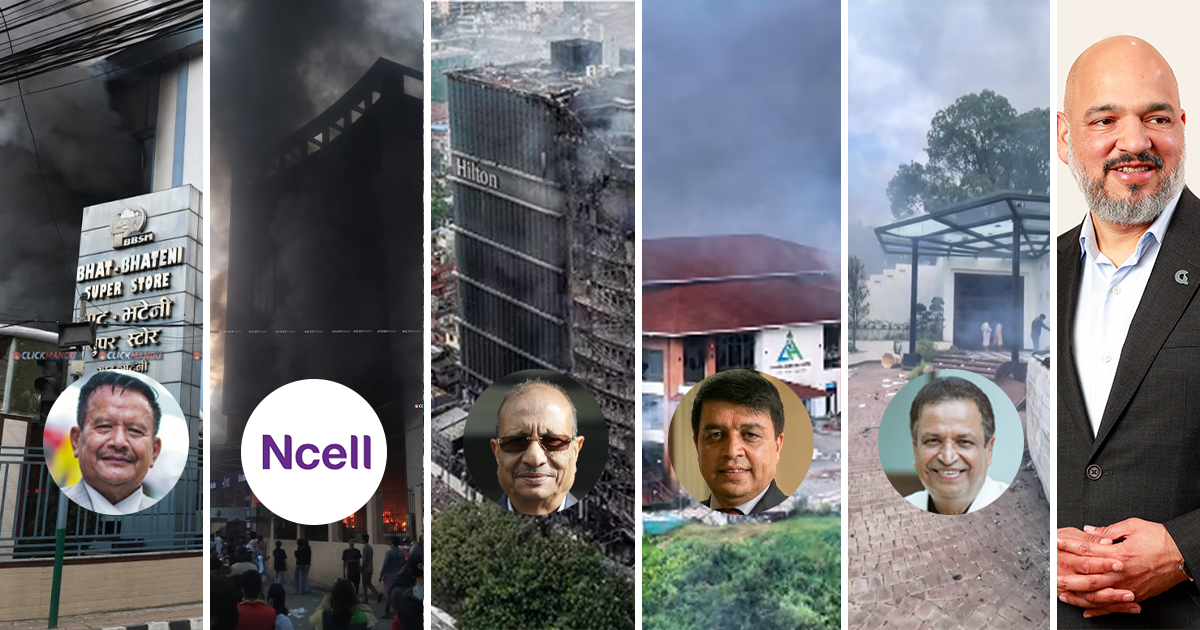

Kathmandu: The government has concluded that the “Gen-Z” protests held on September 9 and 10 have pushed Nepal’s already fragile private sector into a deeper crisis. The finding comes from a “Detailed Action Plan for Reconstruction and Rehabilitation” prepared in the aftermath of widespread physical damage caused by the unrest.
According to the report, the private sector, still struggling to recover from the economic fallout of the COVID-19 pandemic and ongoing external pressures, has been further weakened by the protests. Stressing that safeguarding private property and businesses is a core responsibility of the state, the government has proposed a range of relief measures and facilitation programs to support recovery.
As part of the plan, local governments will be encouraged to waive building permit fees for the reconstruction of damaged structures. They will also be urged to provide property tax exemptions for up to three years to affected businesses, depending on the extent of damage.
The action plan was prepared by a committee led by Prakash Kumar Shrestha, vice chair of the National Planning Commission, earlier in January. While some provisions have already been implemented, most measures will fall to the new government for execution.
The government also plans to coordinate with provincial authorities to waive taxes on scrapping vehicles that were destroyed during the protests. Insurance payouts for damaged structures will be expedited, and if insurers face liquidity shortages, short-term concessional loans will be arranged through institutions such as Nepal Rastra Bank, the Employees Provident Fund, and the Citizen Investment Trust.
To ease the financial burden on businesses, the government intends to extend the deadline for loan rescheduling and restructuring until mid-July 2026. Businesses that have lost their assets entirely will be allowed to repay working capital loans in instalments, along with an extended grace period to help them restart operations.
For reconstruction financing, affected parties will be eligible for loans at a fixed interest rate for up to five years, with only a 0.5 percentage point premium above the base rate. The plan also includes relief support for personal belongings—such as vehicles, mobile phones, laptops, and clothing—damaged within government office premises during the protests. Compensation of up to 25 percent of total losses will be provided through district administration offices based on police verification.
In addition, the government has outlined a three-year strategy for rebuilding public infrastructure. Minor repairs will be covered by reallocating funds within the current fiscal budget, while partially or fully damaged government buildings are expected to be reconstructed within the next two fiscal years. Budget management and implementation will be carried out through the National Project Bank and ministerial budget information systems, with cost-sharing and coordination among federal, provincial, and local governments.

Comment Here