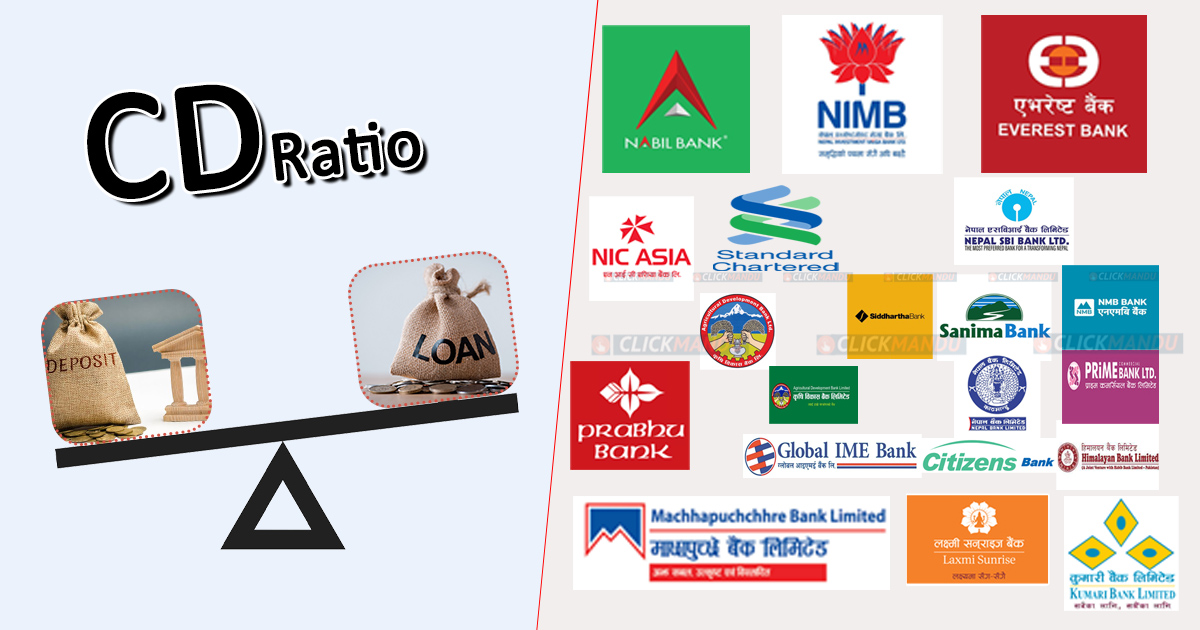

Kathmandu: Commercial banks in Nepal are edging toward a significant imbalance as their credit-to-deposit (CD) ratios continue to fall, with some nearing the 60 percent threshold.
This decline reflects a persistent slowdown in lending over the past three years alongside steady growth in deposits, creating excess liquidity across the banking system. As a result, banks are increasingly unable to deploy the funds they collect, putting pressure not only on their financial performance but also on interest rate dynamics.
According to data released by Nepal Rastra Bank as of March 20, the average CD ratio of banks and financial institutions has dropped to 73.86 percent. By mid-March of the current fiscal year, commercial banks had mobilized deposits worth Rs 7,004.55 billion while extending loans totalling Rs 5,172.95 billion. Figures from the Nepal Bankers’ Association show a similar trend, with the average CD ratio standing at 73.73 percent at the end of February.
Although regulatory provisions allow banks to lend up to 90 percent of their deposits, the system has been grappling with excess liquidity for over three and a half years. Deposits have continued to rise, but credit demand has not kept pace, causing the CD ratio to steadily decline. This mismatch is not just a technical indicator, it has real implications. Banks are under pressure to manage surplus funds, and deposit interest rates have been consistently falling as institutions try to reduce their cost of funds.
In some cases, banks are unable to lend even 60 percent of the deposits they collect, leaving a large portion of funds idle. While part of this surplus is invested in government securities such as treasury bills and development bonds, returns on these instruments have dropped sharply.
The yield on 364-day treasury bills fell to just 1.72 percent as of March 24, according to the Public Debt Management Office. Similarly, the average interest rate on development bonds issued by the government this fiscal year stands at around 3.67 percent, with yields for instruments ranging from three to ten years hovering near 3.5 percent.
Additionally, the central bank has absorbed nearly Rs 900 billion in liquidity from the system at an interest rate of around 2.5 percent. With banks collecting deposits at higher rates but investing them at significantly lower returns, profitability is being squeezed. This has forced banks to continually lower deposit interest rates in an attempt to align their funding costs with declining yields.
Industry data shows that by the end of February, two out of 20 commercial banks had CD ratios below 60 percent. Since the beginning of the fiscal year, deposits across the sector have increased by Rs 473.76 billion, while lending has grown by only Rs 198.40 billion, highlighting the widening gap between resource mobilization and credit expansion.
At the institutional level, deposit growth has been particularly strong in some banks. Rastriya Banijya Bank saw its deposits surge by Rs 80.66 billion to reach Rs 574.64 billion by mid-March. However, its lending increased by only Rs 24.15 billion during the same period, pushing its CD ratio below 60 percent to 58.54 percent. Similarly, Standard Chartered Bank Nepal recorded the lowest CD ratio at 58.50 percent, as its loans declined even while deposits grew.
Other major banks also reported significant deposit growth. Global IME Bank added Rs 72.51 billion in deposits, reaching Rs 647.56 billion, while Nabil Bank increased deposits by Rs 52.49 billion to Rs 584.73 billion. Nepal Investment Mega Bank also saw deposits rise by Rs 50.80 billion to Rs 527.09 billion. Several other banks, including Nepal Bank Limited, Machhapuchchhre Bank, Laxmi Sunrise Bank, and Himalayan Bank, posted notable increases as well.
However, not all banks experienced deposit growth. Prabhu Bank, NIC Asia Bank, and Citizens Bank International reported declines in deposits despite overall sector growth of 7.25 percent. Prabhu Bank’s deposits fell by Rs 8.06 billion, NIC Asia’s by Rs 5.11 billion, and Citizens Bank’s by Rs 1.86 billion.
On the lending side, Nabil Bank emerged as the top performer, increasing its loan portfolio by Rs 30.26 billion to Rs 463.95 billion. Everest Bank followed closely with a Rs 26.51 billion increase, while Global IME Bank expanded its lending by Rs 26.50 billion. Rastriya Banijya Bank also recorded a loan growth of Rs 24.15 billion. In percentage terms, Everest Bank led with an 11.85 percent increase, followed by Machhapuchchhre Bank at 11.48 percent and Rastriya Banijya Bank at 7.82 percent.
In contrast, some banks saw a contraction in lending. NIC Asia Bank’s loan portfolio declined by 9.33 percent, Standard Chartered Bank Nepal’s by 8.92 percent, and Prabhu Bank’s by 0.93 percent. These declines further contributed to the downward pressure on overall CD ratios.
By the end of February, seven banks had CD ratios below 70 percent, including Standard Chartered Bank Nepal and Rastriya Banijya Bank, both below 60 percent. Other banks in this category include Agricultural Development Bank, Nepal Bank Limited, NIC Asia Bank, Nepal Investment Mega Bank, and Nepal SBI Bank.
A CD ratio between 80 and 85 percent is generally considered optimal, as it indicates efficient utilization of deposits without excessive liquidity risk. Ratios above 85 percent can signal potential liquidity stress, while lower ratios suggest underutilized resources. Currently, only five banks fall within or above the desirable range. NMB Bank has the highest CD ratio at 84.37 percent, followed by Prime Commercial Bank at 83.26 percent, Citizens Bank International at 82.87 percent, Sanima Bank at 82.14 percent, and Everest Bank at 81.12 percent.

Comment Here