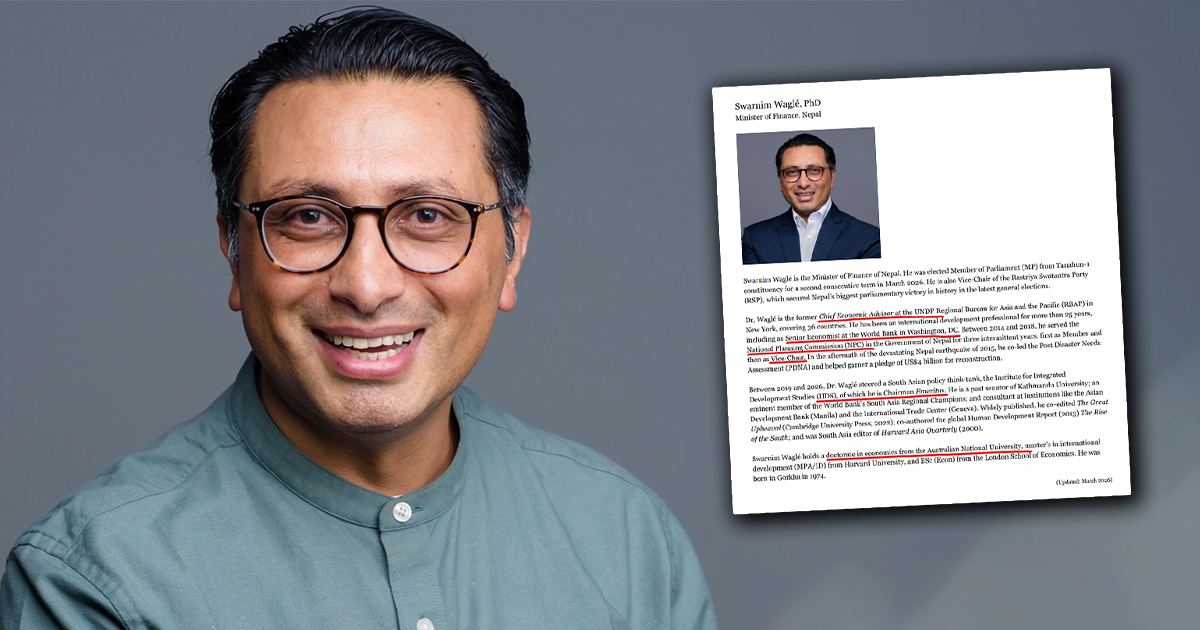

Kathmandu: Economist-turned-politician Swarnim Wagle has been appointed Finance Minister in the newly formed government led by Balen Shah of the Rastriya Swatantra Party (RSP), which commands a near two-thirds majority.
Wagle, elected from Tanahun-1 in the latest elections, has been entrusted with one of the most critical ministries at a time when Nepal’s economy shows mixed signals- strong external sector performance but persistent structural weaknesses.
A former Nepali Congress affiliate, he joined RSP in 2022. He quickly rose to become vice-chair and head of the party’s economic policy department, where he also led the drafting of its election manifesto.
Born in Gorkha in 1974 and raised in Chitwan, Wagle first entered Parliament through a by-election in Tanahun-1, defeating a Congress candidate after the seat was vacated when Ram Chandra Poudel was elected President. He retained the seat in the latest elections, reinforcing his political standing.
With over 25 years of international experience, Wagle has held senior roles at the United Nations Development Programme (UNDP), including as Chief Economic Advisor for Asia-Pacific, overseeing 36 countries.
He has also worked with the World Bank and served in Nepal’s National Planning Commission as both a member and vice-chair. Following the devastating 2015 Nepal earthquake, he co-led post-disaster needs assessment efforts that mobilized around US$ 4 billion in reconstruction pledges.
Academically, Wagle holds a PhD in Economics from the Australian National University, a master’s degree from Harvard University, and a bachelor’s degree from the London School of Economics. He has also contributed to global policy discourse through publications and advisory roles across Asia-Pacific institutions.
Wagle assumes office at a time when Nepal’s external sector appears robust. According to the latest data from the central bank, foreign exchange reserves have surged by over 23 percent to Rs 3.3 trillion. The balance of payments remains in a strong surplus of over Rs 572 billion, while remittance inflows, Nepal’s economic backbone, have jumped nearly 40 percent to exceed Rs 1.26 trillion in the first seven months of the fiscal year.
However, challenges persist. Bank deposits have climbed to nearly Rs 7.7 trillion, reflecting weak credit expansion and subdued investment demand. Despite a 32 percent rise in exports to Rs 168 billion, imports remain significantly higher at over Rs 1.12 trillion, pushing the trade deficit to around Rs 955 billion.
On the fiscal side, the government has spent more than it has earned, with expenditures reaching over Rs 801 billion against revenue collection of Rs 665 billion by mid-year. Capital expenditure remains particularly weak, declining to just Rs 63.7 billion, highlighting ongoing inefficiencies in development spending.
Wagle has consistently argued that poor governance is the biggest constraint to Nepal’s economic growth. He emphasizes that improving governance, creating an investment-friendly environment, and ensuring policy clarity are essential for expanding the economy.
His vision prioritizes digital transformation, clean energy, green industrialization, tourism, and agricultural modernization. He has also advocated leveraging Nepal’s hydropower potential for export earnings and shifting toward a service-oriented, digitally driven economy to overcome the limitations of being landlocked.
Additionally, Wagle has proposed structural reforms, including rationalizing local government units, reducing administrative costs, and streamlining federal structures. He has also stressed the need to broaden the tax base while fostering private sector growth.
With a strong electoral mandate and a reform-oriented agenda, the spotlight is now on how effectively Finance Minister Wagle can translate his policy vision into tangible economic outcomes in the coming months.

Comment Here