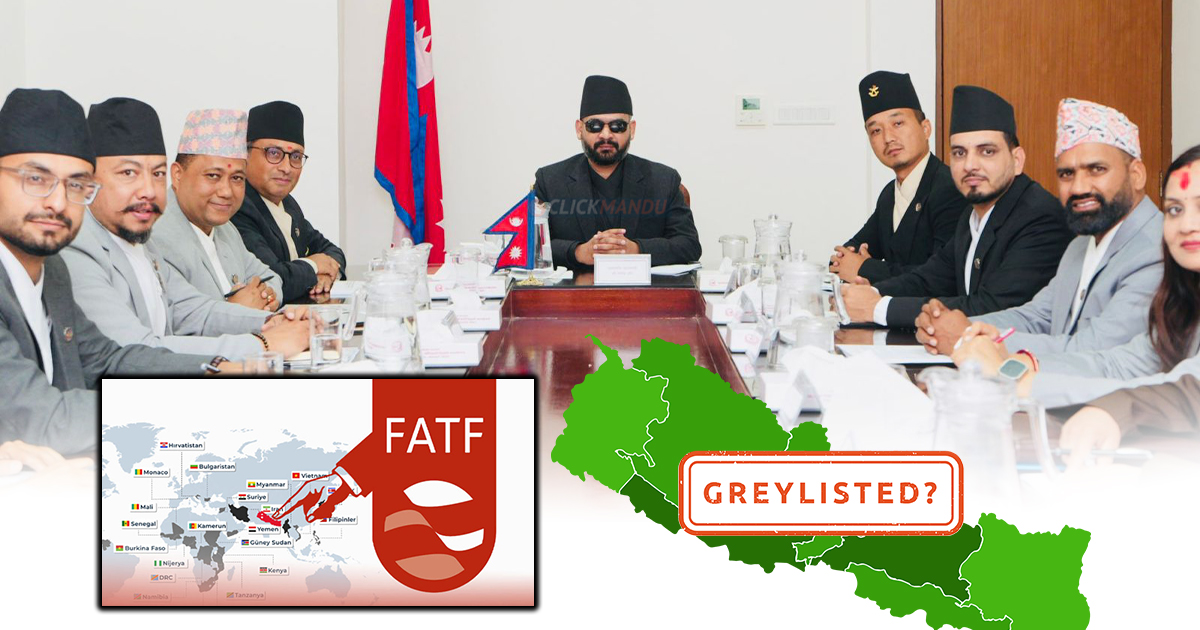

Kathmandu: The governance reform agenda approved by the new government led by Balen Shah has sparked debate over whether it can help Nepal secure an exit from the Financial Action Task Force (FATF) grey list. Although the term “grey list” is not explicitly mentioned in the government’s 100-point plan, several measures included in the roadmap are seen as supportive of that goal.
While the agenda outlines multiple initiatives on corruption control and administrative reform, it stops short of making a clear, time-bound commitment to removing Nepal from the grey list. Still, it does incorporate several technical provisions aimed at strengthening anti–money laundering efforts and improving financial governance, areas that are central to FATF requirements.
Nepal was placed on the FATF grey list on 21 February 2025, following a decision by its plenary and working group meetings, largely due to shortcomings identified by the Asia/Pacific Group on Money Laundering. Weak investigation and prosecution of illicit financial activities, especially money laundering, were cited as key reasons for the listing. Earlier evaluations had found insufficient progress, and at the time Nepal joined Laos on the list, while the Philippines exited.
Although Nepal had made legal commitments that were positively received internationally, delays in implementing reforms and weak enforcement drew criticism. The country has since initiated formal efforts to exit the grey list, introducing legal frameworks and multi-pronged reforms to curb money laundering and terrorist financing. Authorities have also reported progress in improving investigation and prosecution capacities to the APG.
The government has enacted and begun implementing laws related to anti–money laundering, along with guidelines and coordination mechanisms aligned with APG recommendations. These include strengthening systems to detect, report, monitor, and share information on suspicious financial transactions. A medium-term strategy on financial investment covering fiscal years 2024/25 to 2028/29 has also been rolled out, alongside a broader reform action plan targeting grey list exit.
Despite these steps, the newly approved 100-point reform agenda does not explicitly identify grey list removal as a national priority. It lacks a clearly defined “exit plan” with timelines and high-level commitments that directly address FATF concerns.
That said, several provisions in the plan could contribute meaningfully to compliance. For instance, measures to control money laundering and capital flight include stricter enforcement of beneficial ownership disclosure, aiming to uncover the real individuals behind companies and investments. This could help curb shell companies and improve transparency. Plans are also in place to integrate data from bank accounts, stock holdings, and digital wallets, making it easier to trace the flow of funds.
The agenda further proposes a “red flag” system and a unified digital asset registry under Nepal Rastra Bank to identify suspicious transactions. A risk-based approach to financial monitoring is emphasized, enabling automatic alerts for potentially illicit activities, an important technical upgrade in line with FATF standards.
Efforts to improve asset seizure mechanisms are also highlighted, as effective freezing and confiscation of illicit wealth is a key benchmark for grey list removal. Another provision calls for investigating the assets of individuals who have held public office since 1991, signalling a stronger anti-corruption stance that could enhance Nepal’s international credibility.
Recognizing that laws alone are not enough, the plan also focuses on strengthening enforcement agencies. It includes provisions to equip the Central Investigation Bureau with better resources and technology, as increased investigation and prosecution outcomes are crucial for demonstrating real progress.
Avoiding or exiting the grey list is vital for Nepal to attract foreign investment and maintain smooth international financial transactions. While the reform agenda addresses several technical areas such as transparency and asset recovery, questions remain about whether these steps alone will be sufficient to convince the international community of the robustness of Nepal’s financial system.
Nepal has committed to continuing cooperation with FATF and implementing recommendations from its 2023 mutual evaluation report. The country has pledged seven key reforms, including improving risk assessment of money laundering and terrorist financing, strengthening risk-based regulation in sectors like banking, cooperatives, casinos, precious metals, and real estate, cracking down on illegal remittance channels such as hundi, enhancing institutional capacity for investigations, increasing prosecution rates, improving asset tracking and confiscation, and addressing technical gaps in targeted financial sanctions.
However, weak investigation and prosecution remain major challenges. Experts note that successfully resolving money laundering cases and confiscating illicit assets would significantly strengthen Nepal’s case for removal from the grey list. While laws exist, their enforcement has not been sufficiently effective.
The government also plans to introduce a federal economic policy framework to guide fiscal activities across all three tiers of government by mid-2026, alongside efforts to formalize the informal economy and reduce its share.
The FATF, established by G7 nations, is an intergovernmental body that sets global standards to combat money laundering and terrorist financing. Countries that fail to meet these standards are placed on the grey or black list, depending on the severity of risks and non-compliance.
Being on the grey list exposes countries to increased scrutiny from international donors and financial institutions, potentially reducing aid and investment flows. Blacklisted countries face even harsher consequences, including isolation from the global financial system.
Nepal had previously faced a similar risk around 2010 but managed to avoid listing through diplomatic efforts and legal reforms. More recently, Nepal’s progress was reviewed in a FATF meeting in Canada, where it was placed under observation before being officially grey-listed.
Since then, Nepal Rastra Bank and the Department of Money Laundering Investigation under the Ministry of Finance have stepped up their efforts. The central bank has created a dedicated unit to monitor financial risks, while investigative authorities have accelerated enforcement actions.
Experts argue that without visible action against high-profile individuals, international confidence may remain limited. However, provisions to investigate the assets of past public officials are seen as a positive step toward demonstrating political commitment to tackling corruption.

Comment Here