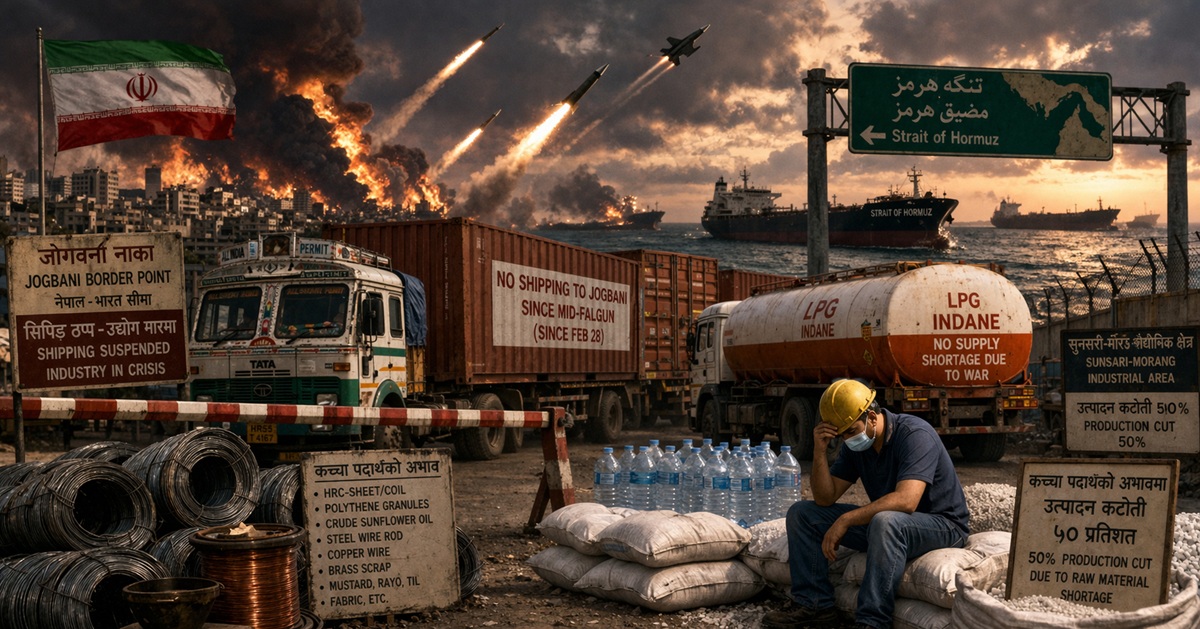

Biratnagar: The ongoing conflict in West Asia has severely disrupted the supply of industrial raw materials and commercial goods destined for Nepal via third countries. Since February 28 (Falgun 16), not a single consignment has been shipped toward the Jogbani border point, a key trade gateway for eastern Nepal.
Suppliers have stopped accepting new orders from Nepali industries, according to industrialists. Transport companies that move raw materials from India and third countries have already informed businesses that they are no longer able to deliver goods.
All previously opened letters of credit (LCs) have been put on hold, and not a single new LC has been issued in the past month. Nandakishore Rathi, president of the Morang Trade Association, said suppliers are citing force majeure and rising costs, demanding up to $500 more per LC while still being unable to guarantee delivery. As a result, shipments through Jogbani have come to a halt.
The shortage of raw materials has forced most industries in the Sunsari–Morang industrial corridor to cut production by more than half, while over 200 plastic factories are on the verge of closure.
Currently, only goods shipped before February 28 are arriving via Jogbani. Biratnagar Customs Chief Umesh Shrestha confirmed that no new shipments have taken place since then. He warned that if the conflict persists and shipments do not resume, imports could come to a complete standstill once existing consignments are cleared.
Industries in the region primarily depend on imports of HR sheets, polyethene granules, crude sunflower oil, steel wire rods in coils, pig iron, copper wire, mustard seeds and oil, LPG, and ready-made garments from India and other countries.
Customs data shows that imports through Jogbani reached Rs 154.16 billion by mid-March of the current fiscal year, while exports stood at Rs 54.73 billion. Key industrial raw materials such as HR sheets, plastic granules, sunflower oil, steel wire rods, and others each contribute around 5 percent to total customs revenue.
The impact of the war has been particularly severe on plastic manufacturers in the Sunsari–Morang industrial belt, many of which are now close to shutting down. Other industries have already slashed production by half due to shortages. Prices of plastic raw materials have surged by as much as 70 percent, and even at higher prices, imports remain uncertain.
The lack of plastic granules has hit packaging and plastic-based industries the hardest. Shortages are emerging in essential products such as saline bottles, bottle caps, drinking water containers, construction pipes, plastic chairs, and packaging materials.
Shipping companies have raised freight charges by up to $2,000 per container. Despite higher costs, exporters from Gulf countries have been unable to supply materials. India had served as an alternative source, but export restrictions there have further worsened the situation. Rathi warned that if plastic production stops, nearly 400 downstream industries that rely on plastic packaging could also be affected.
The shortage stems from disruptions in petrochemical and polymer supplies, which are critical for plastic manufacturing. India typically refines imported crude oil and exports petrochemical products to Nepal, but it is now facing its own supply constraints. Industrialists say prolonged conflict could force not only plastic factories but also other industries to shut down.
One such casualty is Alexa Life Sciences Pvt. Ltd. in Budhiganga, Morang, which produces saline solution for medical use. The factory, which had a daily output of 30,000 bottles, has halted production for a week due to a lack of plastic raw materials needed for bottles.
Similarly, MM Plastic Industry, which produces over 400 types of intermediate plastic packaging materials, is also nearing shutdown due to dwindling stock. Managing Director Suyash Pakurel said suppliers have refused to deliver even previously booked materials, while prices have jumped by up to 70 percent.
MM Plastic supplies packaging materials to more than 400 domestic and multinational companies for products ranging from salt to gold. A shutdown of this industry would ripple across all of its client industries, disrupting production on a much wider scale.

Comment Here